Thinking Process
PHASE 1: VISUAL DECONSTRUCTION
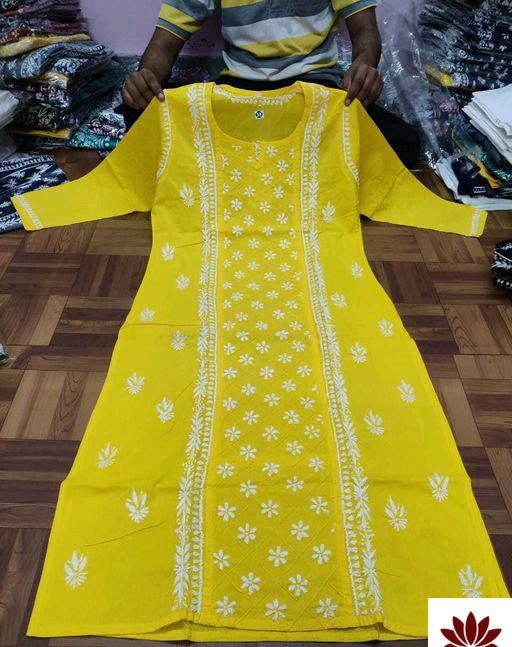
- **Fabric Physics:** The source garment is a cotton or cotton-blend "Chikankari" Kurti. It has a matte finish with zero specularity (shine). The fabric possesses medium weight due to the dense white embroidery, meaning it will exhibit semi-rigid draping rather than fluid, silk-like movement. It is prone to soft, crumpled creases rather than sharp, geometric folds.
- **Key Features:** The intricate white floral embroidery patterns running vertically down the center and sides MUST be preserved without distortion. The distinct round neckline and the specific embroidery borders on the sleeves are critical. The transparency of the fabric (often found in Lucknowi work) should be simulated slightly if the lighting allows, but primarily the opaque yellow saturation and white thread texture are the priority.
PHASE 2: FIT & DRAPE SIMULATION
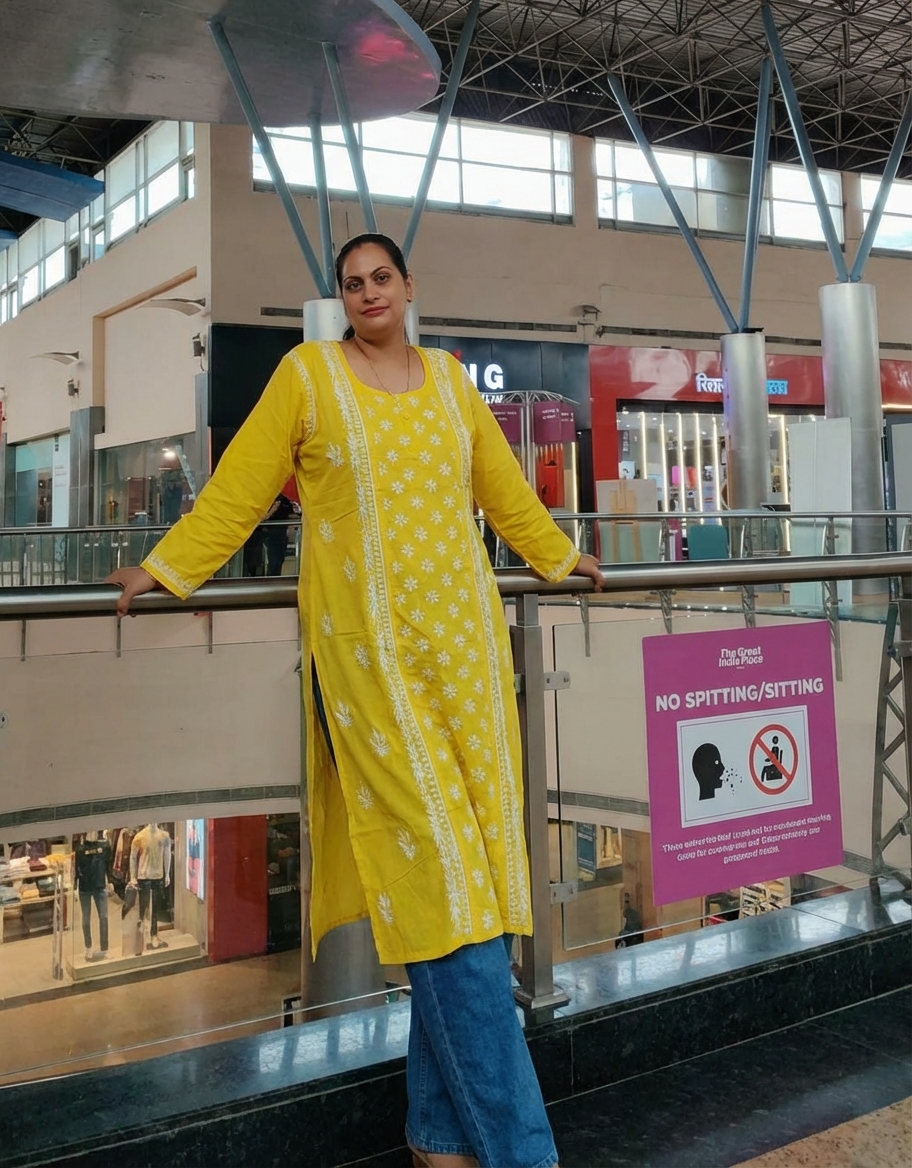
- **Body Mapping:** The user is leaning back against a railing with arms extended.
- *Shoulders:* The shoulder seams must align with the user's anatomical shoulders, draping slightly downward as Kurtis have a relaxed shoulder drop.
- *Torso:* Gravity impacts the fabric differently here; because she is leaning back, the fabric should drape closer to the chest and stomach rather than hanging vertically off the bust.
- *Arms:* The source sleeves are long and straight. They must extend to the user's wrists. Significant tension folds (bunching) must be generated at the axilla (armpits) and inner elbows due to the abduction of the arms.
- **Occlusion Handling:** The user's hands are gripping a railing. The new garment sleeves must end *behind* the hands/wrists. The metal railing creates a foreground occlusion; the lower portion of the Kurti (if visible in the frame) must be masked *behind* the horizontal metal bar. The user's neck skin must layer *over* the back of the collar.
PHASE 3: ENVIRONMENT & LIGHTING
- **Light Match:** The user is in a large atrium with diffuse, cool daylight coming from large windows above and behind. The lighting is soft with low-contrast shadows. The source garment is currently photographed under overhead, likely warm, artificial light. We must remove the "flash" highlights from the source and apply a soft, ambient occlusion map consistent with the mall's diffuse lighting. Shadows should fall gently downwards and slightly to the left based on the floor shadows.
- **Color Calibration:** The source yellow is highly saturated and warm. It needs to be slightly desaturated and color-temperature shifted towards cool/neutral to match the white balance of the atrium environment. This prevents the "sticker effect" where the clothes look too bright for the room.
PHASE 4: IDENTITY PROTECTION
- **Facial Lock:** The user's entire head, including hair, hairline, ears, eyes, nose, mouth, and jawline, is frozen. The skin tone of the neck and the hands must be preserved exactly.
- **Body Integrity:** Strict prohibition on body warping. The volume of the user's arms and torso must remain constant. The Kurti is a relaxed-fit garment; the simulation must show it sitting *on top* of the user's natural form, not shrinking the user's waist or arms to fit the flat-lay image dimensions.