
Thinking Process
PHASE 1: VISUAL DECONSTRUCTION
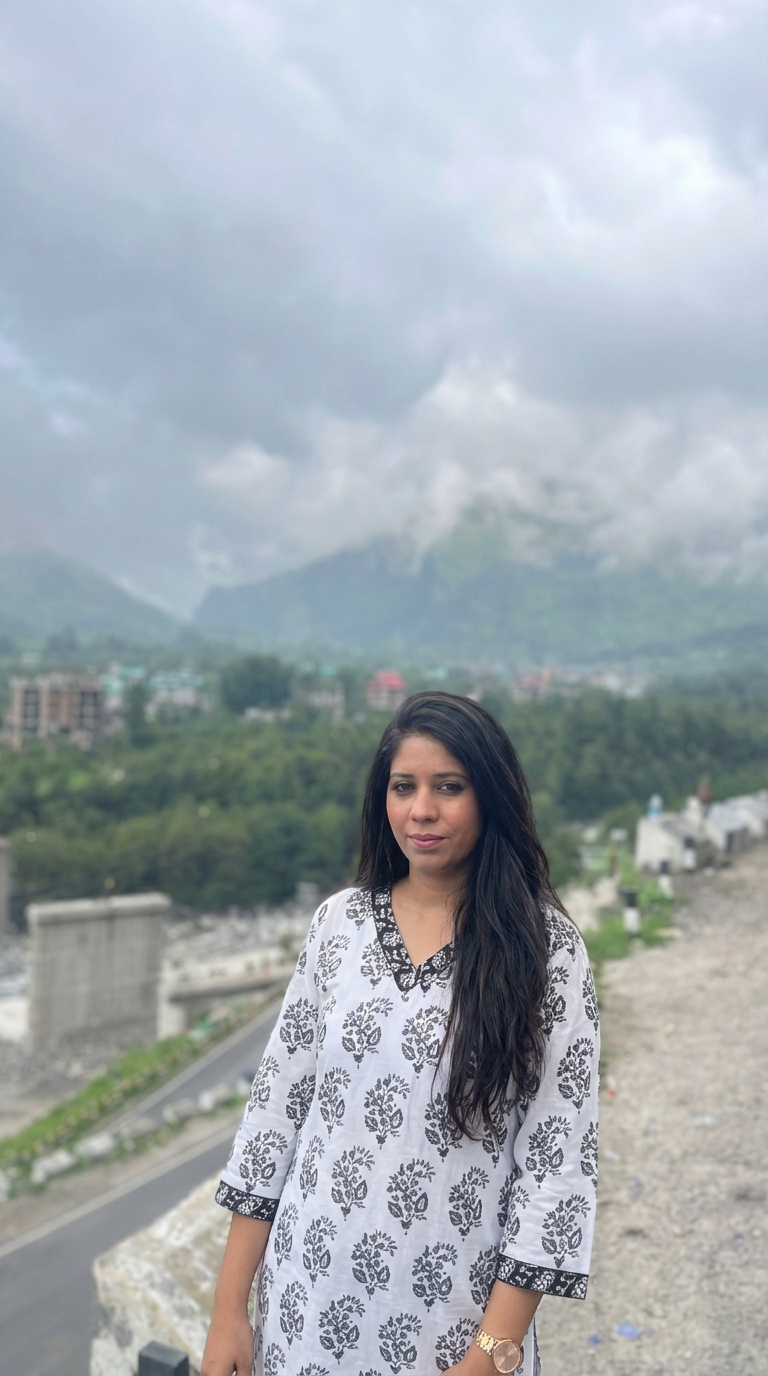
- **Fabric Physics:** The source garment appears to be a lightweight cotton or linen blend. It possesses a matte finish with zero specularity (no shine). The simulation must treat this as a semi-structured fabric that holds its shape better than the user's current flowy/sheer blouse but is soft enough to wrinkle at stress points. It requires high friction parameters to avoid slipping, characteristic of natural fibers.
- **Key Features:** The contrasting dark printed borders on the V-neckline and sleeve cuffs are critical anchor points. The block print pattern (paisley/floral motifs) must remain undistorted across the chest. The side slits (chaak) at the hemline must be preserved to distinguish the silhouette as a Kurti rather than a T-shirt.
PHASE 2: FIT & DRAPE SIMULATION
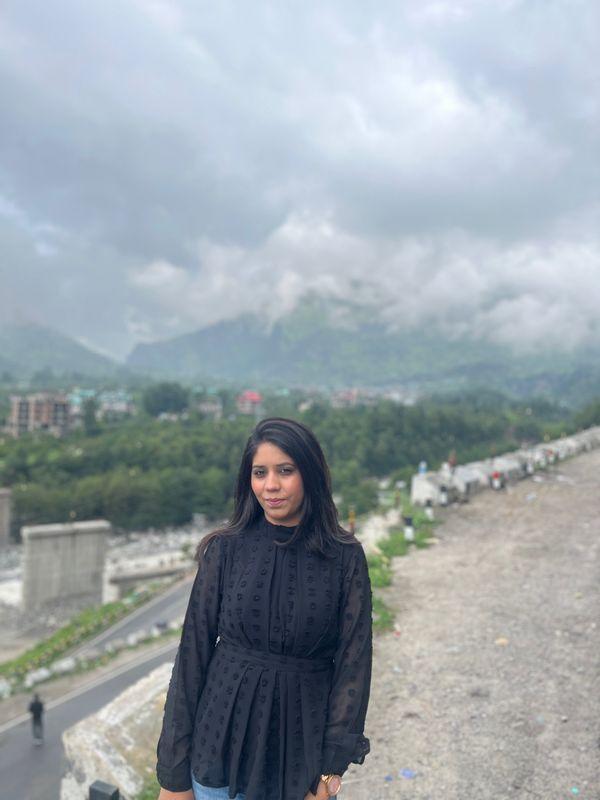
- **Body Mapping:** The target garment is a tunic/kurti designed to be worn untucked, differing significantly from the user's current cinched/peplum style top. The simulation must ignore the current waist-cinching and drape the kurti straight down from the bust line, extending over the hips. The 3/4 sleeves of the source garment are shorter than the user's current full sleeves; the system must generate/inpaint the user's forearms where the new sleeves end, specifically around the wrist/watch area.
- **Occlusion Handling:** CRITICAL: The user has long, dark hair cascading over both shoulders and down the front of the chest. A segmentation mask must separate this hair and layer it *over* the new white kurti. The watch on the left wrist must be preserved; if the new sleeve cuff interacts with it, the fabric should bunch slightly above the watch, not clip through it.
PHASE 3: ENVIRONMENT & LIGHTING
- **Light Match:** The user is in an outdoor, overcast environment with soft, diffused, cool-toned lighting (high cloud cover). There is no harsh directional light source. The white fabric of the kurti must be desaturated and tinted slightly cool (blue/grey) to match the ambient ambient occlusion of the valley background. It cannot remain "studio white."
- **Color Calibration:** The contrast of the black print on the kurti should be softened to match the atmospheric haze visible in the background. Shadows cast by the hair onto the white fabric must be soft and diffuse, not sharp.
PHASE 4: IDENTITY PROTECTION
- **Facial Lock:** Absolute freeze on the facial region (eyes, nose, mouth, jawline) and the hair volume/shape. The hairline must remain untouched.
- **Body Integrity:** The user's shoulder width and posture must remain exact. Do not slim the waist or alter the hip width. The simulation must respect the user's standing posture; the garment should add natural volume consistent with a loose cotton fit, rather than shrinking the user's silhouette.