Thinking Process
PHASE 1: VISUAL DECONSTRUCTION
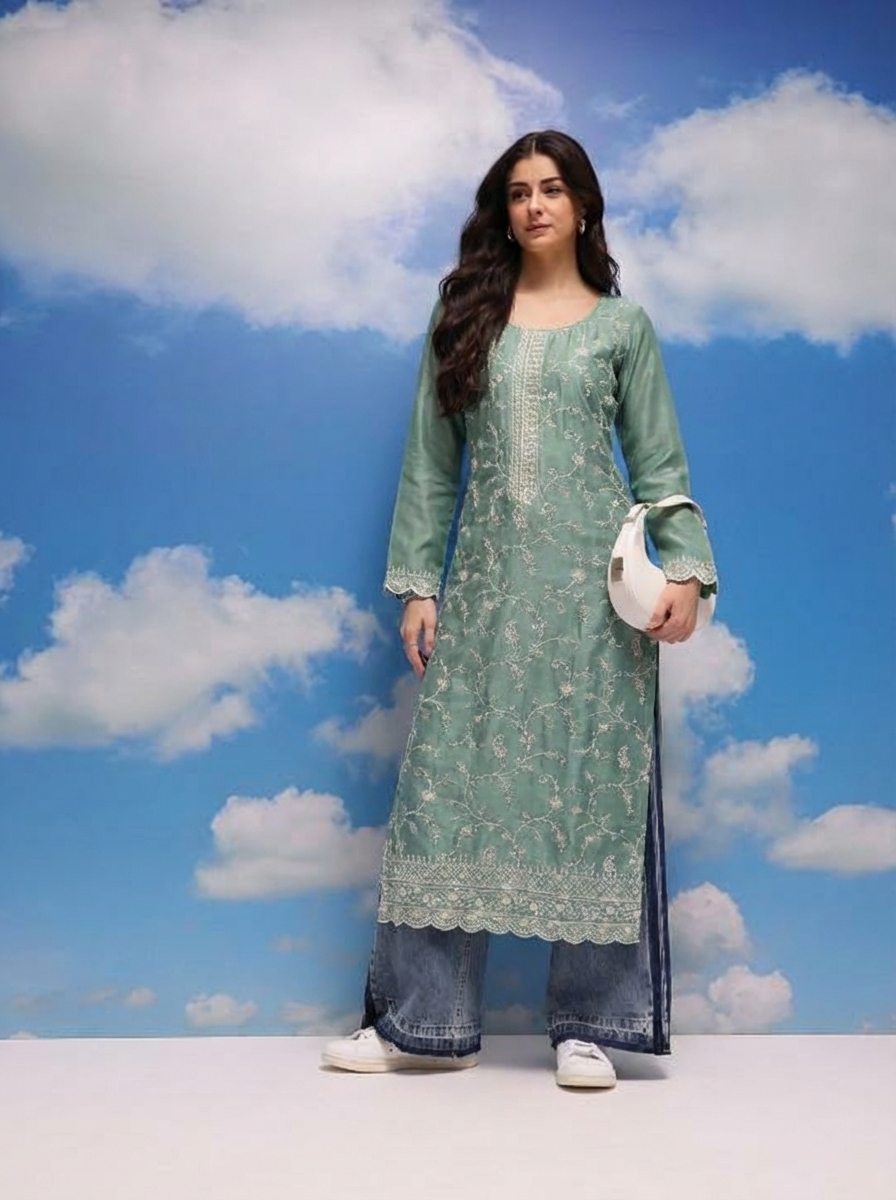
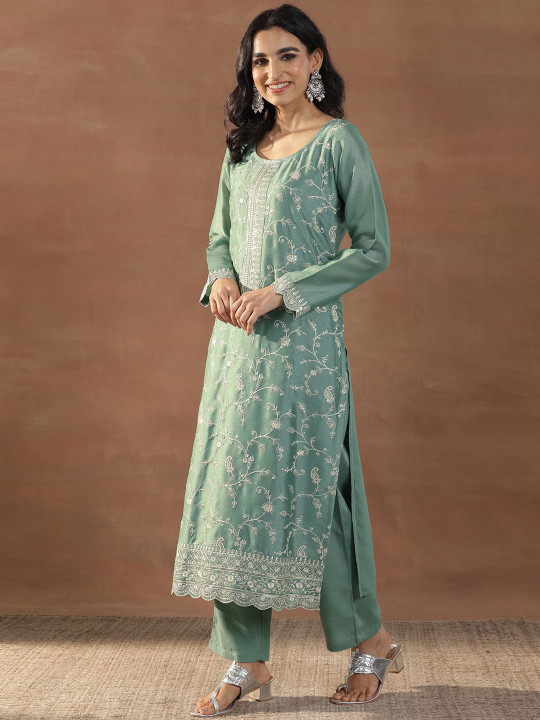
- **Fabric Physics:** The source garment is a Chanderi silk or viscose blend Kurta. It possesses a semi-structured drape with a subtle, pearlescent sheen. It is not fully rigid but holds its shape better than cotton jersey. Light interaction should show specular highlights on the folds and the embroidery thread work.
- **Key Features:** The intricate white floral embroidery patterns covering the bodice and skirt must remain sharp and undistorted. The scalloped hemline with the heavy embroidered border and the matching scalloped cuffs on the long sleeves are critical design elements to preserve. The central vertical placket detail on the chest must be centered.
PHASE 2: FIT & DRAPE SIMULATION
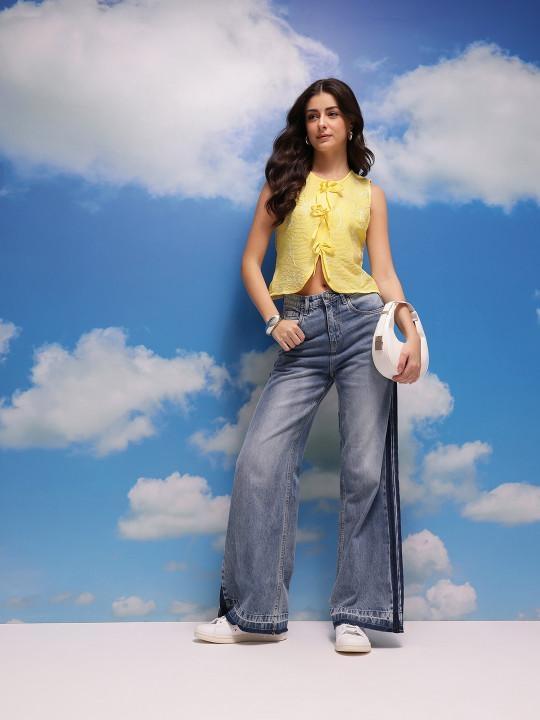
- **Body Mapping:** The user is wearing high-waisted, wide-leg jeans which add volume to the lower torso. The Kurta is a long tunic; therefore, the simulation must drape the fabric *over* the waistband of the jeans. The Kurta should flair slightly at the hips to accommodate the bulk of the denim without looking stretched. The sleeves must replace the user's bare arms, extending to the wrist.
- **Occlusion Handling:**
- **Hair:** The user's long dark wavy hair falls over her right shoulder (viewer's left) and right breast. This hair volume must be segmented and layered *strictly on top* of the new green Kurta.
- **Accessories:** The white handbag held in the user's left hand (viewer's right) creates a hard occlusion. The Kurta's side and hem must drape *behind* the bag. The watch/bracelet on the user's right wrist (viewer's left) will likely be covered by the long sleeve; if the sleeve rides up, the jewelry should be preserved.
- **Jeans:** The Kurta hem will fall to roughly knee-height; the jeans below this line must remain perfectly preserved.
PHASE 3: ENVIRONMENT & LIGHTING
- **Light Match:** The user image utilizes a cool, high-key "daylight" simulation (blue sky backdrop) with soft, diffuse shadows falling slightly to the right. The source garment was shot in warm, brownish studio lighting. The Kurta's texture must be color-corrected to neutralize the warm yellow/brown cast and shifted towards a cooler, natural daylight tone to match the target scene.
- **Color Calibration:** Increase the exposure of the green fabric slightly to match the brightness of the user's environment. Shadows cast by the user's hair onto the new garment must be soft and match the density of the shadows on the user's face.
PHASE 4: IDENTITY PROTECTION
- **Facial Lock:** The user's entire head, facial expression, neck, and the specific fall of her hair must remain pixel-perfectly frozen.
- **Body Integrity:** Strictly forbid any slimming of the user's waist or hips to match the slimmer silhouette of the source model. The garment must be warped to fit the user's actual proportions and the volume of the underlying jeans. The visible skin on the neckline must match the user's skin tone, not the source model's.