
Thinking Process
PHASE 1: VISUAL DECONSTRUCTION
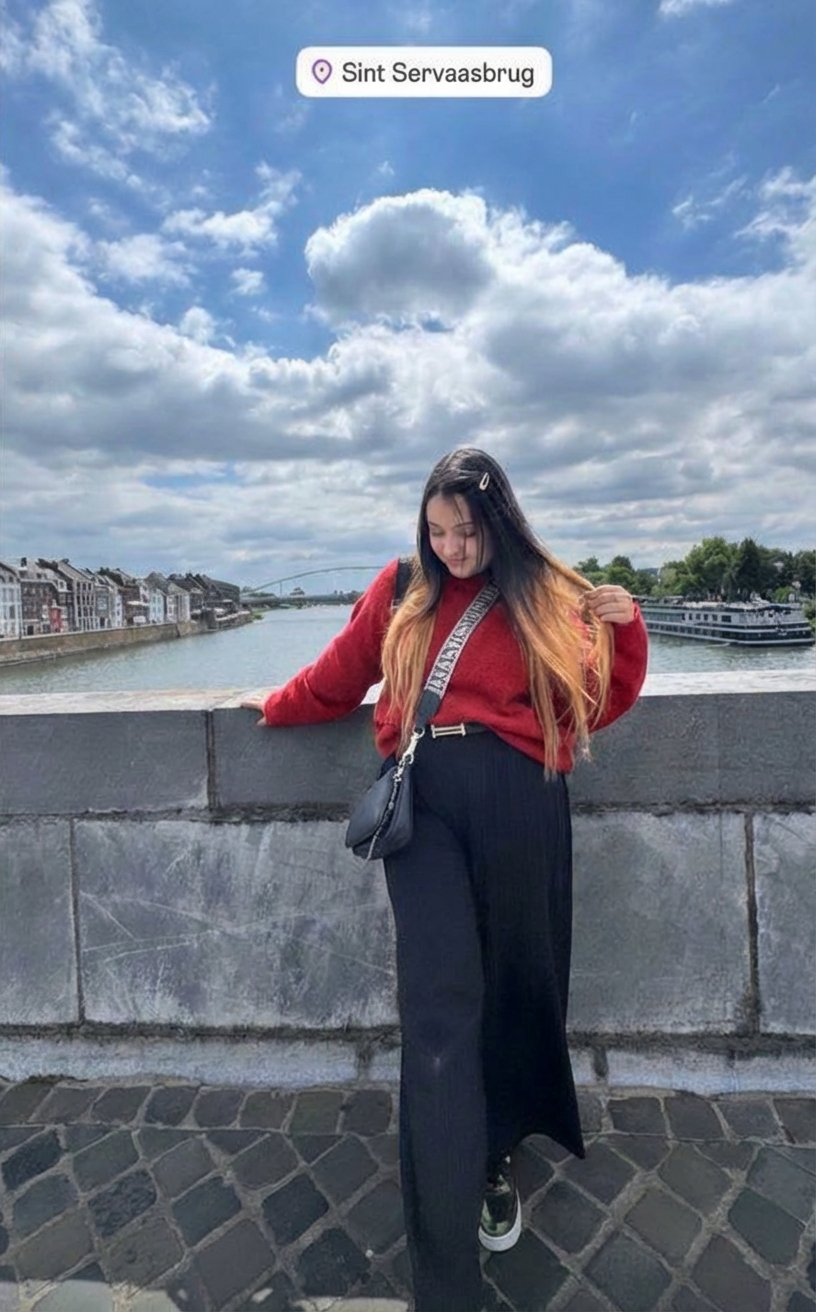
- **Fabric Physics:** The source garment appears to be a dense, felted wool or heavy synthetic knit with a matte finish. It possesses high structural rigidity and low elasticity. Unlike the user's current flowy floral top, this material will not flutter; it will form broad, soft tubular folds rather than sharp creases. It should absorb light rather than reflect it, showing a fuzzy surface texture (micro-displacement) rather than a shine.
- **Key Features:** The thick, rolled crew neckline is a defining feature that must sit higher on the clavicle than the current V-neck. The subtle seam lines along the shoulders and the textured, fibrous surface of the red fabric must be preserved. The garment is tunic-length; it must either drape over the hips or be simulated as tucked in, depending on the interaction with the high-waisted trousers.
PHASE 2: FIT & DRAPE SIMULATION
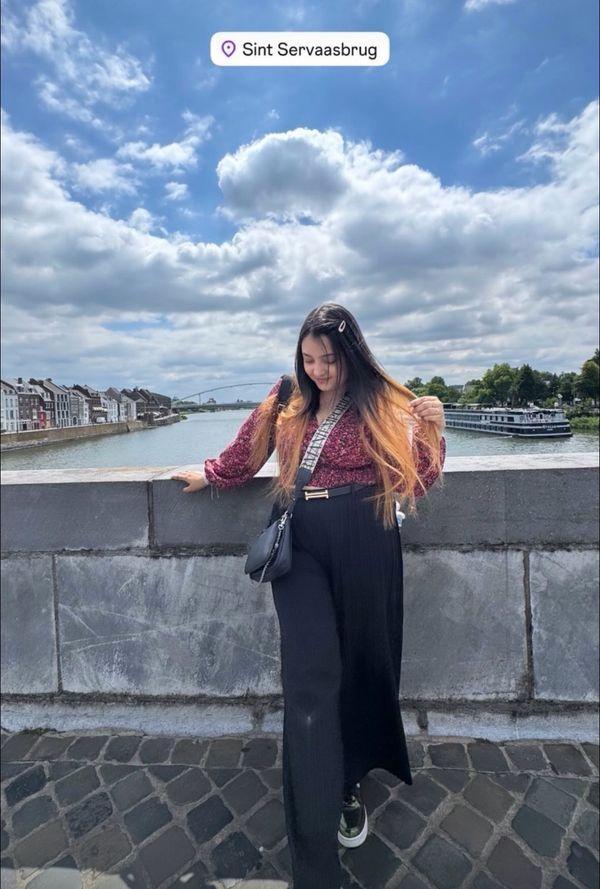
- **Body Mapping:** Due to the user leaning back against the stone railing, the heavy fabric should drape vertically from the chest peak, potentially creating a gap between the fabric and the midriff (avoiding a vacuum-sealed look). On the right arm (resting on the wall), the thick sleeve must bunch significantly at the shoulder and armpit. On the left arm (bent upward), distinct tension wrinkles must form on the outer elbow, with material bunching at the inner elbow.
- **Occlusion Handling:** This is a high-complexity occlusion scenario. The **crossbody bag strap** containing the text branding must be segmented and layered *on top* of the new red garment. The user's long, ombre hair (flowing over both shoulders and the chest) must be meticulously masked and composited *over* the new wool texture. The left hand fingers near the neck/shoulder area must remain visible and un-warped.
PHASE 3: ENVIRONMENT & LIGHTING
- **Light Match:** The target environment is outdoor daylight (overcast/diffuse sunlight) in an open bridge setting. The lighting is soft and top-down. The red garment must be relit to reflect a cooler, blue-tinted ambient skylight, replacing the neutral studio lighting of the source. Shadows should cast softly downwards beneath the bust and inside fabric folds.
- **Color Calibration:** The vibrant red of the source must be desaturated slightly and color-graded to match the outdoor exposure. It needs to interact with the atmospheric scattering of the scene; the blacks/shadows in the red wool should match the black levels of the user's pants.
PHASE 4: IDENTITY PROTECTION
- **Facial Lock:** The user's entire facial structure, skin tone, jawline, and the specific gradation of the hair color must remain absolutely frozen.
- **Body Integrity:** The simulation must respect the user's natural torso curvature and arm volume. Do not slim the waist or flatten the chest to fit the mannequin's shape; the heavy wool must expand to accommodate the user's body volume while maintaining the garment's inherent boxy cut.