Thinking Process
PHASE 1: VISUAL DECONSTRUCTION
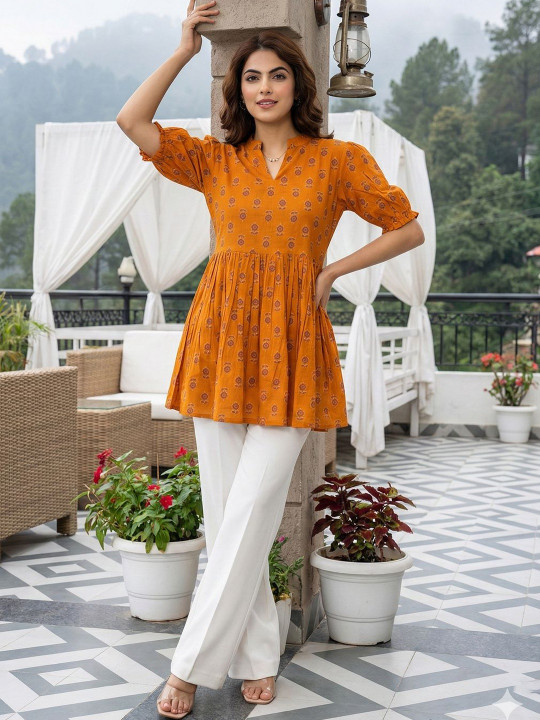
- **Fabric Physics:** The source garment appears to be a lightweight cotton or cotton-linen blend with a matte finish. It possesses medium stiffness—enough to hold the structure of the puffed sleeves and the gathers at the empire waist, but soft enough to drape vertically without rigid angularity. It has low reflectivity (low specularity) and should not shine under lights; rather, it should absorb and diffuse light.
- **Key Features:**
- **Empire Waist/Gathering:** The pleating/gathering just below the bust line is the defining structural element and must remain distinct.
- **Pattern:** The repetitive floral block print must maintain its scale and not be stretched unnaturally across the chest.
- **Sleeves:** The mid-length sleeves have a slight "puff" volume and an elasticated or fitted cuff that must be rendered correctly on the user's arms.
- **Neckline:** The V-neck cut with the small collar stand.
PHASE 2: FIT & DRAPE SIMULATION
- **Body Mapping:**
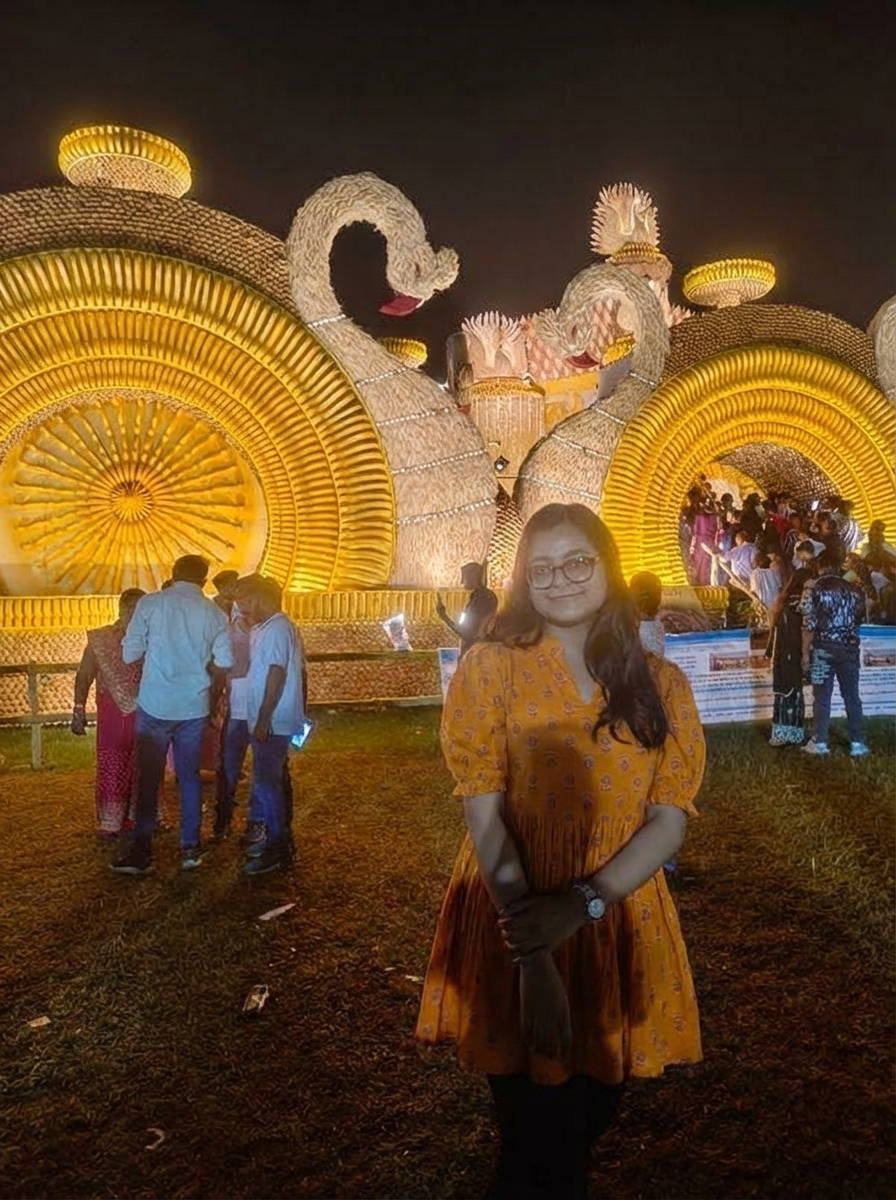
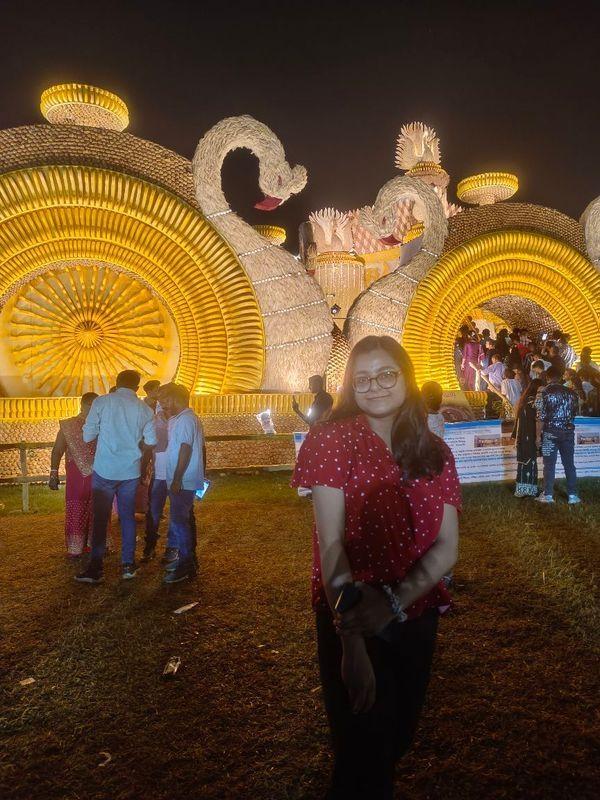
- **Torso flow:** Unlike the user's current fitted t-shirt, the source garment is a loose tunic (kurti). It must fit closer at the shoulders and chest, then flare outwards slightly from the high waist seam.
- **Length:** The garment extends past the hips (unlike the user's current top). The simulation must account for gravity pulling the fabric down over the hips, likely interacting with the user's thighs.
- **Arm interaction:** The user's arms are slightly bent. The fabric at the inner elbow should show slight compression folds, while the sleeve cuffs should sit comfortably on the mid-bicep/lower upper arm.
- **Occlusion Handling:**
- **Hair:** The user has long dark hair draping over both shoulders. A precise alpha mask must be generated for the hair strands to layer them *over* the new orange tunic.
- **Hands & Accessories:** The user's hands are clasped low at the waist/crotch area, along with a watch (left wrist) and bracelet (right wrist). Since the tunic is long and flared, the fabric generally falls *behind* the hands in this pose. The hands and wrists must be masked and brought to the foreground (Z-index top).
PHASE 3: ENVIRONMENT & LIGHTING
- **Light Match:**
- **Source vs. Target:** The source is soft, cool/neutral daylight. The target is a high-contrast, warm, artificial nighttime environment (yellow/amber tint).
- **Shadows:** The target lighting is diffuse but comes strongly from the illuminated structures behind and above. The front of the garment will be in relative shadow compared to the background. Shadows within the fabric folds (pleats) must be deepened to match the low-light environment.
- **Noise/Grain:** The target image has high ISO noise (grain). The clean source garment texture must have matching monochromatic noise applied to blend realistically.
- **Color Calibration:** The "mustard/orange" of the source cloth must be color-graded significantly warm. It should shift toward a deep amber/burnt orange to match the ambient temperature of the festival lights. The white balance of the pattern must shift from pure white/cream to a warmer yellow-cast cream.
PHASE 4: IDENTITY PROTECTION
- **Facial Lock:** The user's face, specifically the eyes, glasses frames, nose, and jawline, must be completely frozen. The hair volume and style must not be altered by the garment insertion.
- **Body Integrity:** The system is strictly forbidden from slimming the user's arms or waist. While the garment is loose/flared, the underlying collision mesh must respect the user's actual body measurements to ensure the clothes hang naturally, not on a generic mannequin shape.