Thinking Process
PHASE 1: VISUAL DECONSTRUCTION
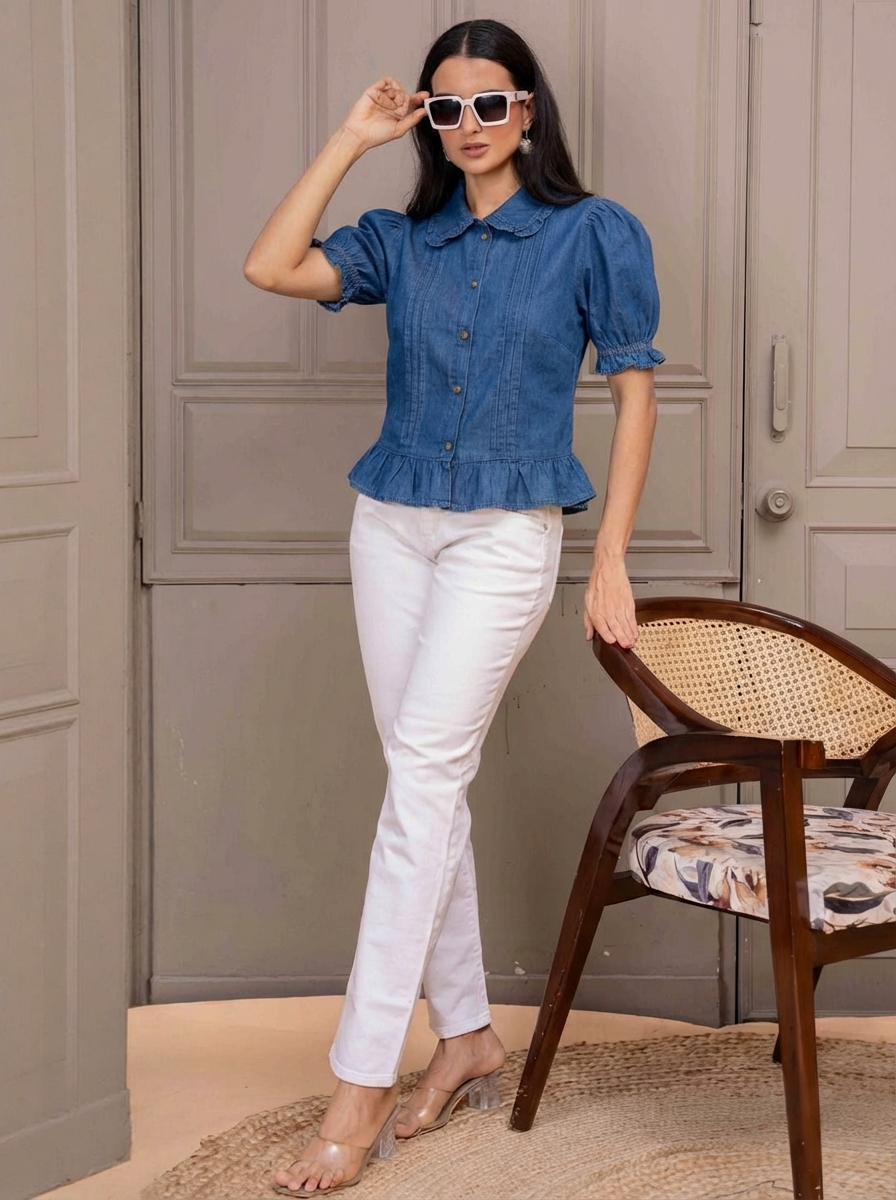
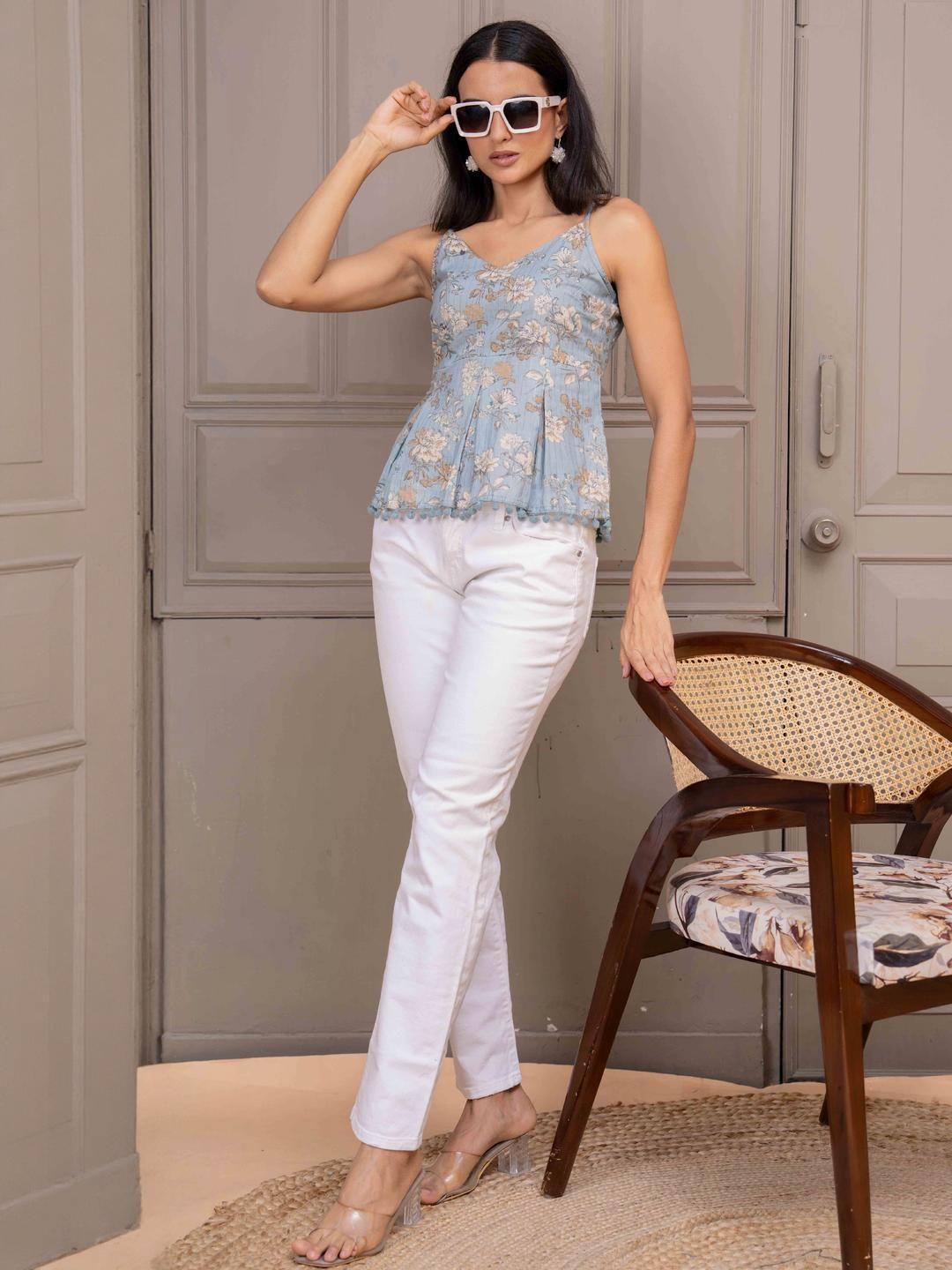
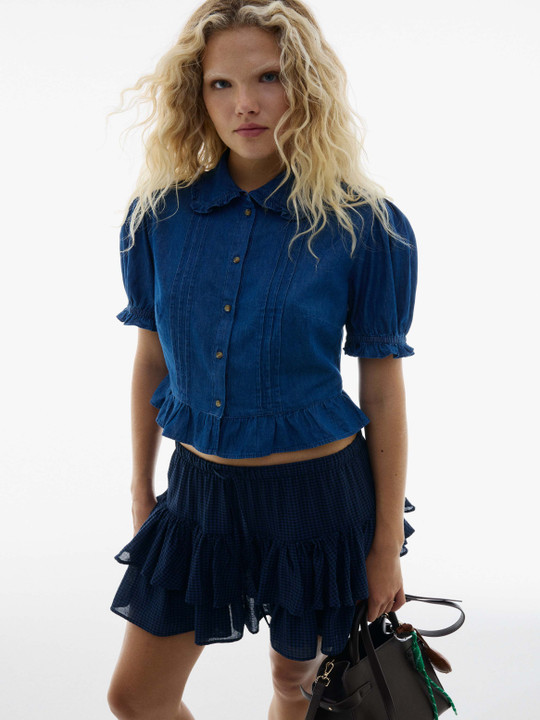
- **Fabric Physics:** The source garment is a structured denim or heavy chambray. Unlike the user's current flowy camisole, this material has high bending stiffness and shear resistance. It should not cling tightly to the skin but rather maintain its architectural shape, particularly in the sleeves and bodice. Surface scattering should be matte, with subtle specular highlights only appearing on the tension points of the weave (shoulders, button placket).
- **Key Features:**
- **Puff Sleeves:** The gathered shoulder heads and elasticated, ruffled cuffs are structural necessities. They must maintain volume and not collapse flat against the user's arm.
- **Front Placket:** The vertical line of brass-colored buttons must align with the user's torso center line.
- **Surface Details:** Vertical pintuck pleating on the chest and the ruffled "peter pan" style collar.
- **Hemline:** The peplum ruffle at the waistline is distinct; it must flare slightly outward, utilizing gravity rather than adhering to the hips.
PHASE 2: FIT & DRAPE SIMULATION
- **Body Mapping:**
- **Right Arm (Raised):** Due to the user's right arm interacting with her sunglasses, the denim fabric at the right axilla (armpit) must demonstrate compression folds. The right puff sleeve should ride slightly higher up the bicep compared to the relaxed left arm.
- **Torso Alignment:** The garment is a fitted bodice with a flared hem. It should sit flush against the user's chest but bridge over the curvature of the waist without sucking in, respecting the rigidity of denim.
- **Waist Interaction:** The source top appears slightly cropped/waist-length. It must be composited *over* the waistband of the white jeans, casting a small ambient occlusion shadow onto the white denim.
- **Occlusion Handling:**
- **Hair:** The user's long dark hair falls over both shoulders and down the back. The new denim collar and shoulders must be generated *behind* these hair strands. Detailed alpha matting is required to composite the hair over the denim texture.
- **Right Arm:** The raised angle requires the sleeve to wrap cylindrically around the upper arm, ensuring the arm emerges naturally from the ruffled cuff.
PHASE 3: ENVIRONMENT & LIGHTING
- **Light Match:** The user environment features soft, diffuse lighting, likely from a large window or softbox to the viewer's left (creating soft shadows on the user's right side). The high-contrast, cool studio lighting of the source garment must be neutralized. We must introduce a warm, soft fall-off consistent with the user's skin tones and the beige/grey background.
- **Color Calibration:** The source denim is a saturated royal/indigo blue. To match the User Image's muted, slightly warm palette, the denim blue needs to be slightly desaturated and color-graded with a subtle warm wash to integrate with the ambient light of the room.
PHASE 4: IDENTITY PROTECTION
- **Facial Lock:** The user's entire head, including the sunglasses, nose, mouth, jawline, and neck structure, must be frozen. The specific texture and flow of the hair are inviolable.
- **Body Integrity:** The simulation must respect the user's current skeletal structure. Do not slim the arms or torso to fit the garment. The white jeans and the user's legs must remain pixels-perfectly unchanged. The goal is to dress the avatar, not modify the avatar's biometrics.