Thinking Process
PHASE 1: VISUAL DECONSTRUCTION
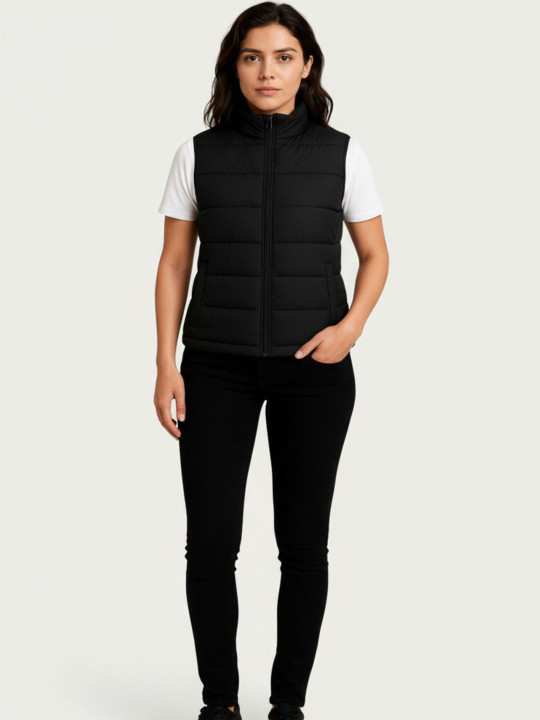
- **Fabric Physics:** The target garment is a quilted puffer vest (gilet) made of synthetic nylon or polyester. It possesses a high degree of structural rigidity due to the down/fiber fill; it does not drape like cloth but rather holds a volumetric shape. The surface has a semi-matte finish with subtle specular highlights on the curve of the baffles (horizontal quilting). The underlying layer is a white cotton jersey t-shirt, which should exhibit soft, matte light absorption.
- **Key Features:** Horizontal quilting channels (baffles) must remain parallel and distinct. The central zipper assembly, the high stand-up collar, and the slightly bulkier silhouette characteristic of insulated outerwear must be preserved. The contrast between the black vest and the white short-sleeve undershirt is a critical design element.
PHASE 2: FIT & DRAPE SIMULATION
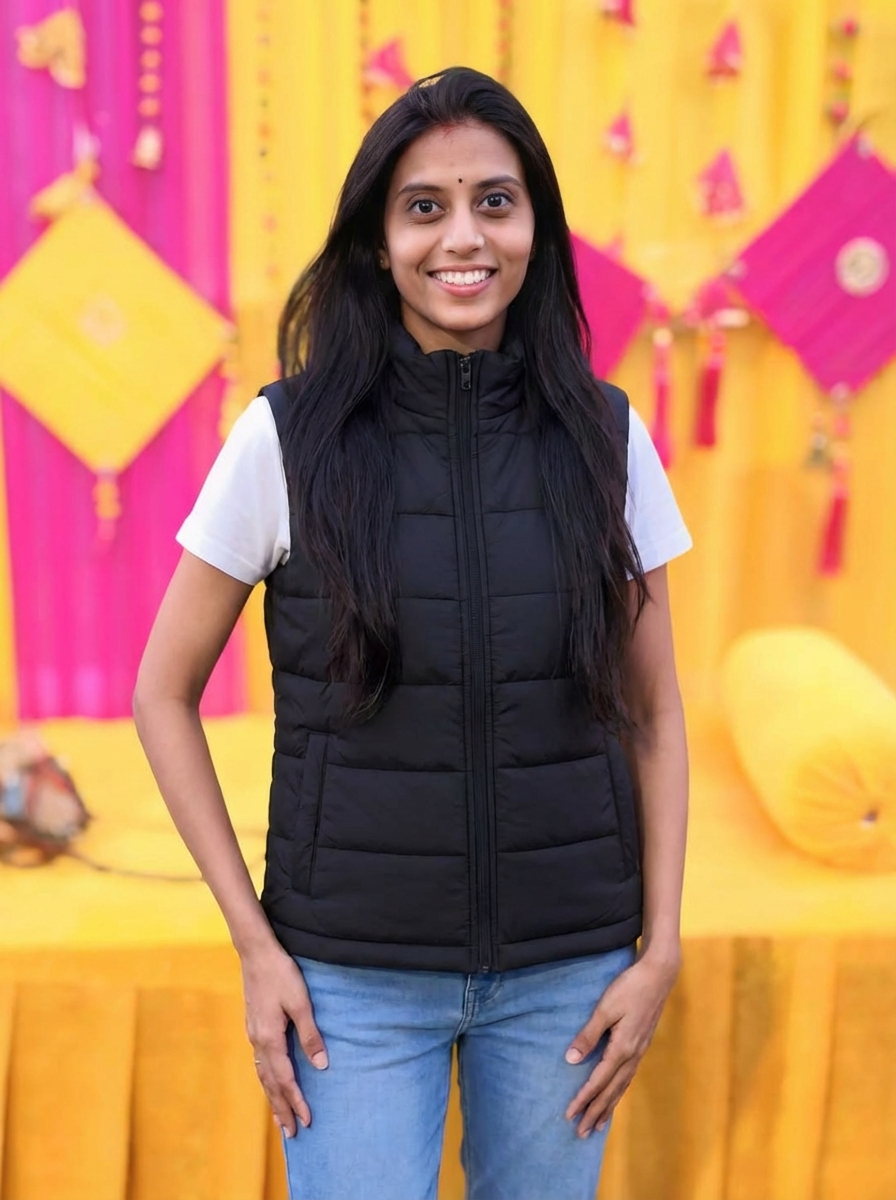
- **Body Mapping:** The vest must sit with added volume around the user's torso, not hugging the skin tightly like the current floral tunic. The high collar must encircle the neck without intersecting the jawline. Since the source is a vest + short sleeve combo and the user has long sleeves, the simulation must account for the exposure of the user's forearms (requiring skin tone inpainting) or the mapping of the white t-shirt sleeves to the user's upper arms.
- **Occlusion Handling:** **Critical:** The user has long, dark hair draped over both shoulders and the chest. This hair must be segmented and layered *on top* of the new puffer vest. The volume of the hair should subtly react to the increased bulk of the vest underneath (sitting slightly higher/further out). The user's hands are at the hip level; the hem of the vest must interact naturally with the hips without clipping into the hands.
PHASE 3: ENVIRONMENT & LIGHTING
- **Light Match:** The user is in a bright, diffuse environment with strong warm color casts (yellow and pink ambient light from the background). The studio-lit source garment (neutral/cool) must be relit to accept these warm tones. The black nylon of the vest should catch soft, warm reflections from the yellow décor, avoiding a "stuck-on" flat black appearance.
- **Color Calibration:** The white t-shirt underneath the vest must be color-graded to match the white point of the user's scene (shifting from sterile white to a warmer, creamy white). The black value of the vest must be lifted slightly to match the dynamic range of the user's photo.
PHASE 4: IDENTITY PROTECTION
- **Facial Lock:** Absolute preservation of the user's face, jawline, and the specific fall of the hair parting. The neck area above the vest's high collar must remain untouched.
- **Body Integrity:** The user's shoulder width and hip alignment must remain constant. While the vest adds external volume (bulk), the underlying skeletal structure and body mass of the user must not be slimmed or distorted to match the source model's physique.