Thinking Process
PHASE 1: VISUAL DECONSTRUCTION
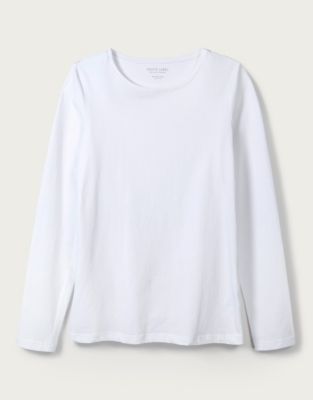
- **Fabric Physics:** The source garment is a white, long-sleeve cotton jersey material. It possesses low specular highlights (matte finish) and medium elasticity. The simulation must reflect soft, organic folding patterns rather than rigid creasing. Light diffusion should be subsurface scattering typical of white cotton, appearing soft rather than shiny.
- **Key Features:** The reinforced crew-neck collar ribbing, the double-stitching at the sleeve cuffs and bottom hem, and the subtle "White Label" branding inside the neck (which must be properly wrapped to the back interior or occluded by the user's neck) must be preserved. The slight waisting in the cut must translate to the drape.
PHASE 2: FIT & DRAPE SIMULATION
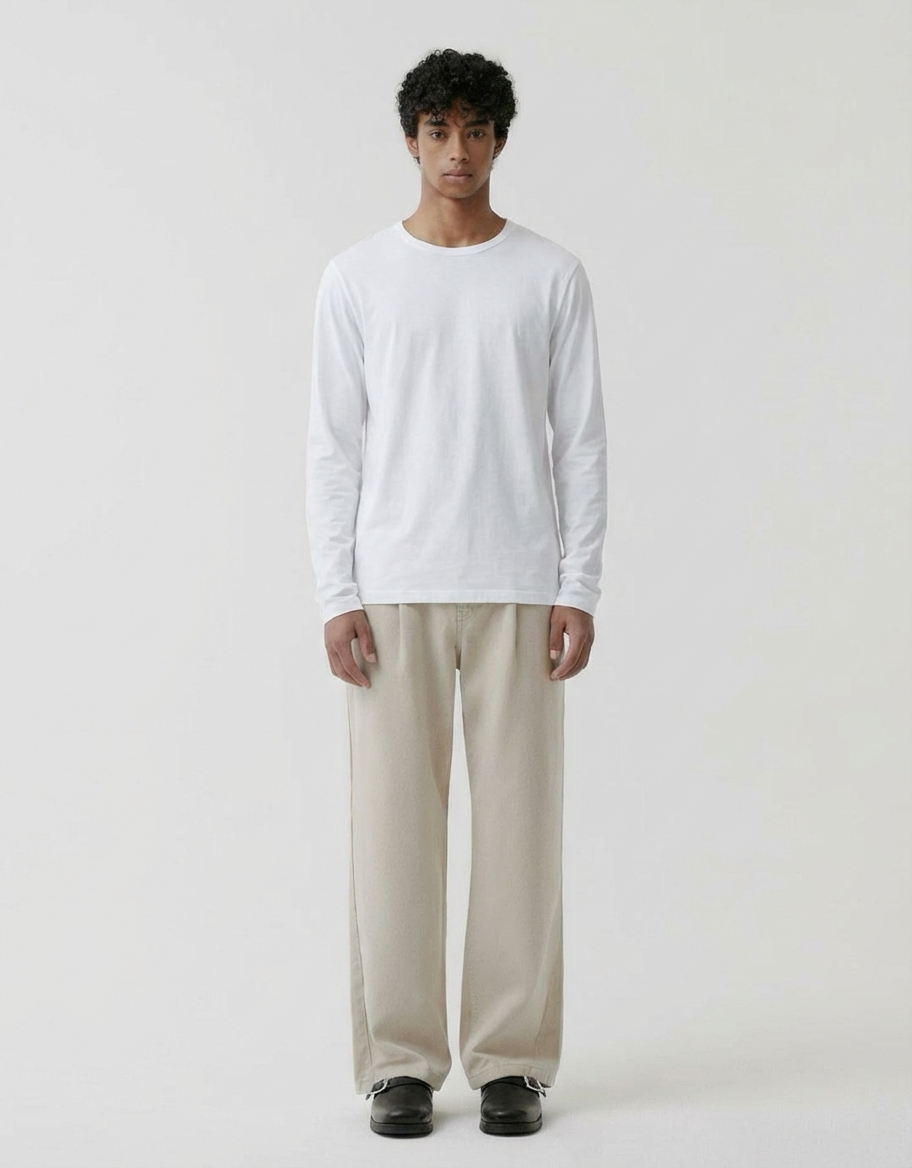
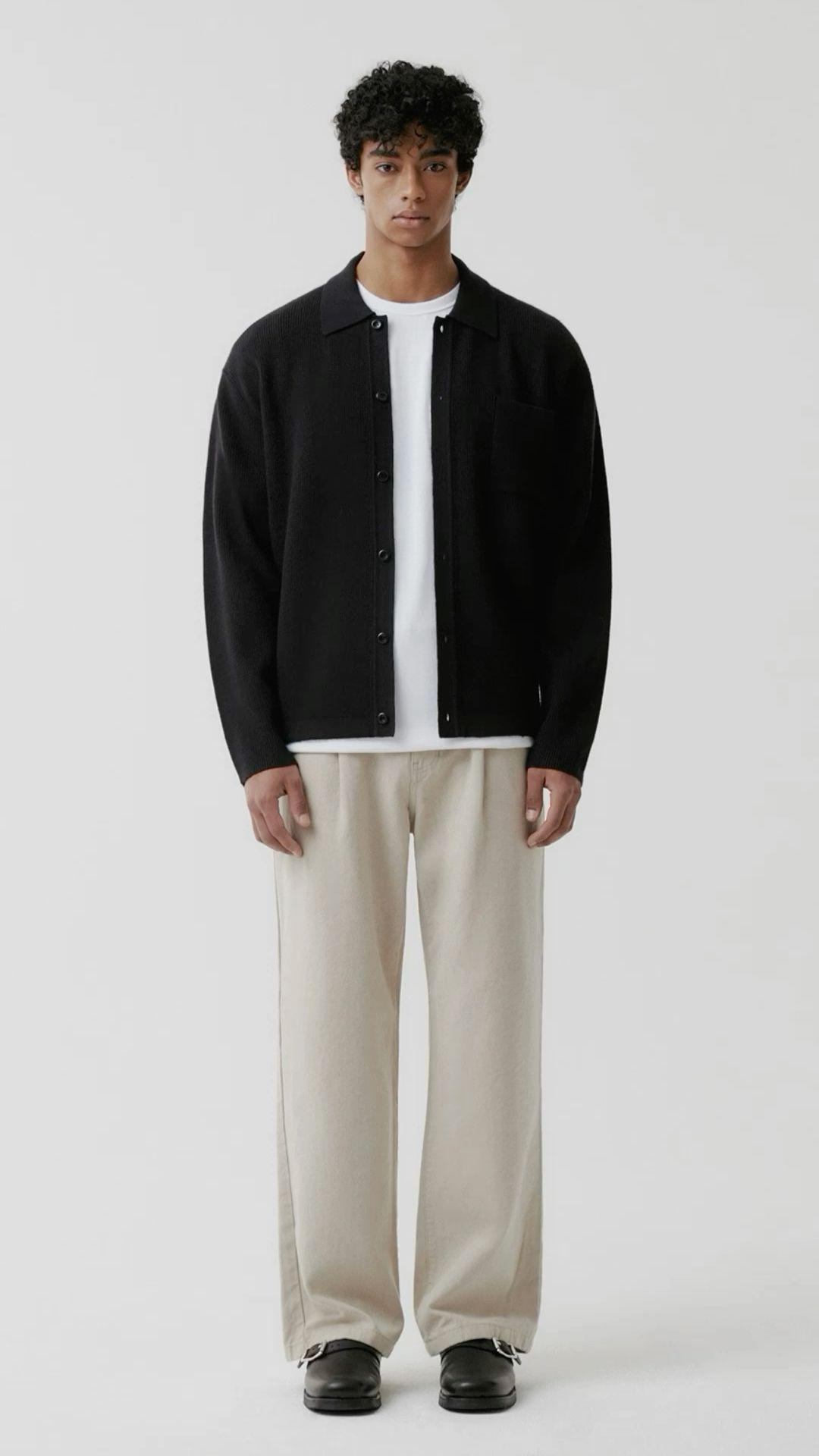
- **Body Mapping:** The current user is wearing a bulky cardigan; this volume must be ignored to fit the new garment to the underlying anatomical shoulders and torso. The new long-sleeve tee should drape closer to the skin than the current outfit. Sleeves should hang vertically with minor bunching at the wrist if the sleeve length exceeds the arm length. The bottom hem should fall naturally over the hips, likely untucked, creating a transition point over the beige trousers.
- **Occlusion Handling:** The user's hands are the primary occlusion point; the sleeve cuffs must terminate *behind* the thumbs and fingers. The user's curly hair sits high enough that it likely won't interact with the collar, but any stray curls at the nape of the neck must layer *over* the new collar. The trousers' waistline currently interacts with a tucked tee; the new shirt will likely cover this, requiring the generation of a shadow *cast by the shirt* onto the upper thigh area of the pants.
PHASE 3: ENVIRONMENT & LIGHTING
- **Light Match:** The user image utilizes soft, diffuse studio lighting, predominantly from the front/top, creating gentle shadows under the chin and nose. The new white garment must generate self-shadowing in the armpits and torso sides to match this ambient occlusion. The brightness of the white shirt must be balanced so it does not "glow" or clip (overexpose) relative to the beige trousers.
- **Color Calibration:** The source cloth is a cool, stark white. The user environment has a slightly warmer, neutral tone (evident in the beige pants and skin tones). The new garment's white point must be shifted slightly warmer to integrate seamlessly, ensuring the white doesn't appear blue-tinted against the skin.
PHASE 4: IDENTITY PROTECTION
- **Facial Lock:** The user's entire head, including the specific volume of the curly hair, facial structure, skin tone, and neck anatomy up to the clavicle, must be frozen and pixel-preserved.
- **Body Integrity:** Strict prohibition on altering the user's skeletal structure or BMI. While the *silhouette* will change because the bulky cardigan is being removed, the underlying shoulder width and torso depth must remain true to the subject's anatomy. Do not artificially slim the waist.