Thinking Process
PHASE 1: VISUAL DECONSTRUCTION
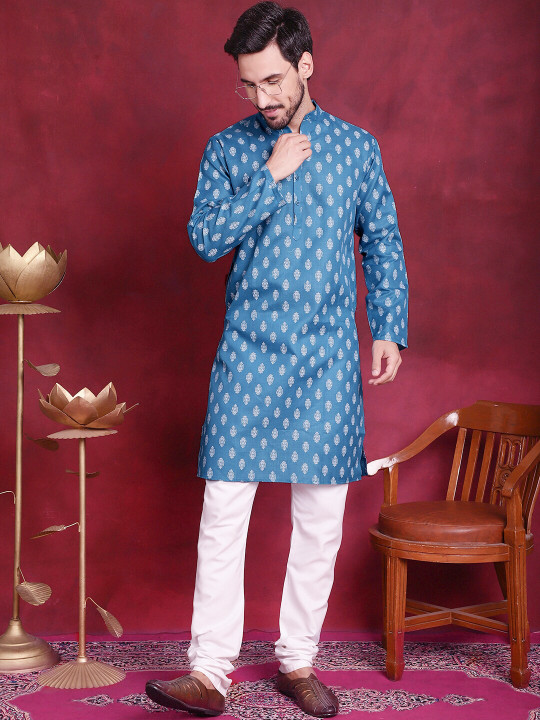
- **Fabric Physics:** The source garment is a woven Kurta, likely cotton or a cotton-silk blend. Unlike the user's current knit polo, this fabric has low elasticity and higher structural rigidity. It should exhibit a matte finish with very subtle specular highlights on the peaks of folds. The drape must be calculated as a medium-weight woven textile, meaning creases will be sharper and less rounded than the current jersey fabric.
- **Key Features:** The Mandarin collar (bandhgala) is a critical structural element that must replace the open polo collar. The recurring silver/white block-print motif must maintain precise geometric alignment and not distort unnaturally across curved surfaces. The button placket running down the center chest and the long-sleeve construction (replacing current short sleeves) are non-negotiable design elements.
PHASE 2: FIT & DRAPE SIMULATION
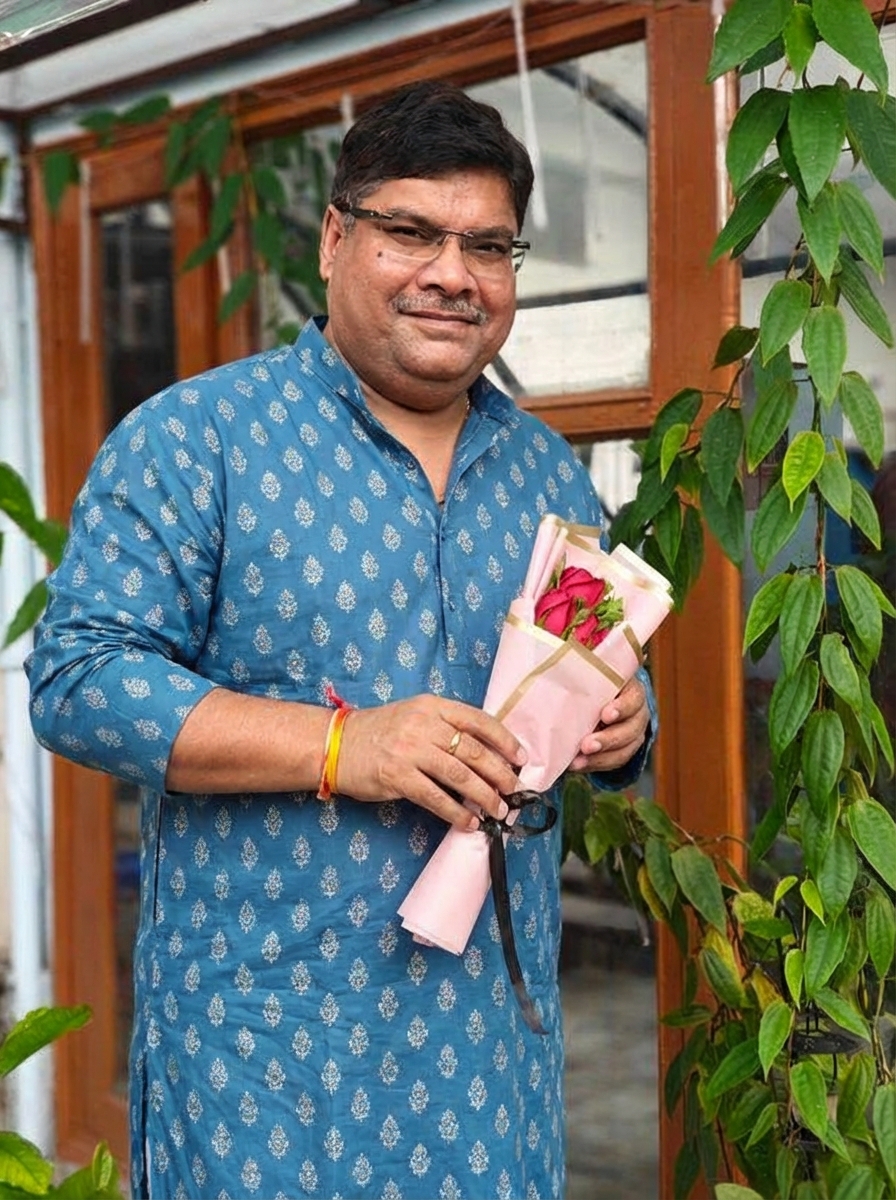
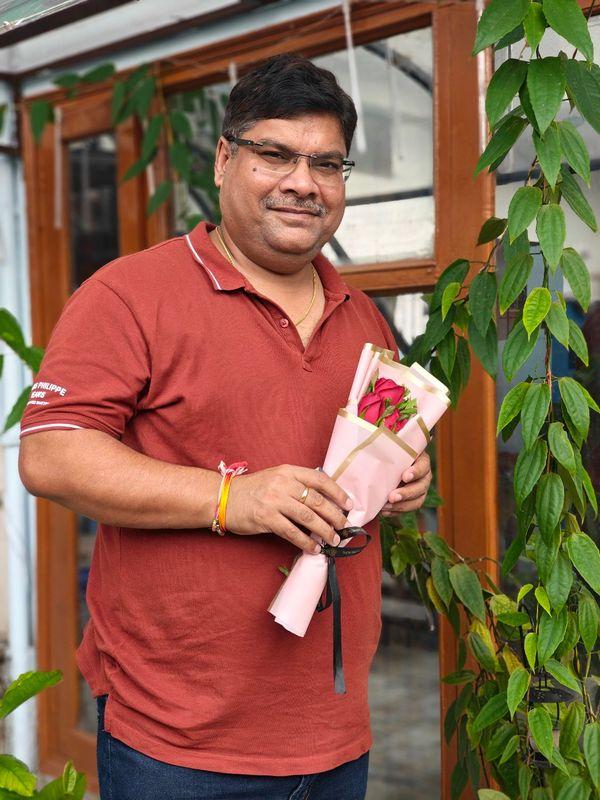
- **Body Mapping:** The Kurta must adapt to a seated-style or relaxed standing posture with significant abdominal volume. Unlike the fitted polo, the Kurta hangs straight from the shoulders and chest, skimming over the midsection rather than hugging it. Due to the user's bent elbows (holding the bouquet), the long sleeves must generate "honeycomb" compression wrinkles at the inner elbows and tension pulls across the deltoids. The hemline is tunic-length and should extend beyond the frame's bottom edge or drape significantly lower than the current waistband.
- **Occlusion Handling:** This is a high-complexity occlusion scenario. The bouquet of roses (pink wrapper, black ribbon, flowers) and **both hands** are strictly foreground layers. The Kurta simulation must be "cut out" or masked precisely behind these elements. The fabric must appear to be compressed slightly behind the bouquet where the hands press against the torso. The red & yellow wrist thread (kalawa) on the right hand creates a collision boundary for the new long cuff.
PHASE 3: ENVIRONMENT & LIGHTING
- **Light Match:** The user scene features soft, diffused daylight entering from the left (likely a large window/greenhouse), creating cool highlights on the left and soft shadows on the right. The source garment's studio lighting is too warm and flat. We must relight the Kurta to accept a cool-toned key light from the left. Shadows must be cast by the bouquet onto the new Kurta fabric to ground the object in the scene.
- **Color Calibration:** The source "Royal Blue" must be slightly desaturated and cool-shifted to match the natural, daylight-balanced environment of the user photo. The intense saturation of the studio shot will look fake without this adjustment. Subtle green color spill from the surrounding plants should be baked into the reflection map of the shoulders.
PHASE 4: IDENTITY PROTECTION
- **Facial Lock:** The user's face, neck structure, glasses, and hair are to be completely frozen. The mask line for the neck must differ from the source; the Kurta has a higher collar, so the user's lower neck skin currently visible in the polo will be covered.
- **Body Integrity:** Strictly forbid any mesh warping that slims or alters the user's body mass index. The garment must drape over the user's *actual* volume. The shoulder width and stomach projection must remain consistent with the input image to ensure the result looks like the user, not a generic model.