Thinking Process
PHASE 1: VISUAL DECONSTRUCTION
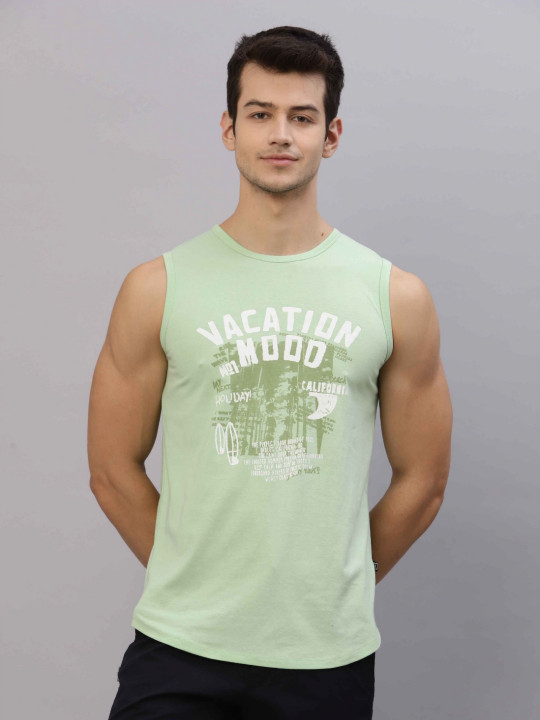
- **Fabric Physics:** The source garment is a light cotton jersey or cotton-blend knit. It possesses a matte finish with low specularity (no shine). The simulation must treat the fabric as soft and pliable with medium weight, allowing for minor micro-wrinkles rather than sharp, rigid folds. It has a high friction coefficient against skin, meaning it will cling slightly rather than slide.
- **Key Features:** The central graphic print ("VACATION MOOD" with palm imagery) is the primary focal point and must undergo perspective warping without pixelation. The ribbed crew neckline and the binding on the armholes must be preserved with their specific thickness. The hemline appears slightly curved and double-stitched.
PHASE 2: FIT & DRAPE SIMULATION
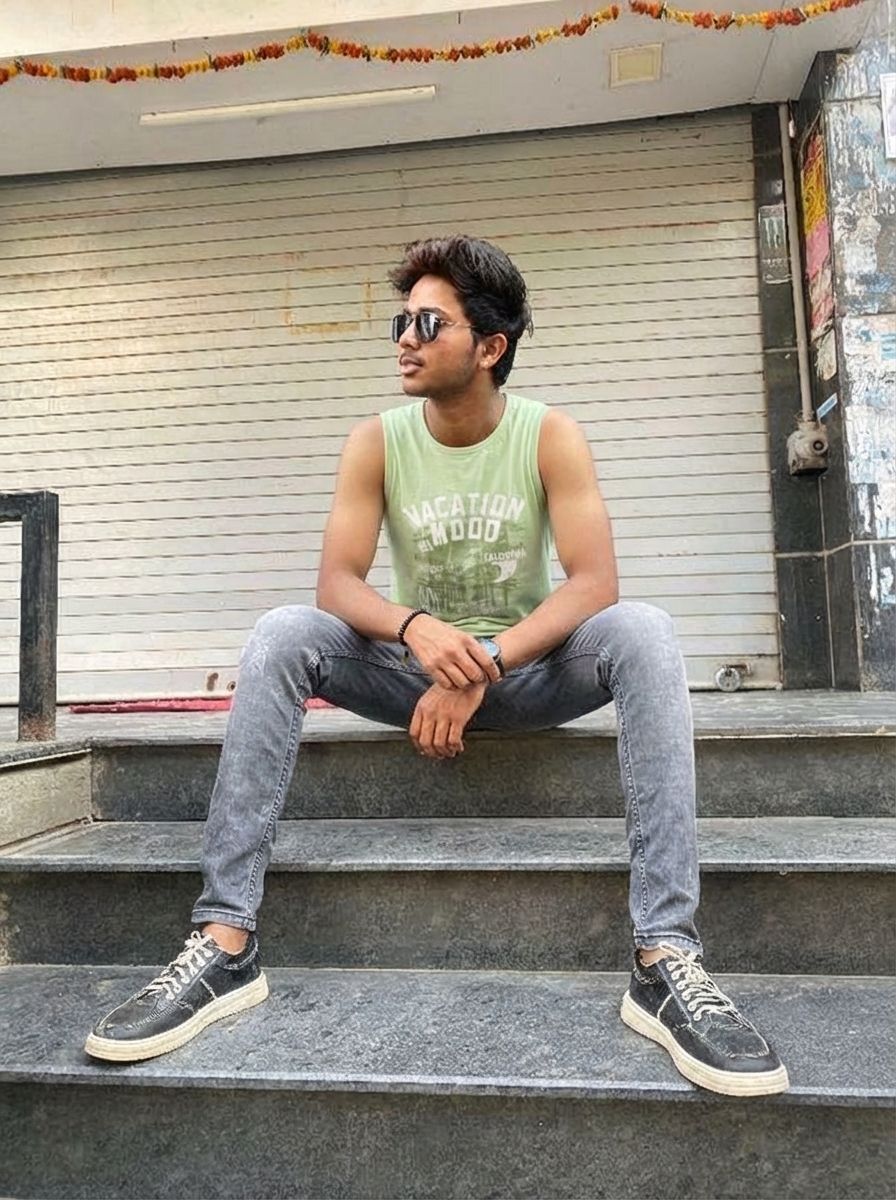
- **Body Mapping:** Due to the user's seated, forward-leaning posture, the garment simulation must account for torso compression. The tank top will not hang straight (as seen in the source); instead, it must pool and fold horizontally across the lower abdomen where the torso meets the legs. The neckline will dip lower relative to gravity due to the forward lean. The graphic print must warp cylindrically across the pectorals and distort comfortably into the abdominal folds.
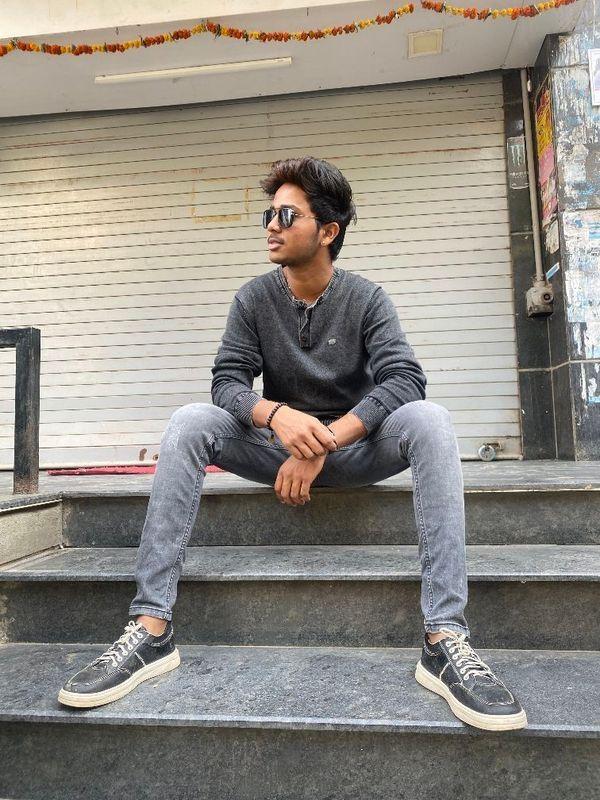
- **Occlusion Handling:** The user's forearms and clasped hands are positioned between the knees, creating a complex depth layer. The garment's lower hem will likely terminate just above the lap, but any fabric extending lower must be masked *behind* the forearms and wrists. The bracelet on the user's right wrist is an external object and must remain visible, though it likely won't interact directly with this shorter garment. *Note: Since the source is sleeveless and the target wears long sleeves, accurate skin inpainting is required for the user's arms.*
PHASE 3: ENVIRONMENT & LIGHTING
- **Light Match:** The user is situated in a shaded outdoor environment with diffuse, natural lighting coming primarily from the upper-front-right. The garment must shed the flat studio lighting of the source image and adopt ambient occlusion compatible with the street setting. Shadows must be cast by the user's chin onto the upper chest area of the tank top.
- **Color Calibration:** The pastel green of the source garment must be color-graded to match the cooler, desaturated tones of the outdoor urban background. The white text graphics should reflect the ambient light color (slightly bluish-grey tint) rather than remaining pure #FFFFFF, to avoid a "sticker" effect.
PHASE 4: IDENTITY PROTECTION
- **Facial Lock:** The user's entire head region, including the specific hair volume, jawline, and the sunglasses, must remain pixel-perfectly frozen. The neck connection point must be seamlessly blended.
- **Body Integrity:** The user's shoulder width and seated skeletal structure must remain unaltered. The volume of the chest and abdomen must dictate the shape of the cloth, not vice versa; do not slim the torso or artificially enhance musculature to match the model in the source image.