Thinking Process
PHASE 1: VISUAL DECONSTRUCTION
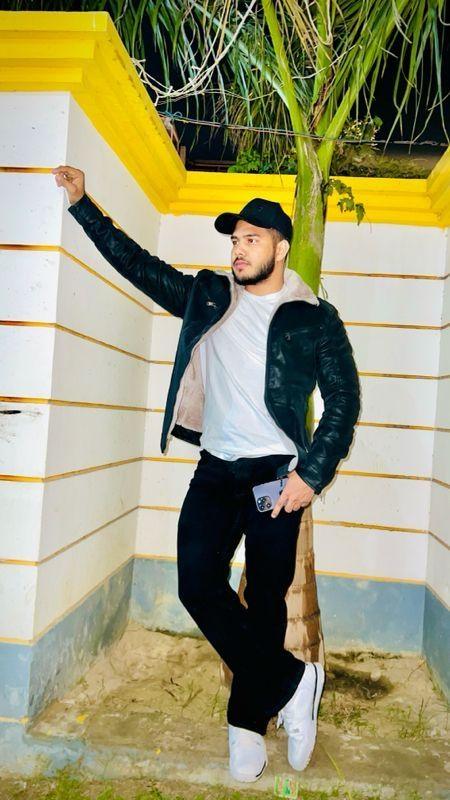
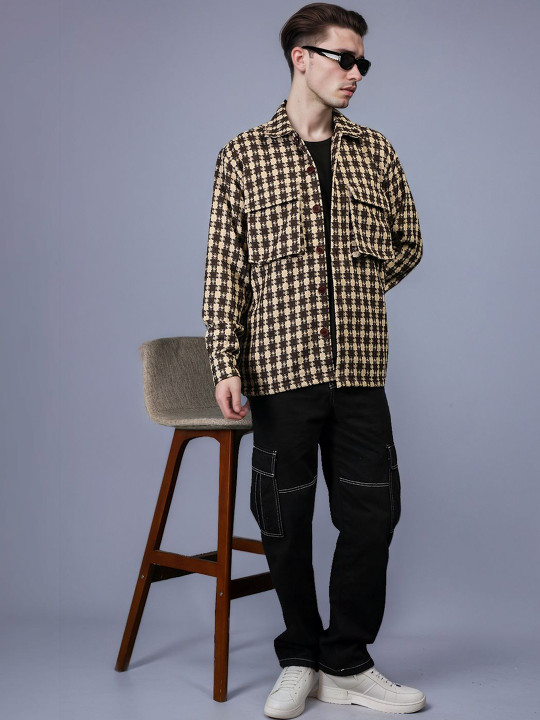
- **Fabric Physics:** The source garment appears to be a heavy flannel, wool-blend, or thick cotton "shacket" (shirt-jacket). Unlike the user's current leather jacket, this material has high light absorption and very low specular reflection (matte finish). It possesses medium tensile stiffness—it will hold its shape at the collar and pockets but will fold softly rather than creasing sharply like starched cotton or stiff leather.
- **Key Features:** The distinctive houndstooth/checkered pattern must be preserved with zero distortion to the grid, even during warping. The two chest pockets with flap closures are structural anchors. The button placket down the center front and the specific cuff width must be retained. The fabric texture should show a slight fibrous "fuzz" consistent with flannel/wool.
PHASE 2: FIT & DRAPE SIMULATION
- **Body Mapping:**
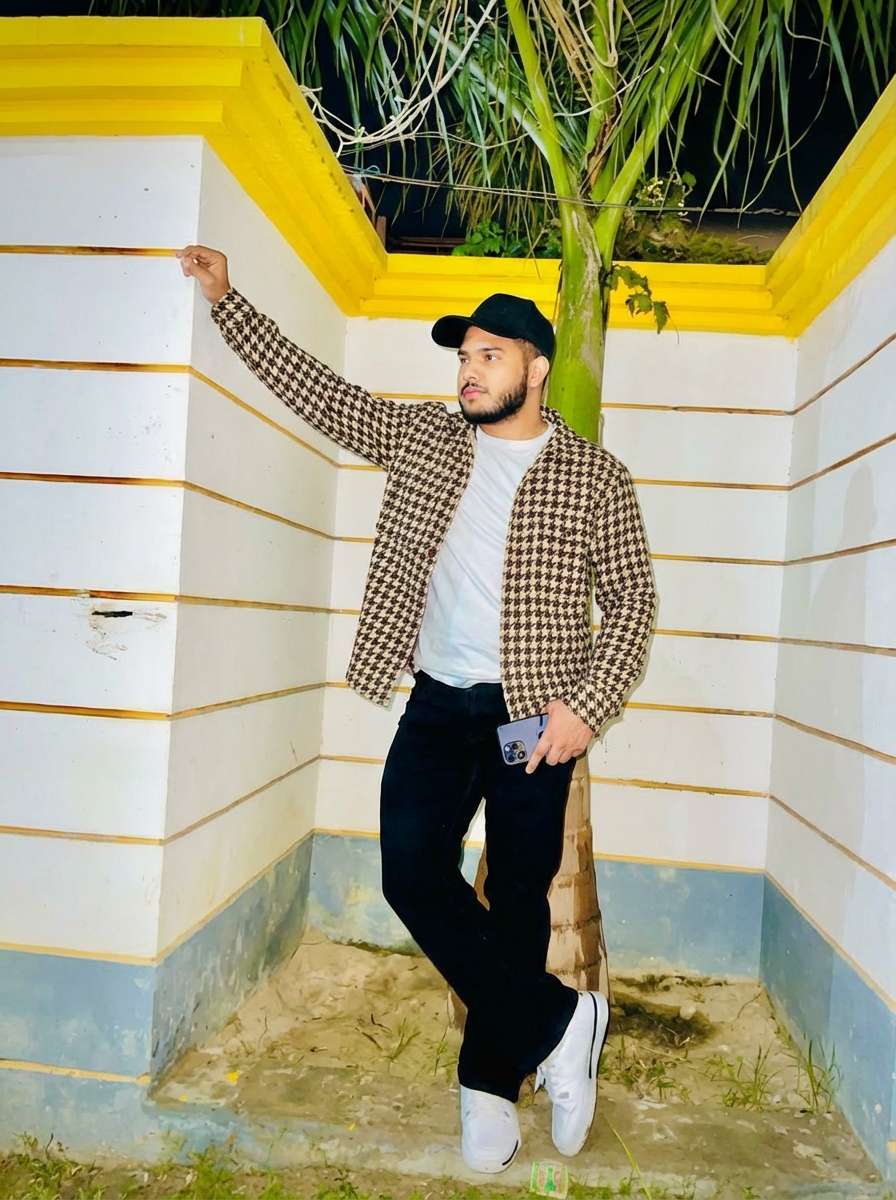
- **Right Arm (Raised):** The most complex physics calculation. The fabric must experience "lift" at the right axilla (armpit). The sleeve on this arm will slide down towards the elbow due to gravity, exposing the wrist/forearm. Tension lines should radiate from the armpit across the chest diagonally towards the left hip.
- **Left Arm (Relaxed):** The sleeve will hang straight, likely stacking slightly at the wrist near the phone.
- **Torso:** Since the user is leaning back, the hemline of the shirt should not hang perfectly perpendicular to the floor; it must follow the angle of the torso lean. The garment should replace the volume of the leather jacket, sitting closer to the body than the leather but looser than the undershirt.
- **Occlusion Handling:**
- **Primary Occlusion:** The smartphone and the user's left hand fingers holding it are positioned at the lower hemline. These must be segmented and layered *strictly over* the new garment.
- **Secondary Occlusion:** The user's beard creates a contact point at the neck; the new collar must sit *under* the beard line. The black cap is a hard boundary; the shirt must not interfere with the headwear.
PHASE 3: ENVIRONMENT & LIGHTING
- **Light Match:** The user image utilizes a harsh, direct frontal flash (camera-mounted light source). This creates hard, high-contrast shadows directly behind the subject on the pillar. The new garment must exhibit this same high-contrast lighting: bright center illumination with rapid fall-off towards the sides. It must cast a hard shadow onto the white pillar behind the right arm, matching the current shadow's angle.
- **Color Calibration:** The user environment is cool-toned (typical of LED flash). The source image is warm studio lighting. The beige/cream tones of the source shirt must be color-corrected to be cooler (bluer) and slightly higher contrast to match the "flash photography" aesthetic of the target image. The black checks in the shirt must match the black point of the user's jeans.
PHASE 4: IDENTITY PROTECTION
- **Facial Lock:** Absolute freeze required on the facial region from the hairline/cap brim down to the chin/beard line. The user's gaze and skin tone must remain pixel-perfect.
- **Body Integrity:** Strictly forbidden to alter the user's shoulder width or waist circumference. The simulation must replace the *clothing volume*, not the *body volume*. The user's crossed-leg stance and the position of the white sneakers must remain untouched.