Thinking Process
PHASE 1: VISUAL DECONSTRUCTION
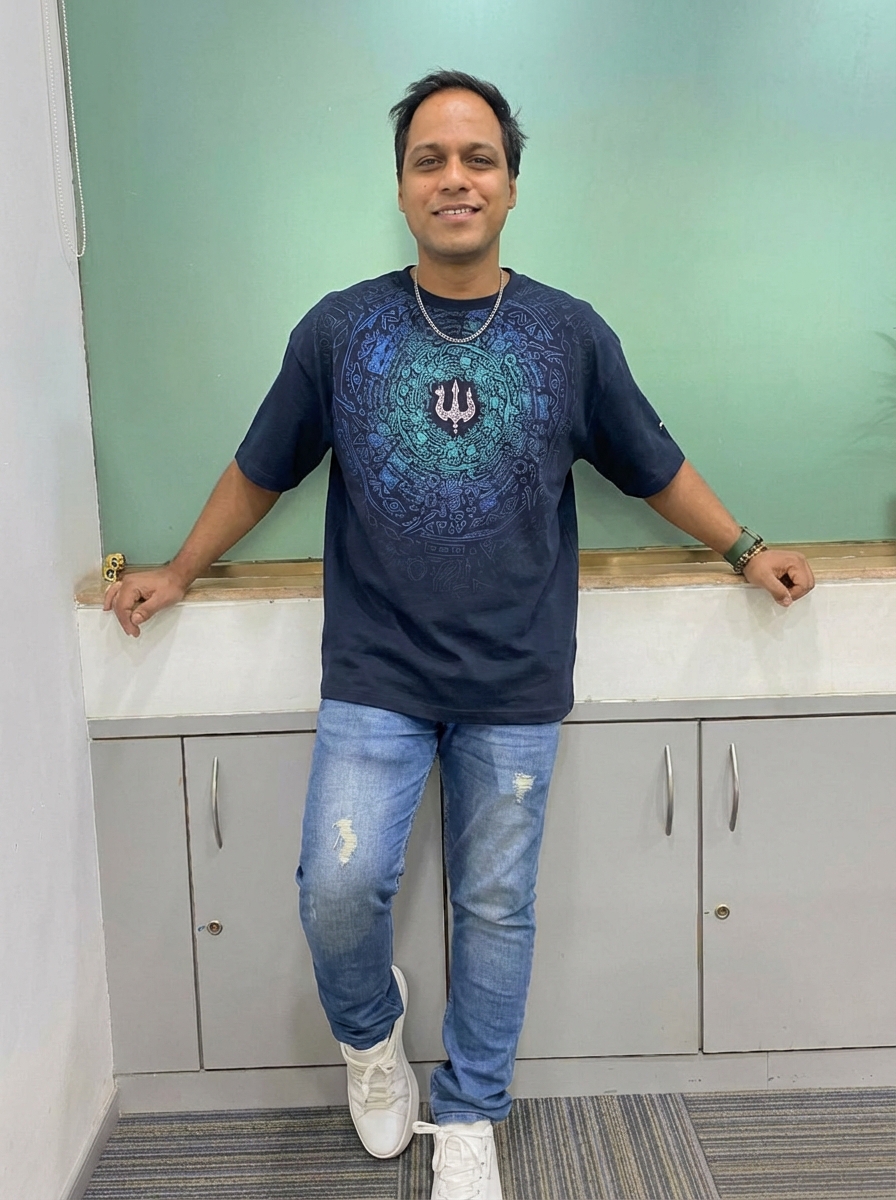
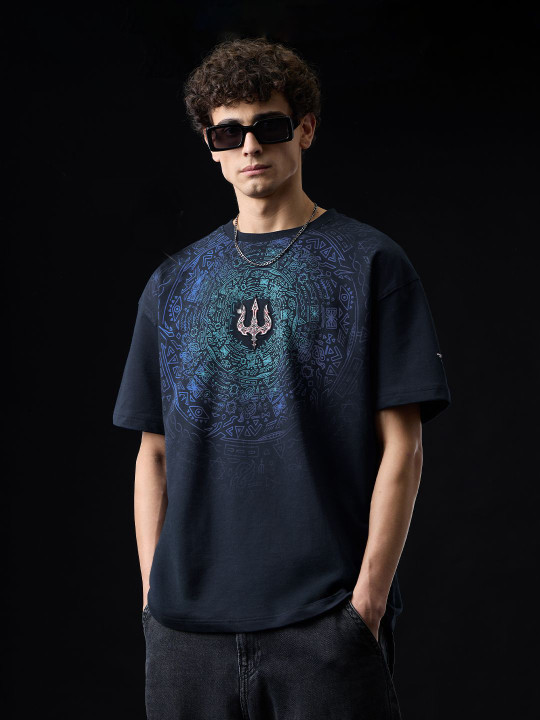
- **Fabric Physics:** The source garment is a heavyweight cotton jersey. It possesses a matte finish with low reflectivity (unlike the slight sheen of the user's current chambray shirt). Simulation must account for a structure that holds its shape slightly (stiff drape) rather than clinging tightly to the skin. Light absorption is high due to the dark navy/black base.
- **Key Features:**
- **Graphic Integrity:** The central intricate mandala-style print with the trident logo must remain centered on the chest and undistorted, aside from natural perspective wrapping.
- **Drop Shoulders:** The garment features a relaxed, drop-shoulder seam which must fall lower on the user's arm than his current fitted shirt seams.
- **Crew Neck:** The ribbed crew neck structure must replace the current open-collar button-down look.
- **Sleeve Volume:** The sleeves are wide and unstructured, distinct from the rolled-up sleeves currently worn by the user.
PHASE 2: FIT & DRAPE SIMULATION
- **Body Mapping:**
- **Leaning Posture:** The user is leaning back against a ledge with arms extended. Gravity dictates the hemline will not hang vertically plumb but will rest slightly against the lower abdomen/pelvis area.
- **Axillary Tension:** Because the arms are abducted (spread to the sides), the fabric must show tension folds radiating from the armpit area across the upper chest.
- **Sleeve Hang:** Unlike the fitted sleeves in the user image, the target oversized sleeves must hang loosely. The bottom of the sleeve cuff should droop downward due to gravity, creating a gap between the fabric and the user's tricep area.
- **Occlusion Handling:**
- **Necklace:** The user wears a thin silver chain. If the high crew neck of the target shirt does not cover this completely, the chain must be segmented and layered *over* the new garment.
- **Watch:** The watch on the left wrist is likely far enough down to be unaffected, but if the oversized sleeve extends past the elbow, strict depth ordering is required to ensure the watch remains visible if the fabric overlaps.
- **Ledge Interaction:** The rear hem of the shirt is effectively "pinched" between the user's lower back and the ledge/wall. The simulation must flatten the fabric at the contact point rather than letting it billow behind him.
PHASE 3: ENVIRONMENT & LIGHTING
- **Light Match:**
- **Direction:** The user image features diffuse, top-down office lighting (likely fluorescent). The source garment's high-contrast studio lighting (hard highlights) must be neutralized.
- **Shadow Fall:** Shadows on the new garment must cast softly downwards and inwards towards the torso center, mimicking the ambient occlusion seen on the user's current jeans.
- **Color Calibration:**
- The dark navy of the source shirt must be color-graded to match the ambient temperature of the room. It should pick up subtle greenish diffuse reflections from the prominent green wall background to ground the object in the scene. The cyan/teal graphics on the shirt must retain vibrancy but lose their artificial studio "glow."
PHASE 4: IDENTITY PROTECTION
- **Facial Lock:** The user's head, including the hairline, ears, jawline, and neck area above the suprasternal notch, must be completely frozen.
- **Body Integrity:** The user's torso width and posture must dictate the shape of the garment, not the model's physique. Do not slim the user or artificially broaden the chest muscles. The legs, jeans, and sneakers must remain the original pixels.