Thinking Process
PHASE 1: VISUAL DECONSTRUCTION
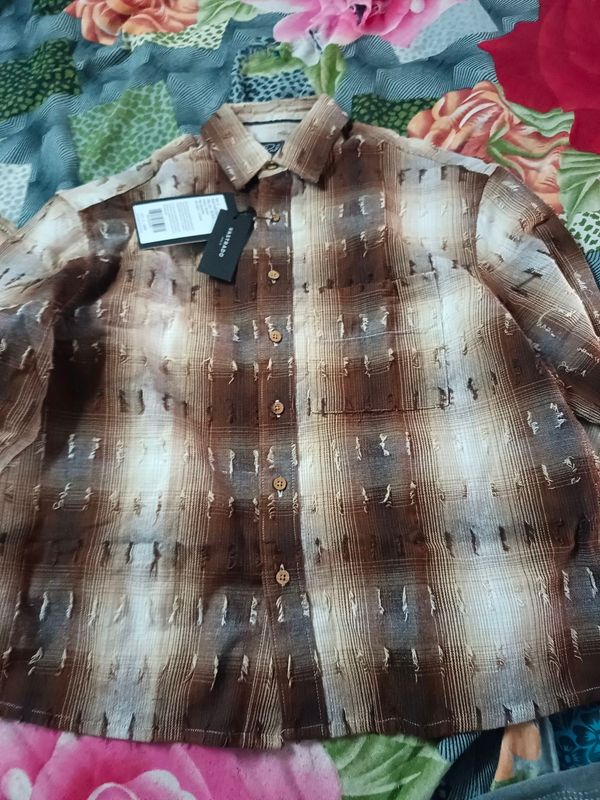
- **Fabric Physics:** The source garment is a textured, distressed flannel or heavy cotton blend with a visible surface pile (frayed/fringed loose thread texture). It possesses a matte finish with low specularity (non-reflective). The simulation must treat this as a medium-weight fabric that holds volume but is susceptible to gravity—it is not rigid like canvas, nor fluid like silk.
- **Key Features:**
- **Surface Texture:** The vertical "fringed" or "hairy" distressing across the plaid pattern is the defining visual characteristic and must be rendered with displacement mapping to avoid looking flat.
- **Hardware:** Standard 4-hole buttons (brown) down the center placket.
- **Structure:** A soft, semi-structured collar that must replace the current crew neckline.
- **Artifact Removal:** The black brand tags hanging from the collar and buttons on the source image must be digitally excised.
PHASE 2: FIT & DRAPE SIMULATION
- **Body Mapping:**
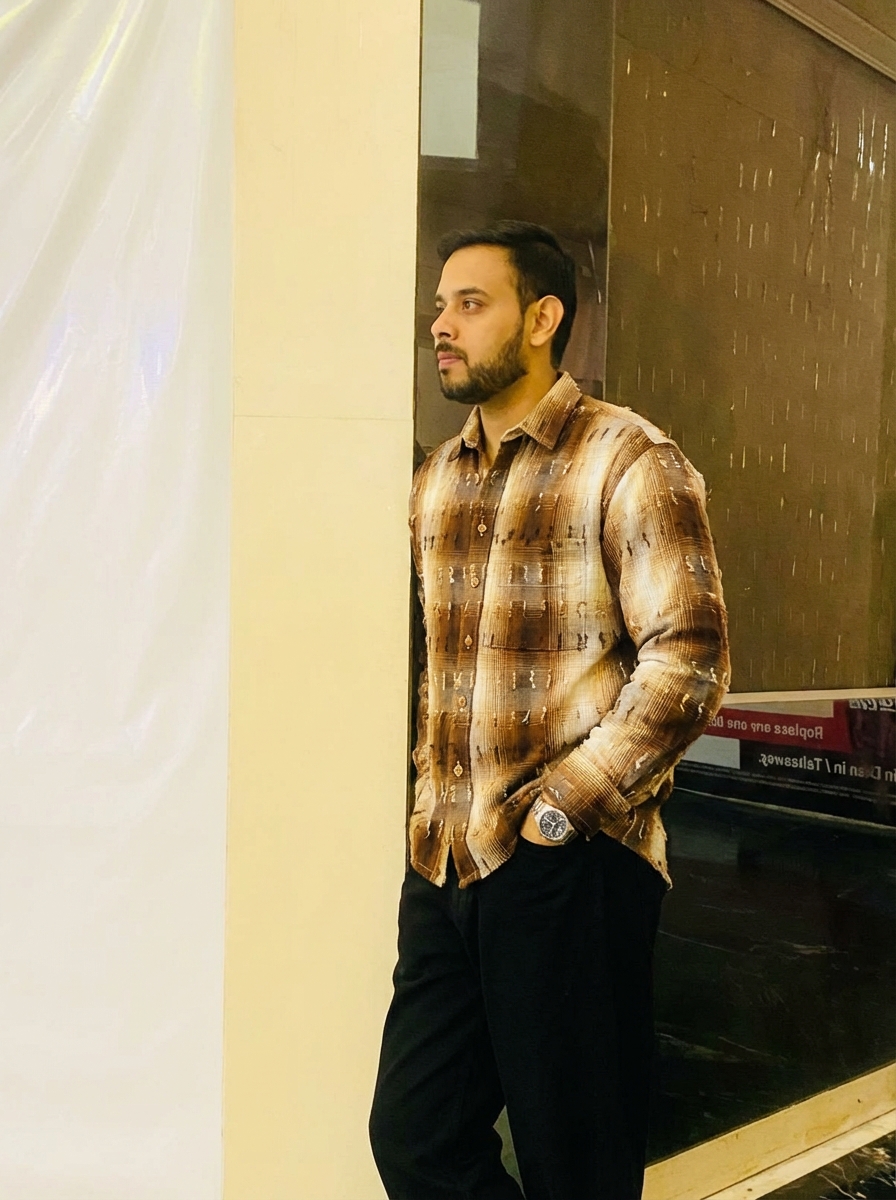
- **Pose Dynamics:** The user is leaning backward against a pillar. The new shirt must drape vertically relative to world-gravity, not the body's angle, causing the hemline to hang slightly away from the lower back/pants.
- **Shoulder & Chest:** The shirt needs to conform to the subject's deltoids but relax over the pectorals.
- **Left Arm Bunching:** Due to the severe bend of the left arm (hand on stomach), the fabric sleeve must demonstrate high-frequency compression wrinkles (bunching) at the inner elbow (antecubital fossa) and tension across the outer elbow.
- **Occlusion Handling:**
- **Primary Occlusion:** The user's **Left Hand and Watch** are positioned over the midsection. Masking must be precise to layer the new shirt *underneath* the hand and wrist.
- **Secondary Occlusion:** The lower hem of the shirt should naturally overlap the waistband of the black trousers, interacting with the slight bulge of the pocket where the hand rests.
PHASE 3: ENVIRONMENT & LIGHTING
- **Light Match:**
- **Source Lighting:** The user is in an indoor environment (likely a mall or lobby) with overhead, warm-toned artificial downlighting.
- **Shadow Projection:** The user's left forearm casts a significant shadow onto his current torso. This specific shadow map must be re-calculated and multiplied onto the plaid texture of the new shirt to ground the arm in 3D space.
- **Color Calibration:**
- The source cloth image has cool/neutral lighting (daylight or flash). The RGB values of the plaid shirt must be color-graded with a warmer (yellow/orange) tint to match the ambient temperature of the user's environment. The brightness should be lowered slightly to account for the indoor setting compared to the bright source photo.
PHASE 4: IDENTITY PROTECTION
- **Facial Lock:** Absolute freeze on the subject’s face, beard, hairline, and ear geometry. The neck skin must be blended seamlessly into the new collar, ensuring skin tone consistency.
- **Body Integrity:**
- **Volumetric Preservation:** The subject's shoulder width and torso volume must remain constant. No slimming or expansion algorithms are allowed.
- **Lower Body Lock:** The black trousers and sneakers are strictly off-limits for alteration; the generated shirt hem must terminate naturally without warping the pant waistline.