Thinking Process
PHASE 1: VISUAL DECONSTRUCTION
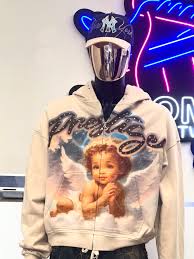
- **Fabric Physics:** The source garment is a heavy-weight cotton fleece hoodie. Unlike the user's current thin dress shirt, this material requires volumetric thickness simulation. It has a matte finish with low reflectivity, except for the rhinestone/stud embellishments on the "Prestige" text, which require high specular reflectivity to mimic light glinting off metal/glass.
- **Key Features:**
- The large "Prestige" script text with rhinestone studding across the upper chest.
- The central graphic print of the cherub/angel.
- The silver center zipper (must appear semi-open or closed depending on drape, but aligned centrally).
- Thick ribbed elastic cuffs and bottom hem.
- The hood structure, which must settle naturally around the neck/shoulders, replacing the current shirt collar.
PHASE 2: FIT & DRAPE SIMULATION
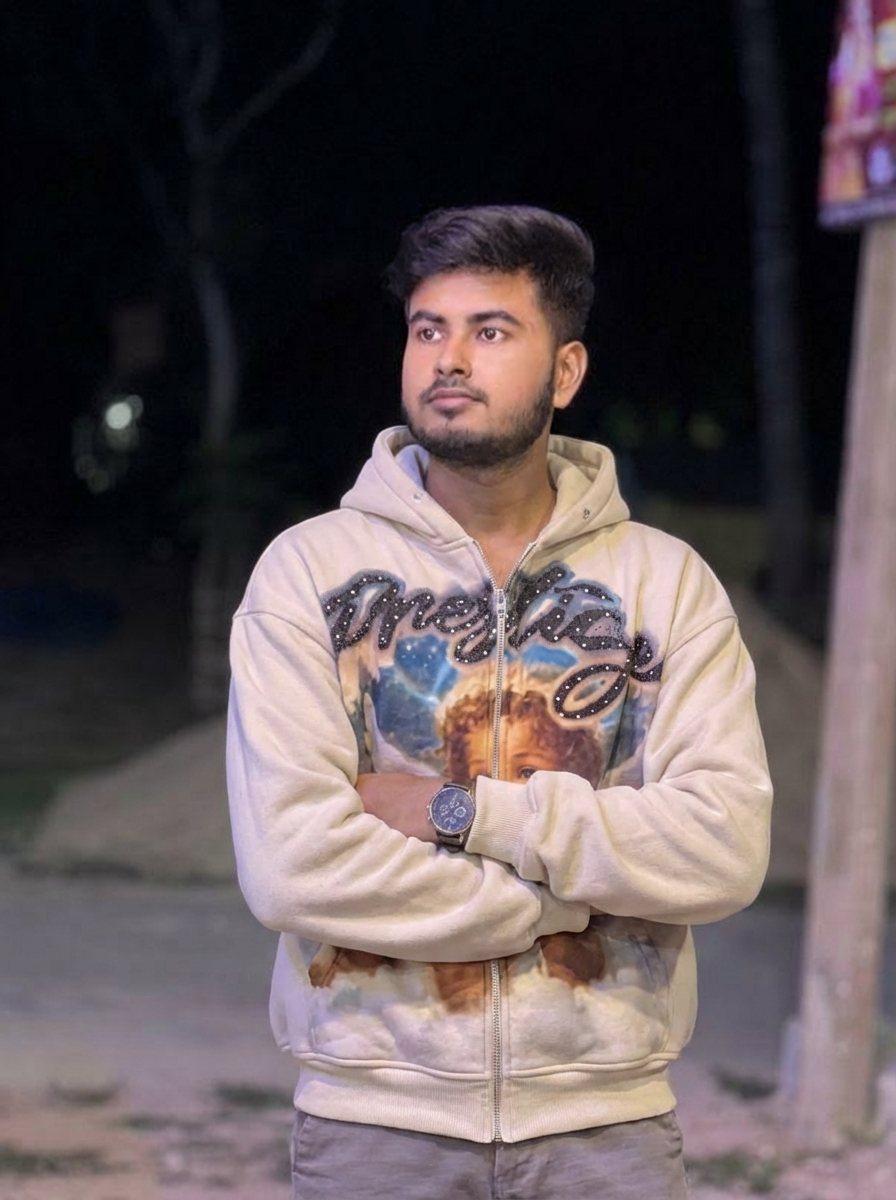
- **Body Mapping:** Due to the crossed-arm pose, the hoodie must exhibit significant compression and folding. The fabric must bunch heavily at the crook of the elbows and under the armpits. The large chest graphic will be partially obscured and distorted by the pressure of the crossed arms. The bottom hem of the hoodie should sit looser and lower than the current tucked-in shirt, likely covering the belt line unless bunched up by the arm position.
- **Occlusion Handling:** This is a high-complexity occlusion scenario. The user's bare forearms, hands, and the wrist watch on the left arm are the primary foreground layers. The hoodie canvas must be generated *behind* these elements. The hoodie sleeves must terminate or bunch behind the exposed forearms, ensuring the skin texture of the arms remains the top layer.
PHASE 3: ENVIRONMENT & LIGHTING
- **Light Match:** The user is in a low-light, nighttime outdoor environment with a cool, artificial light source coming from the front-left. The hoodie, currently lit by bright, flat retail lighting, must be significantly darkened. Deep ambient occlusion shadows must be cast *under* the user's crossed arms onto the hoodie's chest area to ground the garment.
- **Color Calibration:** The source image has a warm/yellow tint and neon reflection. This must be neutralized and shifted towards a cooler, desaturated tone to match the night photography. The bright cream color of the hoodie must be dimmed to avoid looking like it is "glowing" in the dark scene.
PHASE 4: IDENTITY PROTECTION
- **Facial Lock:** The user's face, hair, jawline, and neck must remain pixel-perfectly frozen. The boundary line occurs at the base of the neck where the hoodie material begins.
- **Body Integrity:** Strictly maintain the user's shoulder width and arm volume. Do not slim the torso. The final silhouette should actually appear slightly bulkier than the original image, as the hoodie is a thicker garment than the fitted shirt currently worn.