
Thinking Process
PHASE 1: VISUAL DECONSTRUCTION
- **Fabric Physics:** The source garment appears to be a medium-weight cotton or cotton-poplin blend with a matte finish. It possesses moderate stiffness, indicated by the crisp folds in the flat lay. It should exhibit diffuse reflection with very low specular highlights (no shine). The structural integrity allows for sharp creases at the collar and placket but soft, gravitational draping across the torso.
- **Key Features:**
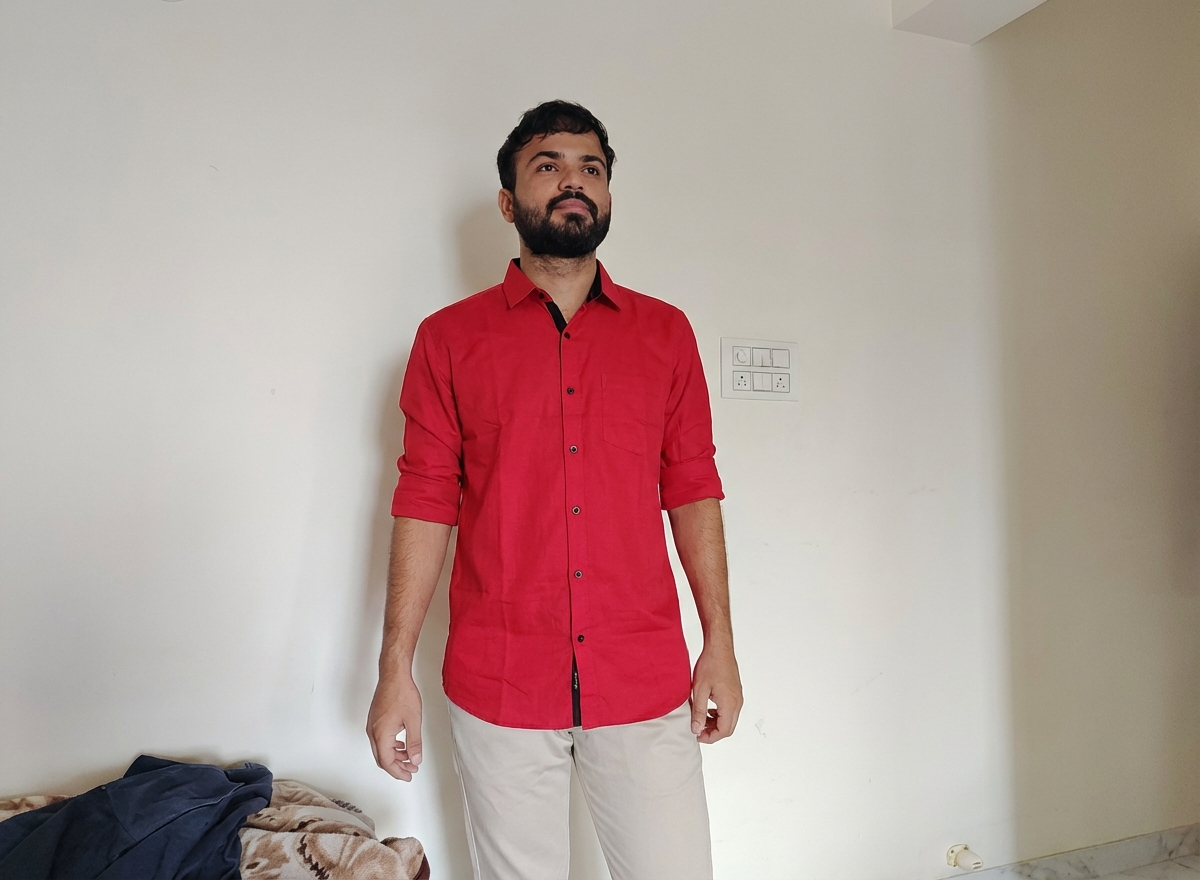
- **Contrast Details:** The inner collar stand is black, which must be visible if the top button is simulated open. The buttons are dark/black, requiring contrast preservation against the red fabric.
- **Sleeve Configuration:** The source image displays sleeves that are folded/rolled up with a specific cuff depth. This geometric folding pattern must be preserved rather than smoothing the sleeve into a standard long sleeve.
- **Pocket:** Single chest pocket on the wearer's left side.
- **Hemline:** Curved shirttail hem which must act as the termination point against the trousers.
PHASE 2: FIT & DRAPE SIMULATION
- **Body Mapping:**
- **Shoulder Alignment:** The yoke of the red shirt must align precisely with the user's shoulder slope.
- **Torso Drape:** The user has a relaxed standing posture. The fabric should fall vertically from the chest, skimming the midsection without clinging. Tension folds should appear radiating slightly from the axilla (armpit) due to the user's arms being held slightly away from the body.
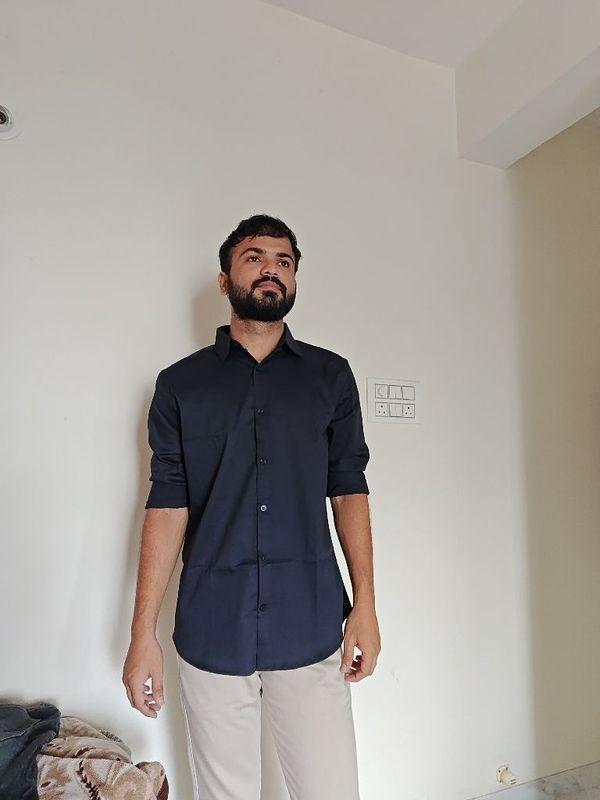
- **Sleeve Interaction:** Since both the user's current shirt and the source shirt feature rolled sleeves, the simulation must generate volumetric "bunching" of the red fabric just above the elbow, mimicking the friction hold on the bicep.
- **Occlusion Handling:**
- **Primary Layers:** The red shirt must strictly overlay the beige trousers at the waistline (untucked simulation).
- **Body Parts:** The user's forearms and hands are exposed. The rendering engine must mask the user's arms to ensure the new sleeve cuffs encircle the arm without the old navy blue fabric bleeding through the edges. The beard does not overlap the collar, simplifying neck occlusion.
PHASE 3: ENVIRONMENT & LIGHTING
- **Light Match:**
- **Source:** The user is in a room with soft, diffuse lighting coming from the top-left (indicated by the shadow on the wall to the user's right).
- **Simulation:** The red shirt must generate cast shadows onto the wall behind the user (right side) and self-shadowing under the collar, pocket, and sleeve rolls. The red value must respond to a slight fall-off of light towards the bottom right of the torso.
- **Color Calibration:** The source image is high-contrast studio lighting. The red albedo must be slightly desaturated and warmed to match the indoor color temperature of the user's environment (likely 3000K-3500K) to prevent the shirt from looking "pasted on" or fluorescent.
PHASE 4: IDENTITY PROTECTION
- **Facial Lock:** Absolute freeze on the Region of Interest (ROI) from the neck up: chin, beard, mouth, nose, eyes, hair, and ears. The boundary between the user's neck skin and the new collar must be seamless.
- **Body Integrity:** The user's shoulder width, arm thickness, and torso volume must remain unchanged. No warping or slimming filters are allowed. The skin texture and tone of the visible forearms and hands must remain original pixel data.