
Thinking Process
PHASE 1: VISUAL DECONSTRUCTION
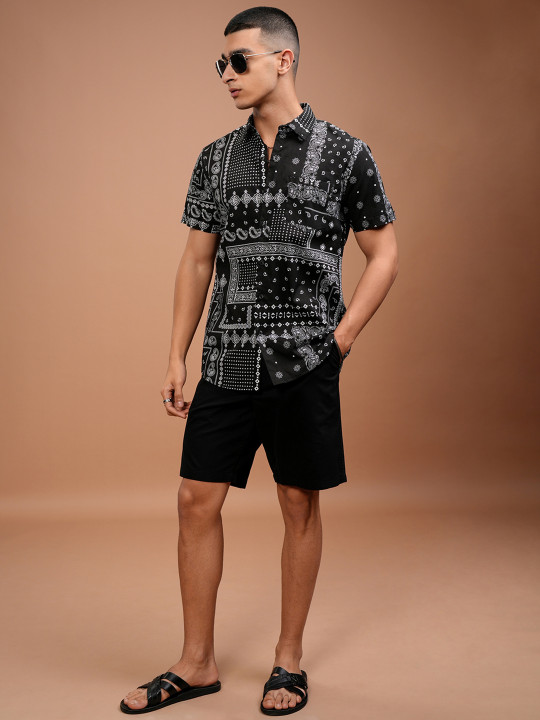
- **Fabric Physics:** The source garment appears to be a lightweight viscose or soft cotton blend with a fluid drape. Unlike the user's current heavy knit sweater, this fabric has low structural rigidity. It should exhibit a semi-matte finish with soft specular highlights on the folds, reacting dynamically to movement rather than holding a stiff shape.
- **Key Features:** The complex monochromatic paisley/bandana patchwork print must be preserved without distortion at the seams. Critical elements include the camp collar (open neck structure), the chest pocket on the wearer's left, the black buttons on the placket, and the relaxed short-sleeve hemline.
PHASE 2: FIT & DRAPE SIMULATION
- **Body Mapping:** Due to the user's leaning pose against the railing, the fabric must simulate gravity pulling downwards and slightly away from the torso where he leans forward. The shirt is short-sleeved, whereas the user currently wears long sleeves; the simulation must successfully inpaint/generate realistic skin texture for the user's forearms and elbows, replacing the thick grey wool. The collar area needs to transition from the current high crew neck to an open V-neck, requiring realistic neck geometry generation.
- **Occlusion Handling:** The black metal railing in the foreground is a hard occlusion layer; the shirt's hem must terminate naturally behind it. The user's right hand (resting near the waist) and left forearm (resting on the rail) are critical occlusion points. The garment must be masked *behind* the right hand and fingers, ensuring the fabric bunches slightly where the hand presses against the torso.
PHASE 3: ENVIRONMENT & LIGHTING
- **Light Match:** The user is situated in diffuse, soft outdoor daylight (likely shade or overcast) with ambient greenery. The source garment's high-contrast studio lighting must be neutralized. Shadows on the new shirt should be soft and diffuse, originating from above/front-left to match the user's face shading.
- **Color Calibration:** The stark black and white of the source shirt must be color-graded to match the ambient temperature of the target image. The black levels should be lifted slightly to match the dynamic range of the user photo, avoiding a "crushed black" look, and a subtle cool/green tint should be applied to the white print to reflect the surrounding foliage.
PHASE 4: IDENTITY PROTECTION
- **Facial Lock:** The user's entire head, including hair volume, facial hair, jawline, and ears, must remain pixel-perfectly frozen.
- **Body Integrity:** The user's shoulder width and torso volume must be preserved. While the new fabric is thinner than the original sweater (suggesting a slightly closer fit), the underlying body mesh must not be slimmed or warped. The skin tone generated for the exposed arms must perfectly match the user's face and hands.