Thinking Process
PHASE 1: VISUAL DECONSTRUCTION
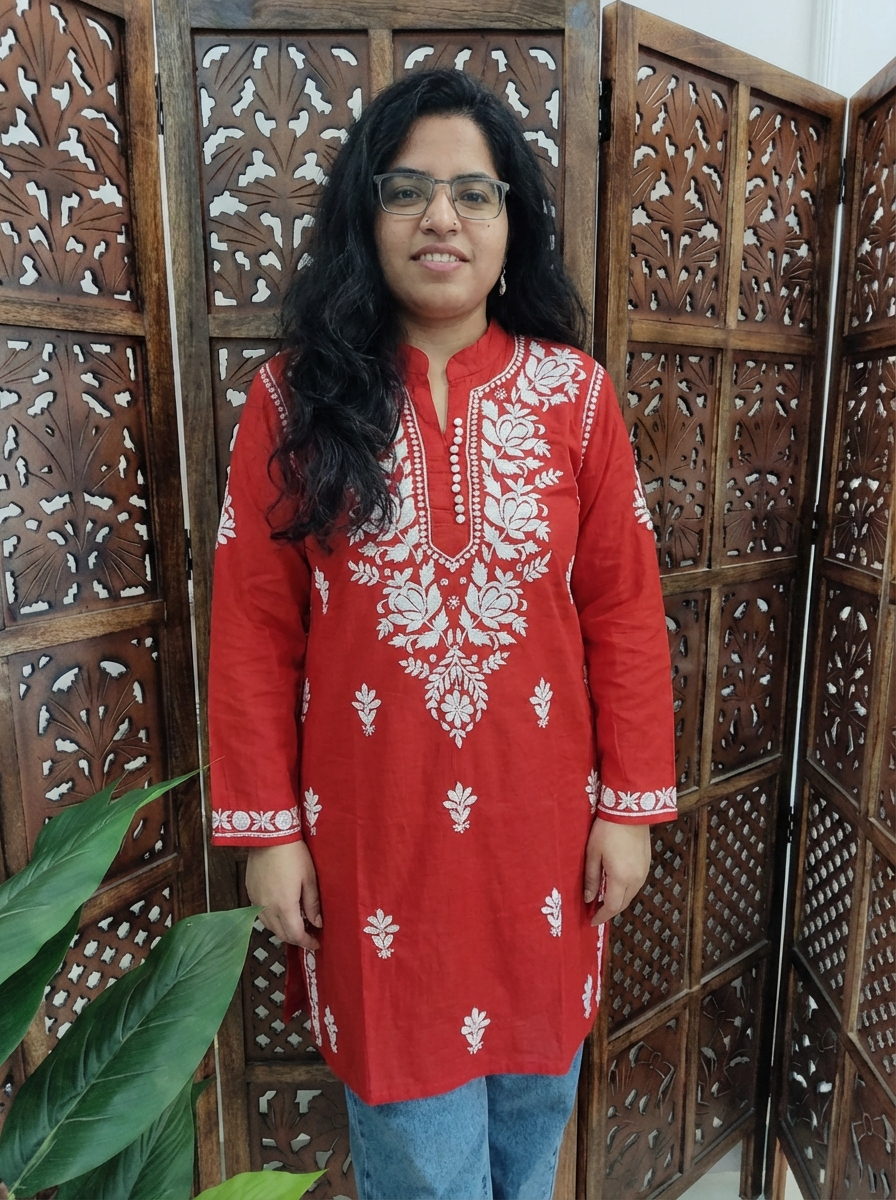
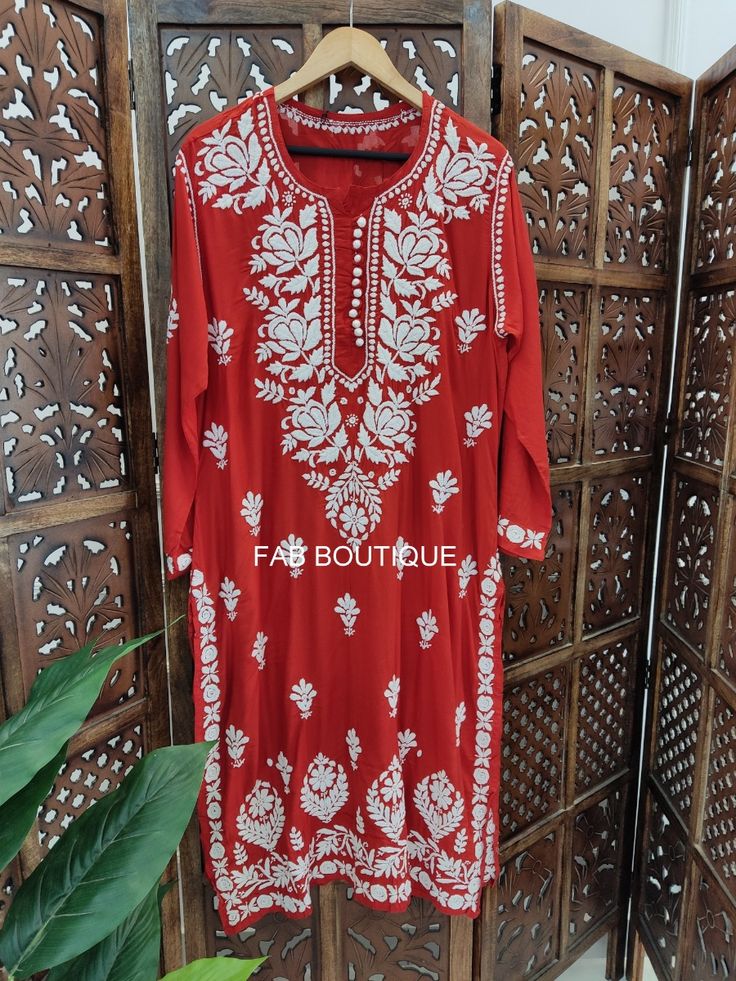
- **Fabric Physics:** The source garment appears to be a cotton or cotton-georgette blend commonly used for Kurtis. It has a matte finish with zero specularity (shine). The fabric possesses medium weight; it is structured enough to hold the shape of the mandarin collar but soft enough to drape vertically without rigid creasing. The white embroidery adds localized stiffness and surface texture (displacement) that must render as raised threads, not a flat print.
- **Key Features:**
- **Embroidery:** Intricate white Chikankari-style floral patterns on the chest, neckline, and hem must be preserved with high contrast against the red base.
- **Neckline:** The mandarin collar with a V-notch and the vertical button placket are critical focal points.
- **Silhouette:** This is a long tunic (Kurti); the hemline extends significantly lower than the user's current shirt, likely to mid-thigh or knee level.
- **Sleeves:** Long sleeves with embroidered cuffs.
- **Watermark:** The "FAB BOUTIQUE" text overlay on the source image must be disregarded and not transferred to the generated texture.
PHASE 2: FIT & DRAPE SIMULATION
- **Body Mapping:**
- **Shoulders & Bust:** The garment must align with the user’s shoulder width. The fabric should drape naturally over the bust, falling vertically from the widest point of the chest rather than cinching at the waist (characteristic of Kurti fits).
- **Length Extension:** Unlike the user's current tucked/short top, the simulation must extend the fabric down over the hips and upper thighs. The fabric physics must simulate the transition from the torso to the hips, allowing for side slits if implicit in the cut, ensuring the fabric doesn't clip through the jeans.
- **Sleeve Interaction:** The sleeves should follow the user's arm position, gathering slightly at the elbow due to the relaxed bend of the arms.
- **Occlusion Handling:**
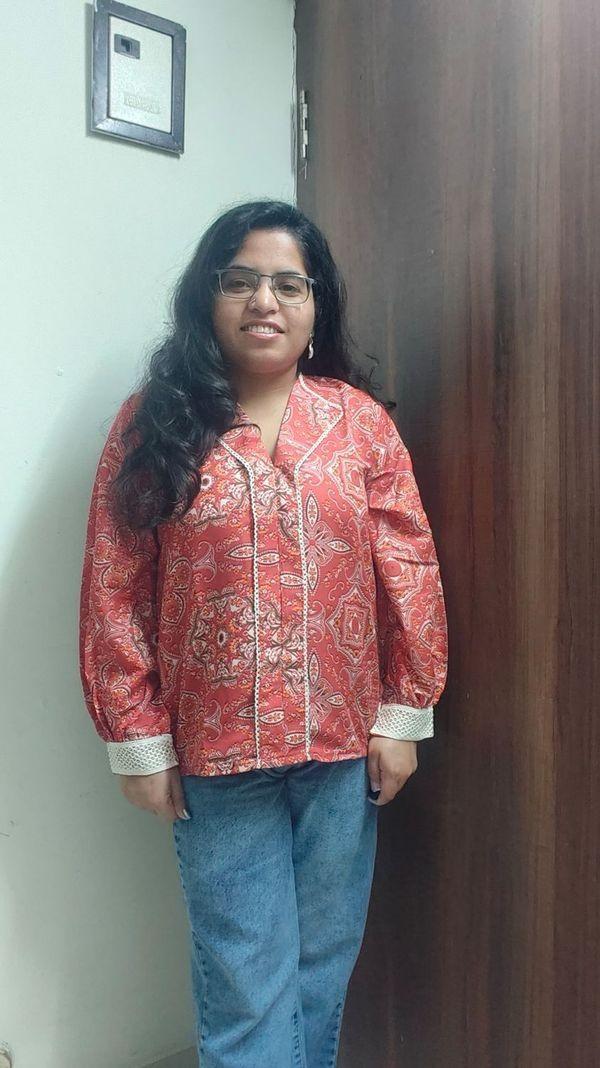
- **Hair Masking:** **CRITICAL.** The user has voluminous, dark wavy hair cascading over both shoulders and the upper chest. The new Kurti must be generated *underneath* these hair layers. A high-precision segmentation mask is required for the hair to ensure the red fabric does not paste over the black locks.
- **Hands:** The user's hands are positioned at the thigh level. Since the Kurti is long, the hemline will likely interact with the hands. The fabric must fall *behind* the fingers/wrists if the length reaches them.
PHASE 3: ENVIRONMENT & LIGHTING
- **Light Match:** The user's environment has soft, diffuse indoor lighting, likely from a ceiling source (casting soft shadows downwards). The source garment is brightly lit with high saturation. The generated garment's brightness must be lowered slightly, and the contrast softened to match the "living room" ambience. Shadows must be generated under the collar and where the hair falls onto the fabric.
- **Color Calibration:** The source red is very vibrant. To avoid a "sticker effect," the red channel must be color-graded to interact with the slightly cool/greenish cast of the user's room lighting. The white embroidery should reflect the ambient room tone (slightly off-white) rather than remaining pure #FFFFFF.
PHASE 4: IDENTITY PROTECTION
- **Facial Lock:** Absolute preservation of the user's face, including the glasses, earrings, nose ring, and hairline. The jawline transition to the neck must remain untouched.
- **Body Integrity:** The user has a distinct body shape. The simulation is strictly forbidden from "slimming" the waist or altering the width of the hips. The Kurti must adapt to her volume, not the other way around. The visible portions of the jeans (below the new hemline) must remain unchanged in texture and shape.