Thinking Process
PHASE 1: VISUAL DECONSTRUCTION
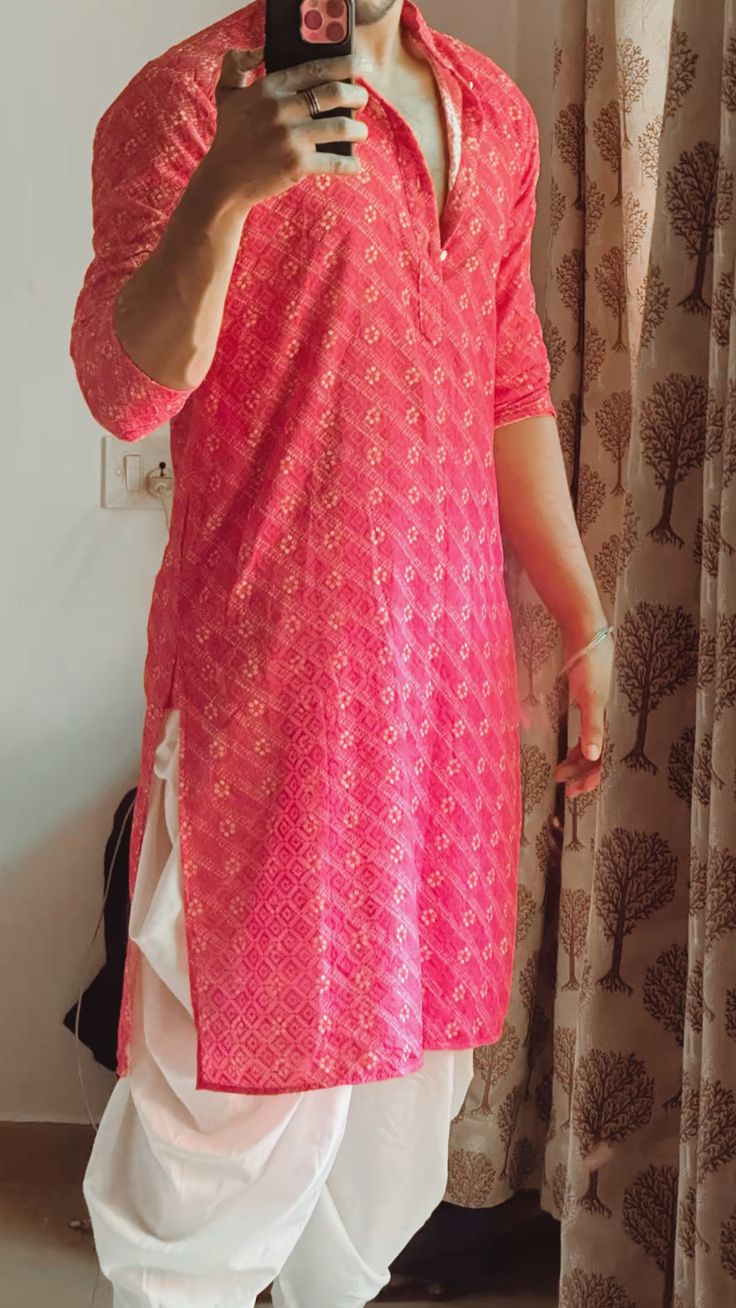
- **Fabric Physics:** The source garment is a traditional Kurta, likely composed of cotton or a cotton-silk blend. It possesses medium-weight drape properties—lighter than the user's current leather jacket but stiffer than a jersey t-shirt. The material has a semi-matte finish with specular highlights visible on the geometric diamond pattern (likely gold or silver thread), which should catch the light aggressively under the target image's flash photography.
- **Key Features:**
- **Mandarin Collar & Placket:** The stand-up collar and the unbuttoned V-shape neckline must be preserved.
- **Pattern Continuity:** The diagonal geometric diamond pattern must wrap correctly around the torso volume without warping unrealistically.
- **Sleeve Styling:** The source sleeves are rolled up to the mid-forearm. This styling should be maintained, requiring the generation of forearm skin texture where the current leather jacket covers the user's arms.
- **Hemline:** This is a long tunic (Kurta); the hemline extends to the mid-thigh/knee, unlike the current waist-length jacket.
PHASE 2: FIT & DRAPE SIMULATION
- **Body Mapping:**
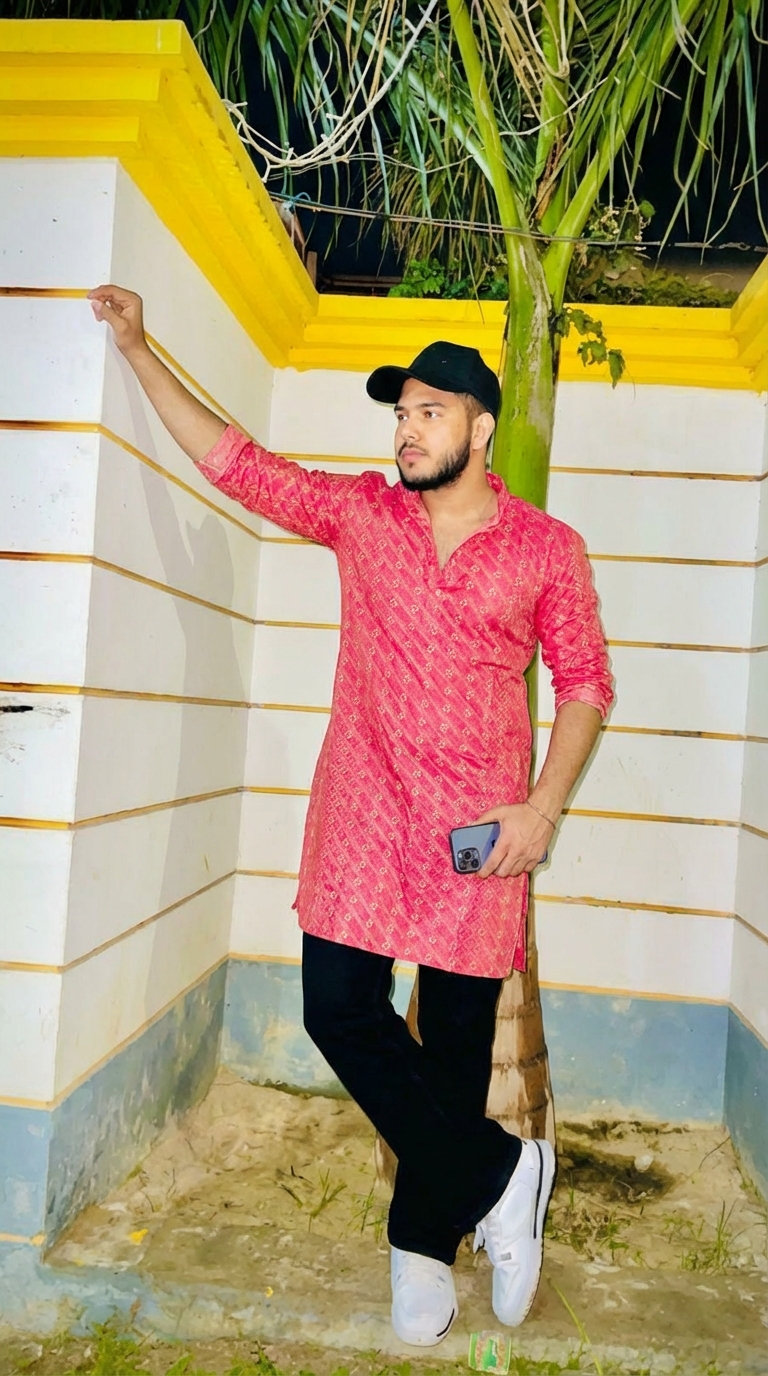
- **Right Arm (Raised):** The user's right arm is extended upward against the wall. The Kurta fabric must experience tension/pulling from the right armpit down to the waist. The shoulder seam must elevate significantly. Gravity will cause the sleeve to slide slightly down towards the shoulder.
- **Left Arm (Bent):** The fabric must compress and fold heavily at the inner left elbow (ante-cubital fossa).
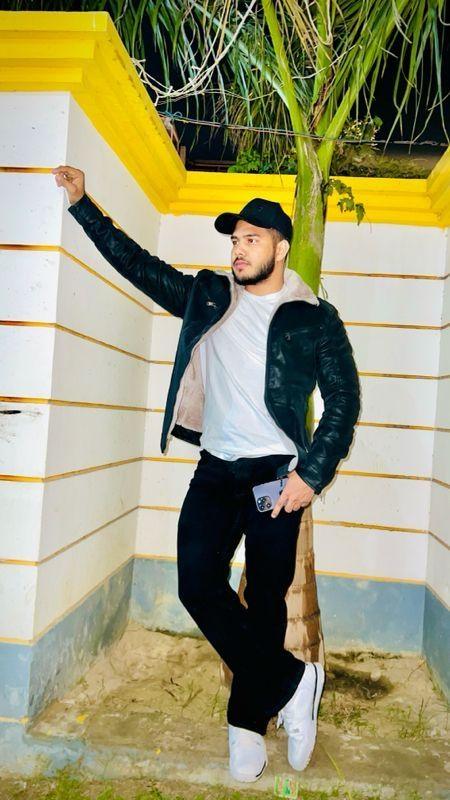
- **Torso Volume Correction:** The user is currently wearing a bulky leather jacket. The simulation must estimate the slimmer body volume underneath to ensure the Kurta fits the user's actual frame, not the "puffed" silhouette of the leather jacket.
- **Lower Drape:** As the Kurta is long, the fabric must flow past the waist belt, covering the upper portion of the black jeans. It should hang vertically due to gravity, creating a gap between the fabric and the user's leaning torso on the lower right side.
- **Occlusion Handling:**
- **Left Hand & Phone:** The user's left hand and the phone (blue case) overlap the hip area. The new long Kurta hemline must pass *behind* this hand/phone complex, or draped around it if the fit is loose.
- **Beard:** The user's beard overlaps the current collar region; the new mandarin collar must sit *under* the beard line.
PHASE 3: ENVIRONMENT & LIGHTING
- **Light Match:** The target environment utilizes a harsh, direct frontal flash (camera-on-flash), creating high contrast and hard shadows.
- **Shadow Generation:** A hard, distinct drop shadow must be cast by the Kurta onto the white wall behind the user, mimicking the current shadow of the jacket.
- **Surface Scattering:** The folds of the Kurta needs sharp transitions between light and dark (high hard-light response) to match the flash photography style.
- **Color Calibration:** The target image has cool/neutral night lighting with a white flash balance. The source image is warm/indoor. The pink/red of the Kurta must be color-corrected to appear vibrant but naturally illuminated by a white flash, removing the yellow indoor cast from the source.
PHASE 4: IDENTITY PROTECTION
- **Facial Lock:** The user's facial geometry, facial hair (beard/mustache), and the black cap must remain pixel-perfectly frozen.
- **Body Integrity:** The user's lean pose and leg position must remain unaltered. Crucially, the "slimming" effect of removing the leather jacket must result in a natural anatomical estimation of the torso; do not warp the user's shoulder width or neck alignment. The skin tone generated for the exposed forearms (due to rolled sleeves) must match the user's facial skin tone.