Thinking Process
PHASE 1: VISUAL DECONSTRUCTION
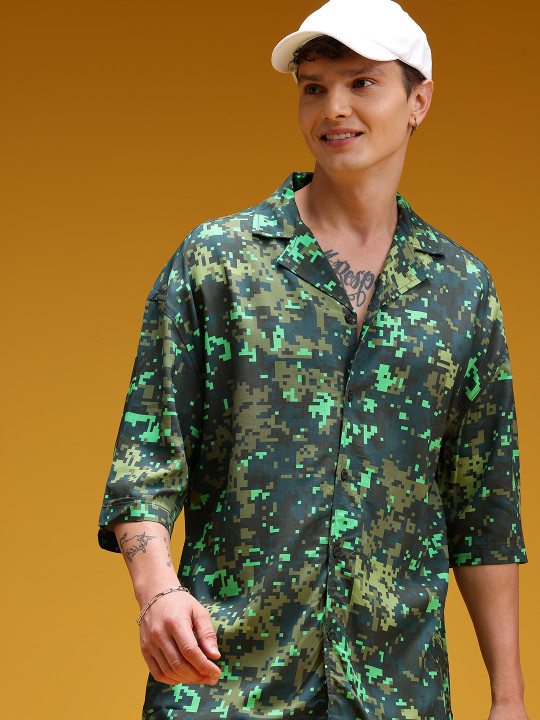
- **Fabric Physics:** The source garment appears to be a lightweight Viscose or Rayon blend with a "camp collar" cut. It possesses low structural rigidity, characterized by a fluid drape and soft, rolling folds rather than crisp creases. The surface texture is matte to semi-satin; it should diffuse light softly without high-gloss specularity, reacting to movement with fluid ripples.
- **Key Features:** The distinctive "digital pixel" camouflage pattern (neon green/forest green/black) must remain dimensionally accurate without stretching. Critical structural elements to preserve include the open notch lapel (camp collar), the drop-shoulder seam placement, the elbow-length sleeves, and the black button contrast against the green placket.
PHASE 2: FIT & DRAPE SIMULATION
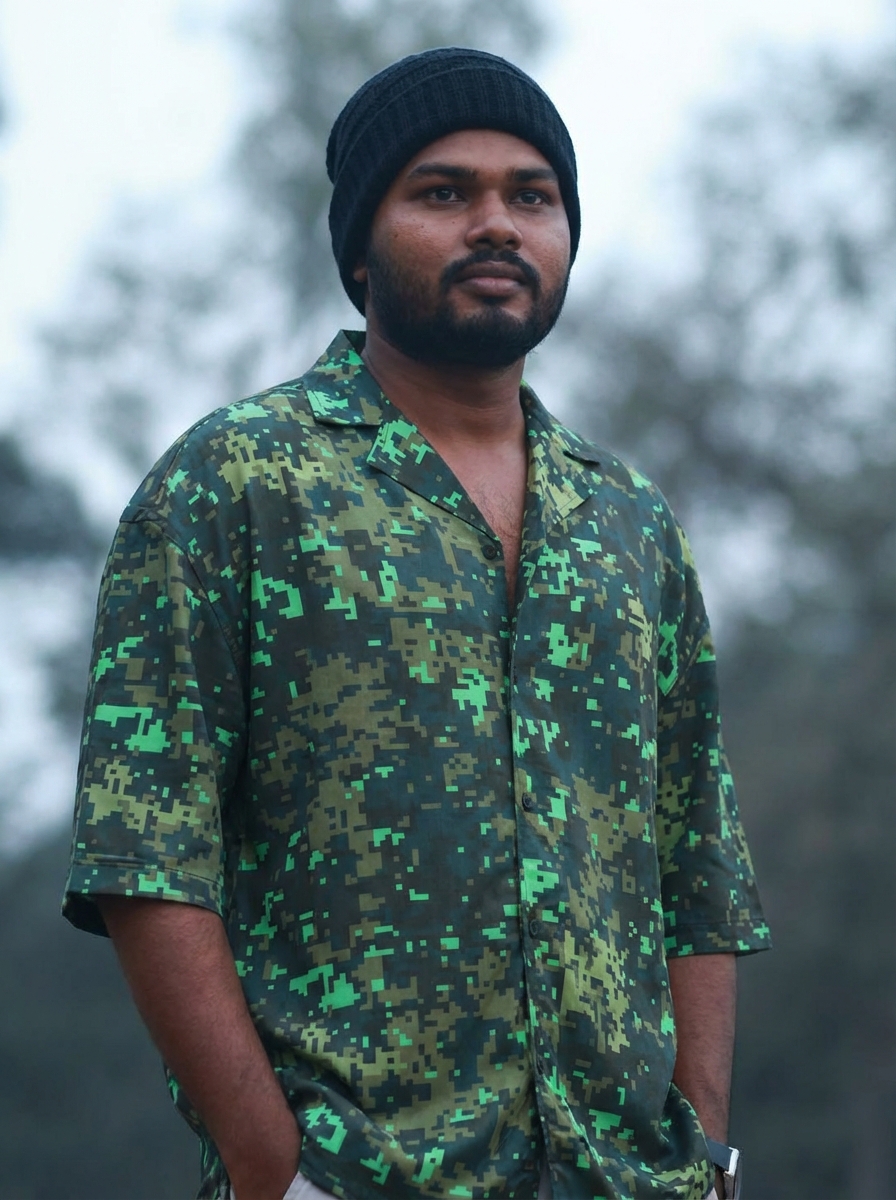
- **Body Mapping:** **CRITICAL CHALLENGE:** The user is currently wearing a high-volume puffer jacket. The simulation must estimate the user's actual torso geometry beneath this bulk. The target shirt is relaxed-fit but will have significantly less volume than the source jacket. The fabric must hang vertically from the estimated shoulder line, tapering closer to the torso than the current jacket, while allowing for bunching at the elbow crooks where the user's arms are bent.
- **Occlusion Handling:** The user's hands appear to be in pockets or resting at the waist; the shirt hemline must interact naturally with this posture (bunching slightly at the wrist/waist insertion point). The hood of the current jacket frames the face; since the new shirt has no hood, the area currently occupied by the puffer hood behind the neck and ears will require background inpainting or the retention of the beanie/hat layer only.
PHASE 3: ENVIRONMENT & LIGHTING
- **Light Match:** The target environment features soft, diffuse, cool-toned outdoor lighting (overcast/blue hour), whereas the source cloth is under warm, directional studio lighting. The warm yellow cast must be neutralized and shifted to a cooler, desaturated palette. Shadows on the shirt must be soft and ambient (contact shadows) rather than hard directional cast shadows, matching the flat lighting on the user's face.
- **Color Calibration:** The neon greens in the pixel camo must be slightly desaturated and color-graded to match the low-contrast, atmospheric haze of the outdoor background. The black values in the shirt pattern should match the black point of the user's facial hair, not the deep black of the current puffer jacket (which is darker due to material density).
PHASE 4: IDENTITY PROTECTION
- **Facial Lock:** The user's facial structure, beard texture, skin tone, smile lines, and the visible beanie hat must be frozen. The boundary between the beard and the new open collar must be seamless.
- **Body Integrity:** While the artificial bulk of the puffer jacket must be removed to show the shirt correctly, the user's underlying shoulder width and chest dimensions must not be artificially slimmed. The simulation must respect the user's organic build, ensuring the shirt looks like an oversized fit on a medium-build body, not a fitted shirt on a slim body.