Thinking Process
PHASE 1: VISUAL DECONSTRUCTION
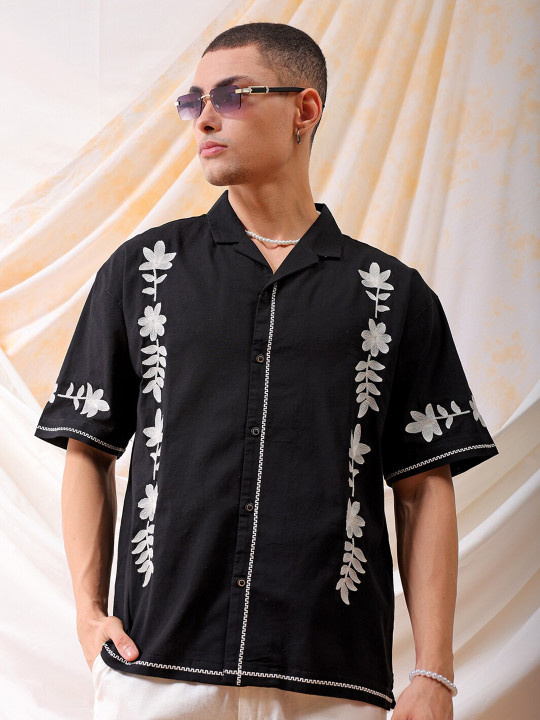
- **Fabric Physics:** The source garment is a structured cotton or linen blend with a matte finish. Unlike the user's current soft-knit t-shirt, this material has higher bending resistance. It should not cling tightly to the musculature but rather maintain a boxy, relaxed silhouette. Light reflection should be diffuse with no specular highlights, appearing deep black rather than grey.
- **Key Features:** The vertical white floral embroidery strips on both frontal panels are the critical visual anchor and must preserve their high-contrast definition. The "Camp Collar" (open neck) structure must be generated to replace the current crew neck. The geometric white stitching on the sleeve cuffs and bottom hemline must remain sharp.
PHASE 2: FIT & DRAPE SIMULATION
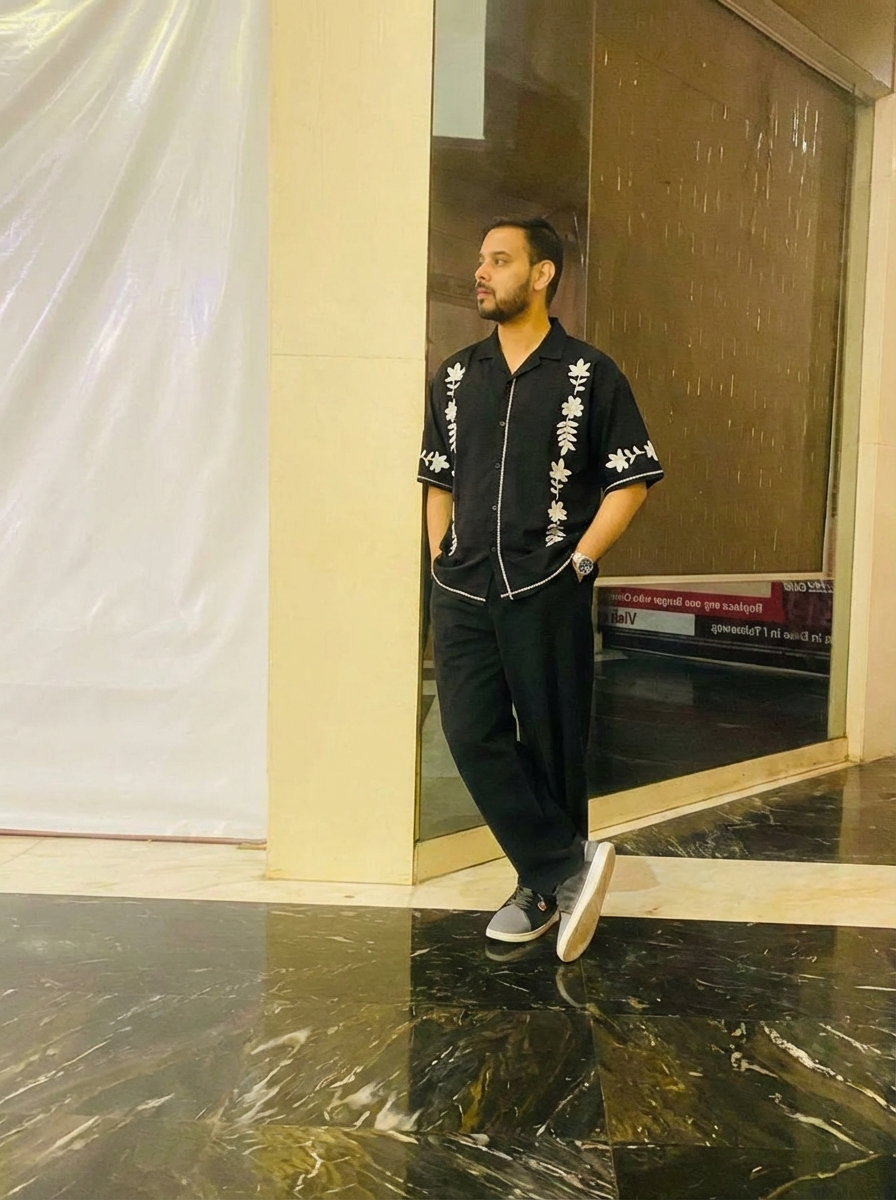
- **Body Mapping:** Due to the user leaning back against the glass/wall surface, the back of the garment must flatten against the scapula and lumbar region. The front of the shirt should hang relatively straight due to the boxy cut, but gravity will pull the fabric slightly toward the user's left side (viewer's right) due to the tilt of the torso. The open collar must lie flat against the clavicle area, requiring the generation of skin texture where the current t-shirt covers the upper chest.
- **Occlusion Handling:** The user's left arm (viewer's right, wearing the watch) is bent. The new shirt has elbow-length sleeves; the sleeve hem must sit clearly *above* the watch and forearm, ensuring the watch remains fully visible. The user's right arm (viewer's left) is pressed against the wall; the sleeve on this side must compress slightly against the surface. The bottom hem of the shirt should drape *over* the waistline of the trousers, potentially obscuring the top of the pockets.
PHASE 3: ENVIRONMENT & LIGHTING
- **Light Match:** The user environment features warm, overhead artificial lighting (tungsten bias), creating downward casting shadows. The stark white embroidery of the source shirt must be color-graded to accept this warm yellow cast to avoid looking "pasted on." The black fabric must generate deep ambient occlusion shadows in the folds, particularly under the armpits and inside the open collar.
- **Color Calibration:** The source image is high-key studio lighting (cool/neutral). The target environment is low-key and warm. The black levels of the shirt must be matched to the black levels of the user's trousers to ensure tonal consistency. Crucially, the reflection of the garment on the marble floor must be updated from beige to black.
PHASE 4: IDENTITY PROTECTION
- **Facial Lock:** The user's entire head, including the beard, jawline, and neck structure, must be frozen. The hairline and ears must remain untouched.
- **Body Integrity:** The user's shoulder width and arm volume must remain constant. Do not slim the torso; the boxy fit of the new shirt should actually add slight volume compared to the current fitted t-shirt. The user's crossed-leg pose and hand placement on the thigh must be preserved exactly.