Thinking Process
PHASE 1: VISUAL DECONSTRUCTION
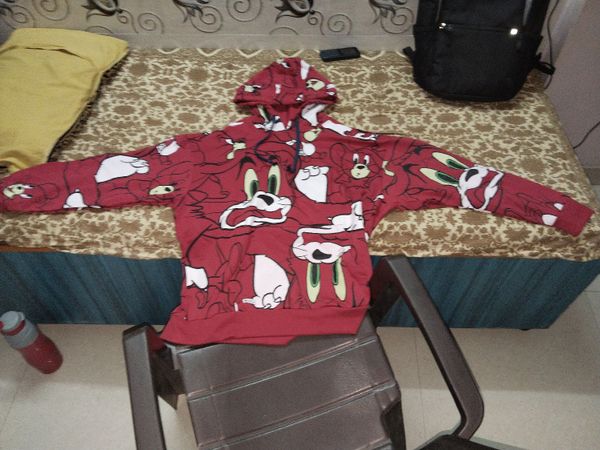
- **Fabric Physics:** The source garment is a knit cotton-blend jersey (hoodie material). Unlike the user's current crisp woven shirt, this material has high volumetric weight and soft deformation properties. It is matte, meaning it should diffuse light with low specularity (no shine). It must exhibit "puffiness" where the fabric folds, particularly around the hood and cuffs.
- **Key Features:** The all-over "Jerry Mouse" graphic print must be preserved without distortion that defies physics. The dark drawstrings at the neck, the ribbed elastic cuffs, the ribbed bottom hem, and the attached hood structure behind the neck are critical anchors for realism.
PHASE 2: FIT & DRAPE SIMULATION
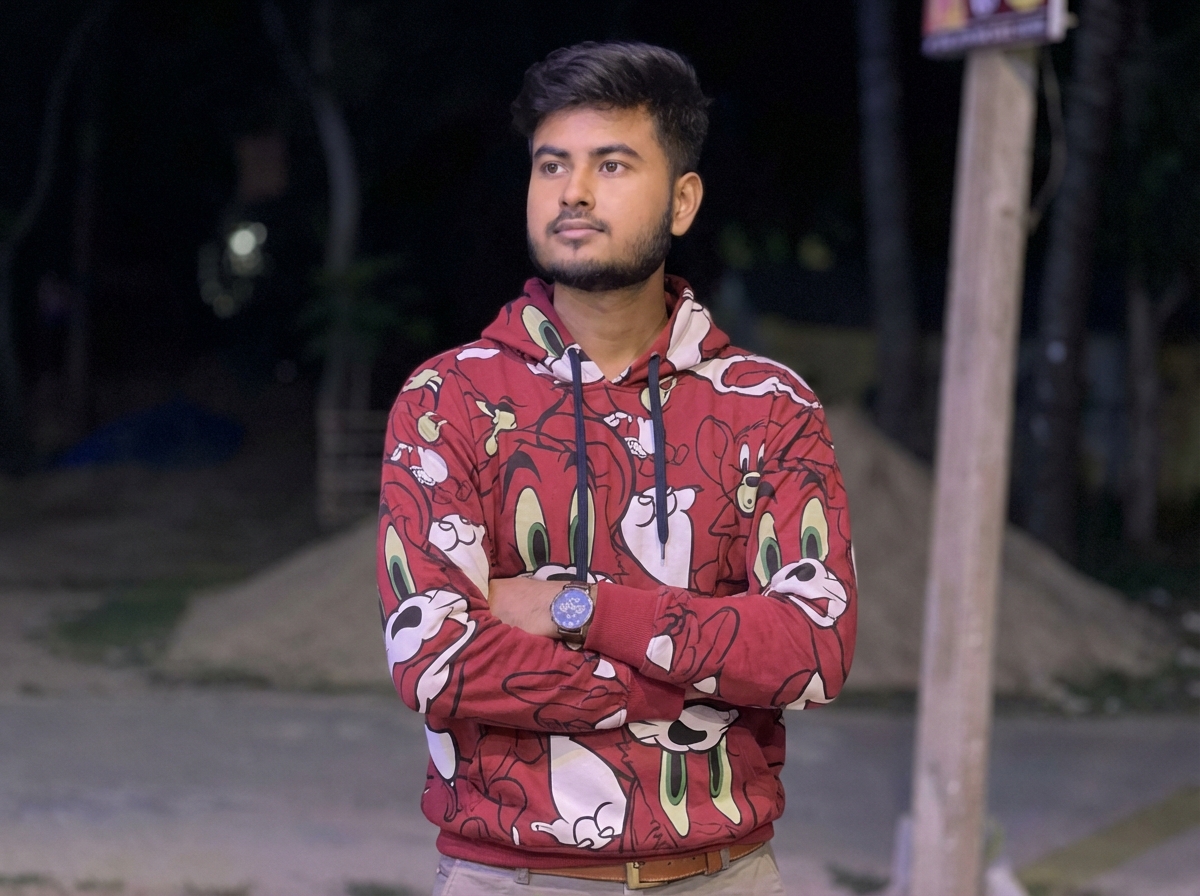
- **Body Mapping:** The user is in a "closed" pose with arms crossed. This requires high-tension simulation. The fabric must pull tight across the deltoids and upper back. Significant transverse wrinkling and compression must occur at the inner elbows where the material is pinched. The hoodie body will naturally bunch up slightly above the crossed forearms, creating horizontal folds across the chest. The bottom hem should hang loose, likely covering the belt line, unlike the currently tucked-in shirt.
- **Occlusion Handling:** This is a high-complexity occlusion scenario. The user's forearms and hands are crossing *over* the torso. The hoodie texture must be applied to the chest area *behind* the arms, and on the sleeves *around* the arms. The wristwatch on the left wrist must be segmented out and layered strictly **on top** of the new hoodie sleeve (or the sleeve pushed up to reveal it).
PHASE 3: ENVIRONMENT & LIGHTING
- **Light Match:** The user image is a low-light, nighttime outdoor scene with soft, artificial illumination coming from the front-left. The source garment is currently lit by flat, warm indoor overhead lighting. The hoodie's brightness must be lowered significantly to match the exposure of the target scene. Shadows must be generated under the crossed arms and inside the hood cavity.
- **Color Calibration:** The source image has a warm/yellow cast. This must be neutralized and shifted towards the cooler, slightly blue-magenta ambient tone of the user's nighttime environment. The vibrant red of the hoodie must be desaturated slightly to account for the lower light levels (Purkinje effect simulation).
PHASE 4: IDENTITY PROTECTION
- **Facial Lock:** The entire head region—including the specific hairstyle volume, beard texture, jawline definition, and skin tone—must be frozen. The neck area needs careful blending where the hoodie collar replaces the shirt collar.
- **Body Integrity:** The user's shoulder width and arm volume must be respected. Do not slim the user; in fact, the silhouette should expand slightly to account for the thickness of the fleece material compared to the thin dress shirt. The trousers and background elements must remain pixel-perfectly unchanged.