Thinking Process
PHASE 1: VISUAL DECONSTRUCTION
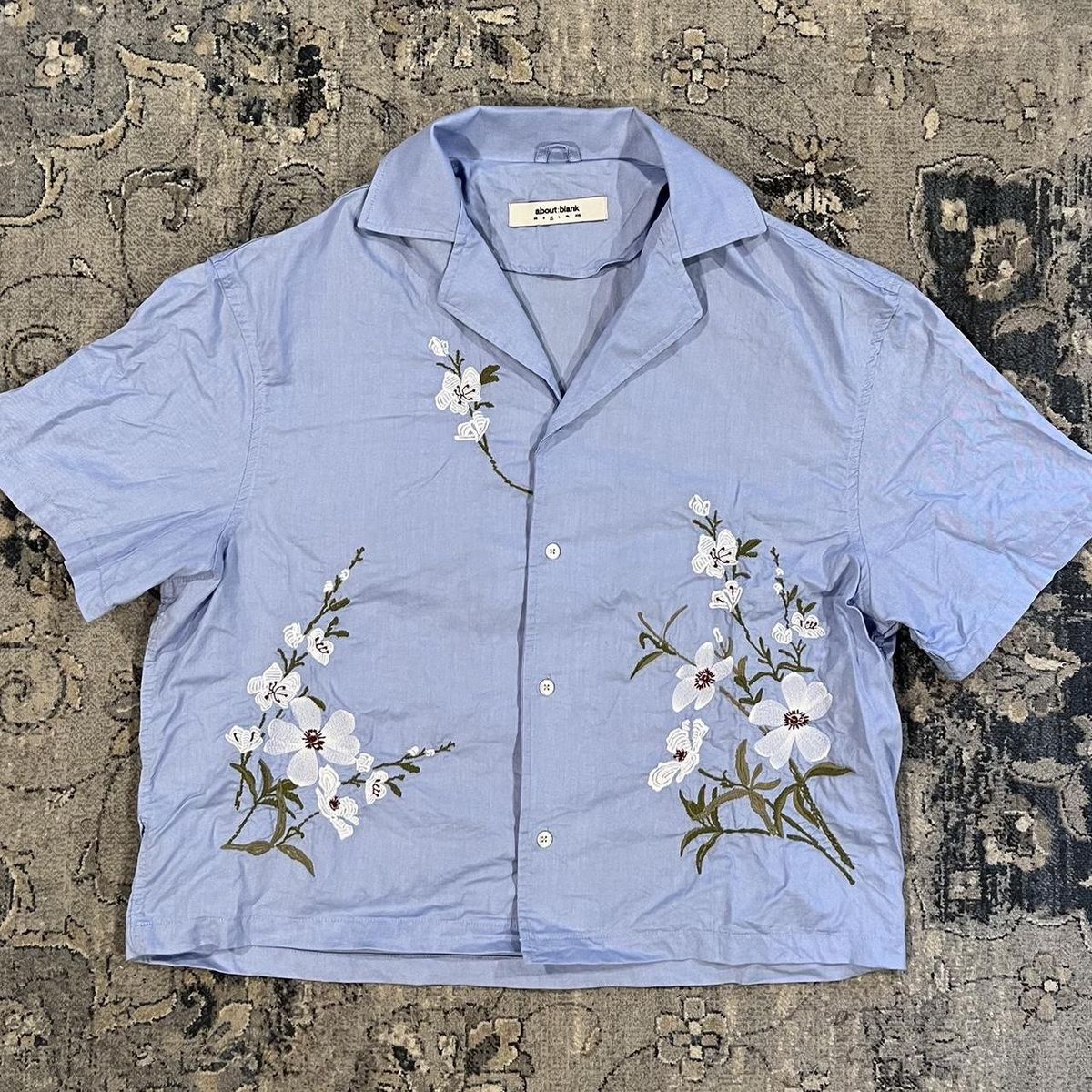
- **Fabric Physics:** The source garment appears to be a lightweight cotton or linen blend with a matte finish. It possesses a medium-weight structure, meaning it holds its shape at the collar and placket but will drape softly with gravity. It should exhibit diffuse light reflection (low specularity) rather than shiny highlights.
- **Key Features:**
- **Embroidery:** The white floral embroidery on the lower left and right quadrants is the primary focal point and must maintain high texture resolution.
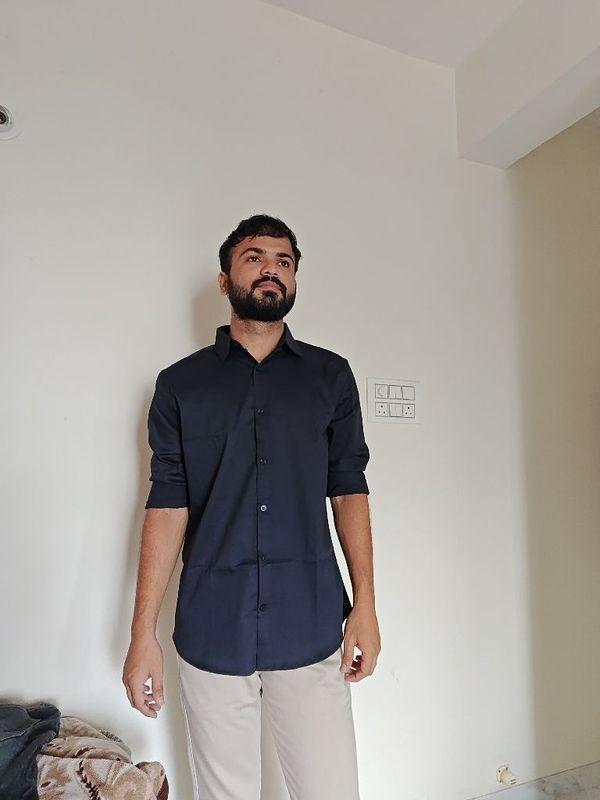
- **Collar:** The "camp collar" (open, flat lapel style) must be preserved, differing significantly from the user's current stiff button-down collar.
- **Tag:** The "about blank" neck tag is visible in the source but will likely be occluded by the user's neck; however, the inner back yoke construction should imply its presence if the collar gapes.
- **Silhouette:** Boxy, short-sleeved cut with a straight hemline.
PHASE 2: FIT & DRAPE SIMULATION
- **Body Mapping:**
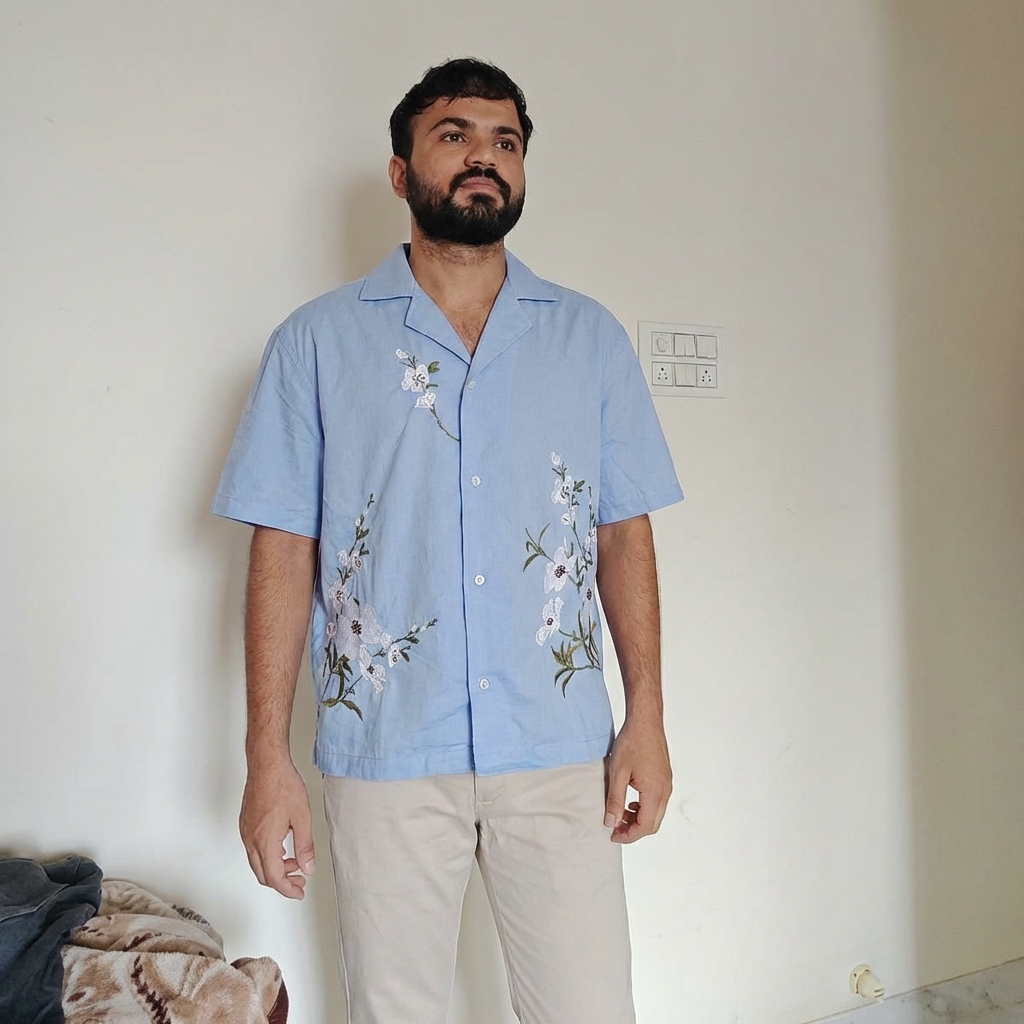
- **Shoulder Anchor:** The garment should anchor firmly at the user's acromion (shoulder bone), draping vertically with a relaxed fit. It should not contour tightly to the pectorals like the user's current shirt.
- **Sleeve Transition:** The source is short-sleeved. The simulation must generate the user's skin texture for the exposed mid-to-lower bicep area, which is currently covered by the long sleeves of the user's dark shirt. The new sleeves should flare slightly away from the arm, creating a "negative space" gap typical of resort wear.
- **Volume:** The shirt requires a "loose fit" logic. It should hang straight down from the chest, creating a slight gap between the fabric and the user's waist area to mimic the boxy cut.
- **Occlusion Handling:**
- **Beard:** The user's beard creates a boundary at the neck. The new collar must sit *under* the beard line to avoid clipping.
- **Hands:** The hands are currently at the sides. While they do not overlap the torso, the sleeve simulation must ensure the fabric does not intersect the wrist/forearm volume if the arms move closer to the body during mesh generation.
PHASE 3: ENVIRONMENT & LIGHTING
- **Light Match:** The user's environment has a soft, diffused light source coming from the **upper left**, casting shadows toward the right side of the body and background wall. The new garment must render self-shadows (folds) on the right side of the torso and cast a soft shadow onto the beige trousers.
- **Color Calibration:** The source image is lit with cool, flat, high-intensity light (likely flash). The user image is warmer with ambient indoor lighting. The "cornflower blue" of the shirt must be slightly desaturated and warmed (yellow-shift) to match the ambient occlusion of the room, ensuring it doesn't look like a "sticker" placed on top.
PHASE 4: IDENTITY PROTECTION
- **Facial Lock:** Absolute pixel-lock required for the user's face, including the beard, ears, and neck skin above the clavicle. The eyes and expression must remain 100% original.
- **Body Integrity:** The user's biometrics (shoulder width, chest depth) must be preserved. Do not slim the torso to fit the shirt; the shirt mesh must expand to accommodate the user's frame. The lower body (beige trousers) must remain unchanged starting from the beltline down.