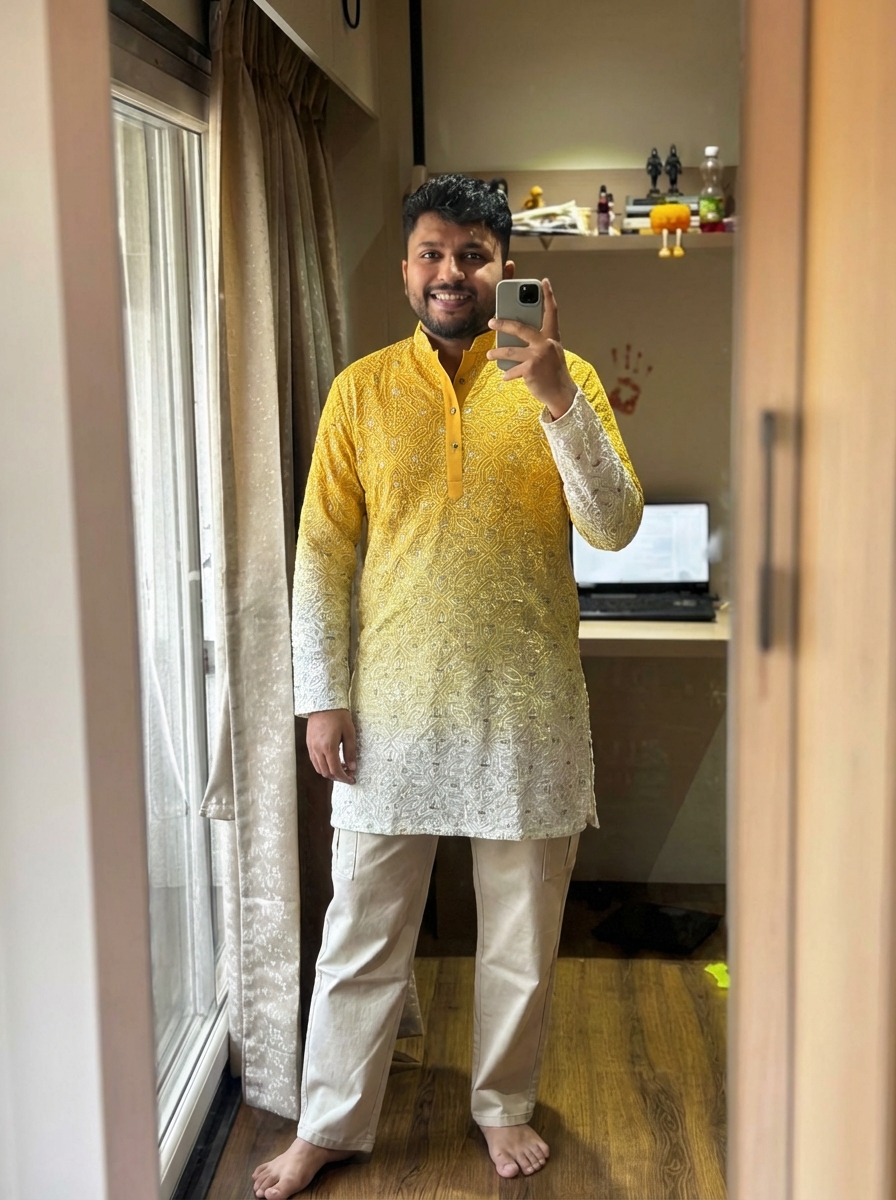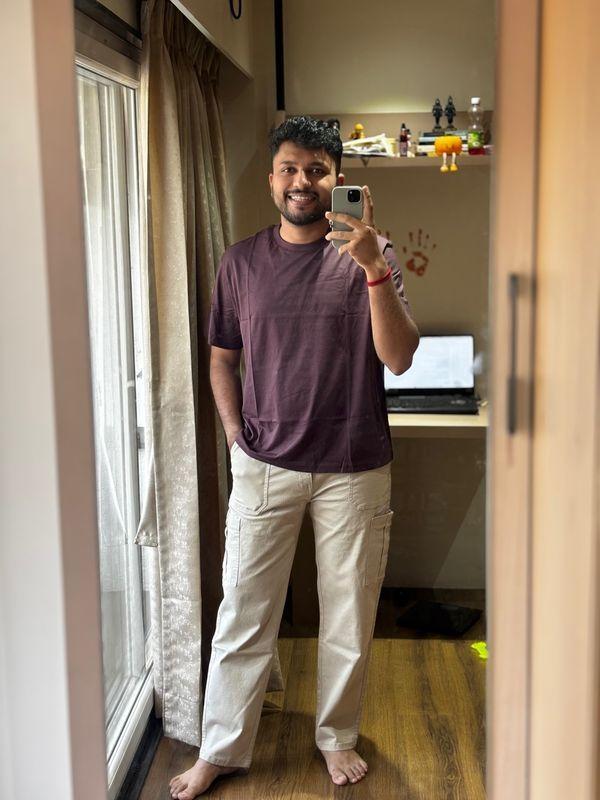
Thinking Process
PHASE 1: VISUAL DECONSTRUCTION
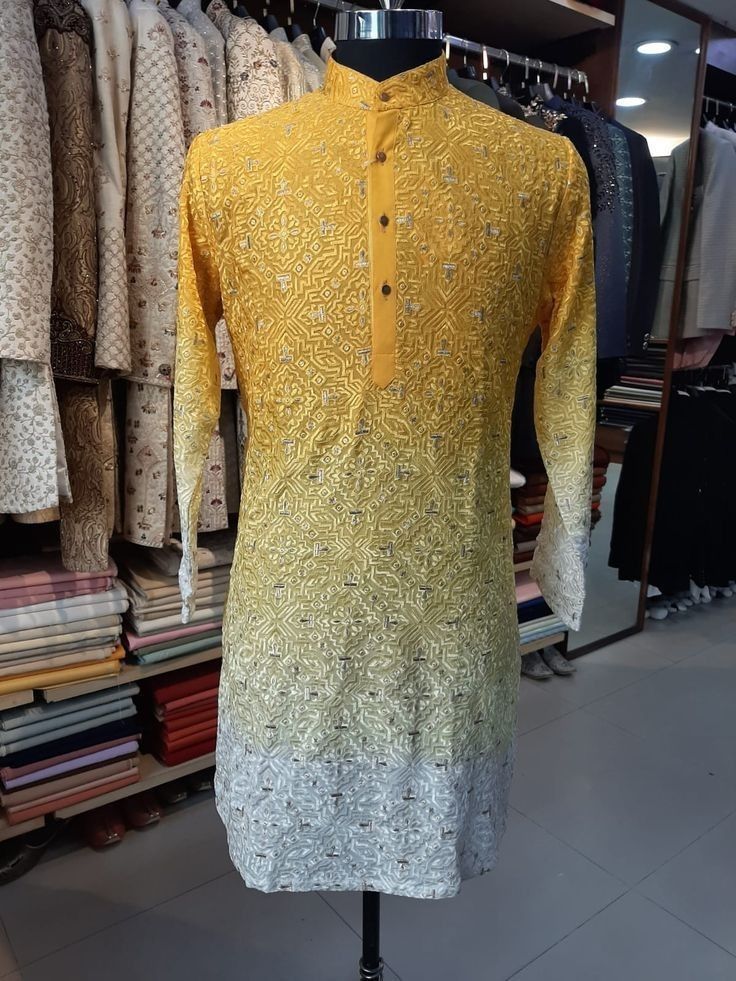
- **Fabric Physics:** The source garment is a structured, embroidered Kurta (likely raw silk or a stiff cotton blend). Unlike the user's current soft cotton jersey t-shirt, this fabric possesses high shear stiffness and will not cling to the muscles. It has a significant weight due to the heavy embroidery. The texture includes sequins or metallic thread work, requiring specular highlights that react sharply to light sources rather than a diffuse matte finish.
- **Key Features:**
- **Ombre Gradient:** The transition from bright marigold yellow at the shoulders to silver-white at the hem must be preserved.
- **Embroidery Detail:** The geometric/diamond lattice pattern must remain sharp and not blur during warping.
- **Structure:** The Mandarin collar (standing collar) and the center-front button placket are rigid elements that must maintain their shape.
- **Length:** This is a tunic-length garment; it must extend past the user's hips to the mid-thigh level, drastically changing the silhouette from the current waist-length t-shirt.
PHASE 2: FIT & DRAPE SIMULATION
- **Body Mapping:**
- **Shoulders:** The Kurta has a defined shoulder seam that is sharper than the current t-shirt's drop.
- **Right Arm (Phone Arm):** As the user's elbow is bent at an acute angle to hold the phone, the stiff fabric of the Kurta sleeve must form deep, angular compression folds at the inner elbow (antecubital fossa). The sleeve cuff should settle around the wrist/forearm, potentially sliding down slightly due to gravity.
- **Left Arm:** The arm hangs relatively straight. The sleeve should drape naturally with minimal bunching.
- **Torso/Hips:** The garment must hang straight down from the chest/shoulders, overriding the inward curve of the waist (boxier fit). It will overlap the upper portion of the cargo pants.
- **Occlusion Handling:**
- **Primary Occlusion:** The user's **right hand and the smartphone** are the critical foreground layer. The Kurta sleeve must pass *behind* the phone and the fingers gripping it.
- **Secondary Occlusion:** The user's left thumb appears hooked into a pocket or resting on the hip; the hem of the Kurta must fall over the pants but potentially interact with this hand placement, or drape over the hand if the hand is close to the body.
PHASE 3: ENVIRONMENT & LIGHTING
- **Light Match:** The user is in a room with warm, overhead artificial lighting (tungsten tone). The light source creates soft downward shadows. The new garment must accept this warm cast; the silver-white bottom of the Kurta should take on a creamy, warm ivory tone to match the room's ambient temperature, rather than a sterile blue-white.
- **Color Calibration:** The reflective elements (sequins/thread) on the Kurta must reflect the room's light sources (the bulb visible in the reflection context). Shadows should be cast downwards from the collar onto the chest and from the sleeve folds.
PHASE 4: IDENTITY PROTECTION
- **Facial Lock:** The user's entire head, including the beard, hairstyle, glasses/eyes, and neck structure, must be completely frozen. The transition from the user's neck to the new Mandarin collar must be seamless.
- **Body Integrity:** Strictly forbidden to slim the user's build. The user's shoulder width and arm volume must dictate the size of the Kurta. While the Kurta covers the waist, the lower legs and feet (barefoot) must remain unaltered. The mirror frame and background room details (curtains, laptop) must remain untouched.