Thinking Process
PHASE 1: VISUAL DECONSTRUCTION
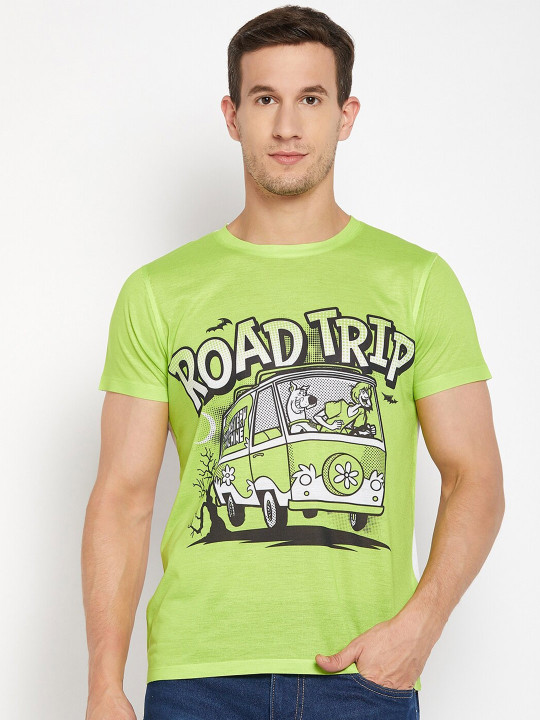
- **Fabric Physics:** The source garment is a cotton jersey knit. It possesses medium weight and softness, meaning it creates soft, rounded folds rather than sharp creases. It has a matte finish, so it should absorb the room's lighting rather than reflecting it like the user's current slightly sheen tank top. The graphic print area may have slightly higher stiffness than the surrounding green fabric.
- **Key Features:**
- The "ROAD TRIP" typography and "Mystery Machine/Scooby Doo" graphic illustration on the chest must be preserved without distortion that ruins readability.
- The ribbed crew neckline.
- The hem stitching on the short sleeves and waist.
- The specific lime green hue (though it will need lighting adjustment).
PHASE 2: FIT & DRAPE SIMULATION
- **Body Mapping:**
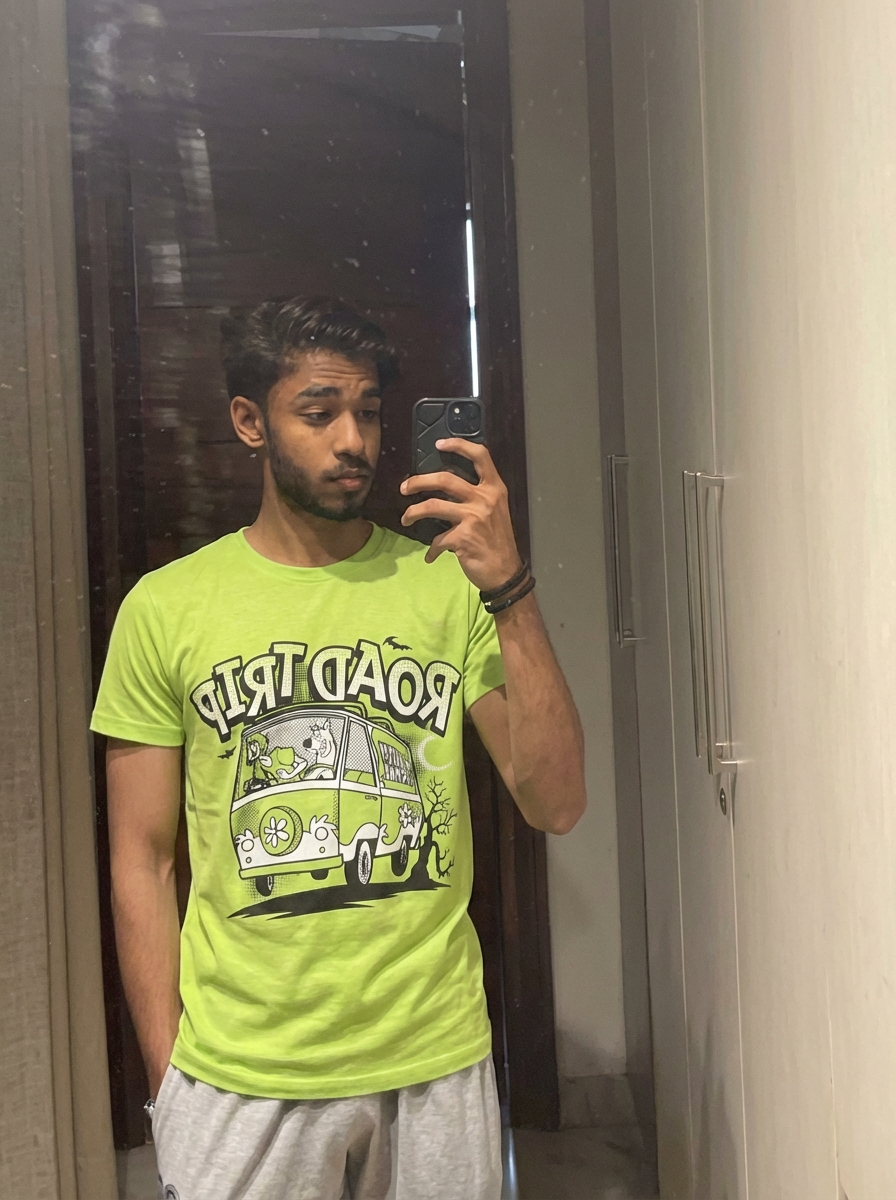
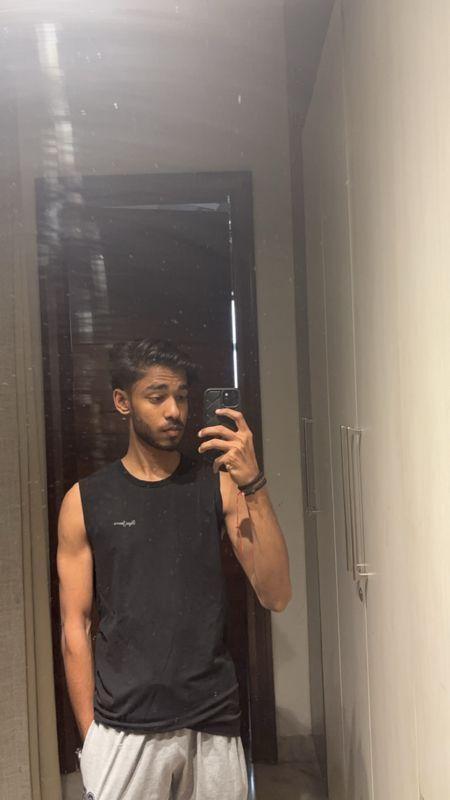
- **Shoulders/Arms:** The target user is wearing a sleeveless tank; the new garment is a short-sleeve T-shirt. The simulation must generate sleeves that cover the deltoids.
- **Left Arm (Phone Arm):** Because the left arm is raised to hold the phone, the fabric on the left shoulder/armpit area must compress and bunch upwards. The sleeve opening on this side will be angled upward.
- **Right Arm:** The arm is down with the hand in the pocket. The sleeve should hang vertically due to gravity.
- **Torso:** The user has an athletic build. The shirt should drape slightly loosely over the abs (unlike the current tight tank top) but contour over the pectorals. The bottom hem will likely bunch slightly on the user's right side where the hand enters the pocket.
- **Occlusion Handling:**
- **CRITICAL:** The user's left hand and the iPhone are positioned directly in front of the upper chest. These objects must be masked out and layered *over* the new graphic tee.
- The wristbands on the left wrist must remain visible and overlap the sleeve if the sleeve is long enough to reach them (unlikely, but proximity requires checking).
- The right hand entering the pocket implies the shirt hem might drape over the wrist or be tucked slightly behind the forearm depending on length; standard length implies it hangs over the pocket entry.
PHASE 3: ENVIRONMENT & LIGHTING
- **Light Match:**
- The user image is a mirror selfie with somewhat dim, warm, top-down artificial lighting and mirror glass diffusion/glare.
- The source image is high-contrast studio lighting.
- **Action:** The lime green garment must be significantly darkened and warmed (color temperature shift towards yellow/orange) to match the ambient room tone. Shadows must be cast under the pectoral muscles and inside the folds created by the raised arm.
- **Color Calibration:**
- Apply a subtle noise/grain filter to the high-resolution cloth image to match the lower-resolution, grainy texture of the mirror selfie.
- Reduce the saturation of the lime green so it does not look "radioactive" or superimposed compared to the muted tones of the room.
PHASE 4: IDENTITY PROTECTION
- **Facial Lock:** The user's hair, forehead, eyes, beard, and jawline visible around the phone must be strictly frozen. The phone itself acts as part of the "face" lock in this context.
- **Body Integrity:** The user's arm musculature (biceps, triceps, vascularity) is distinct. The simulation must NOT slim the arms or alter the shoulder width. The user's grey sweatpants must remain untouched.