Thinking Process
PHASE 1: VISUAL DECONSTRUCTION
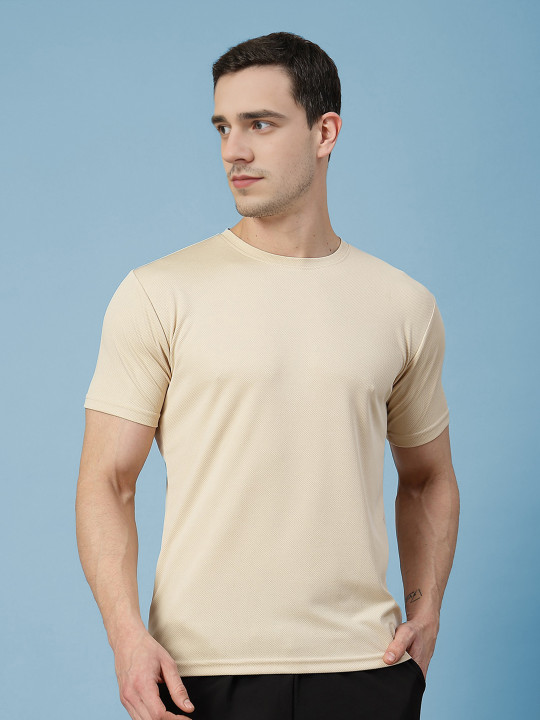
- **Fabric Physics:** The source garment is a lightweight, likely synthetic blend or pique cotton knit (resembling performance wear or breathable mesh). It has a low bending stiffness and high pliability. Unlike the user's current rigid puffer jacket, this fabric must drape closely to the body, exhibiting micro-folds at stress points and a matte finish with very subtle specular highlights on the weave texture.
- **Key Features:** The crew neck collar with ribbing, the precise stitching on the sleeve hems and bottom hemline, and the solid beige/cream colorway. The subtle waffle/mesh texture of the fabric surface must be preserved during transfer to maintain realism.
PHASE 2: FIT & DRAPE SIMULATION
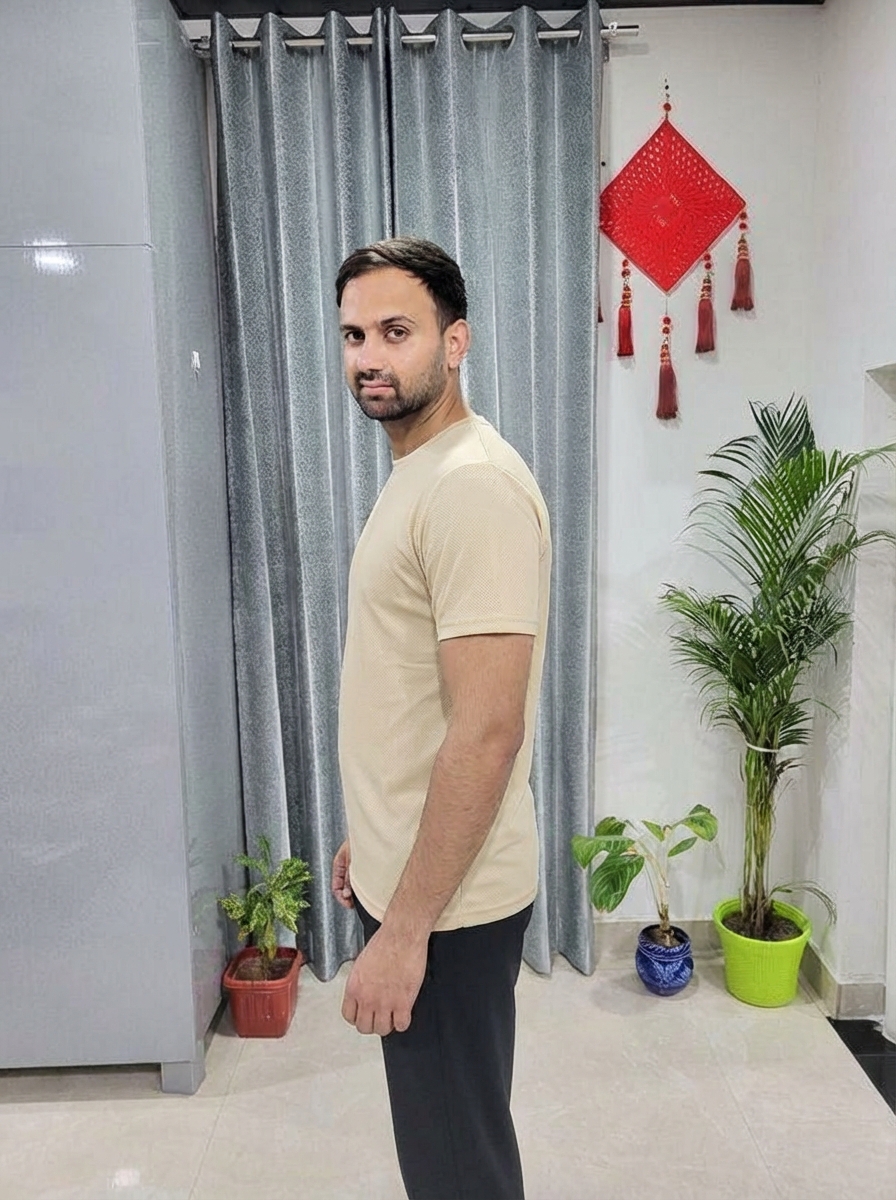
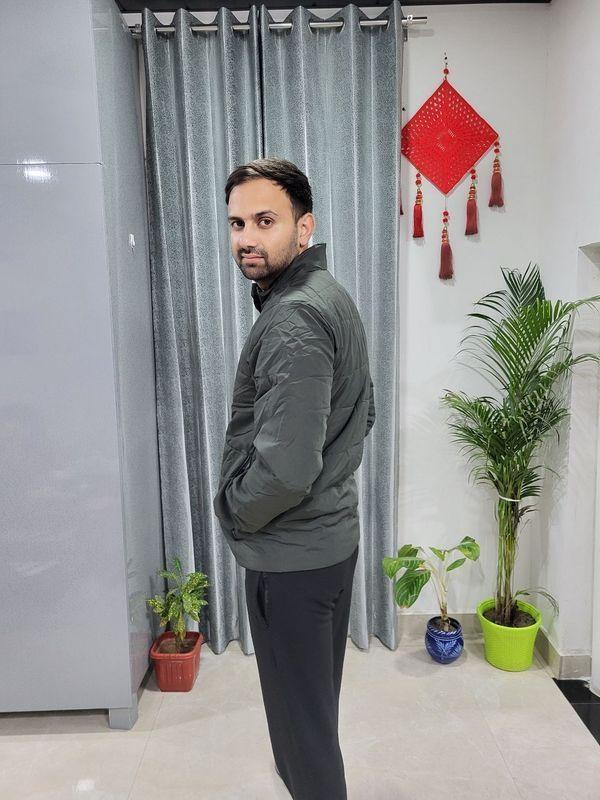
- **Body Mapping:** The user is in a profile/side-stance. The simulation must essentially "deflate" the volume of the current puffer jacket to map the T-shirt to the user's actual anatomical skin surface. The T-shirt should hang vertically from the shoulder blade (scapula) in the back, while draping over the pectoral region in the front. The sleeve must follow the angle of the user's upper arm, which is hanging downwards with a slight forward bend at the elbow.
- **Occlusion Handling:** The user's chin and jawline currently interact with the high collar of the jacket; the new neckline is lower, requiring accurate skin estimation for the neck area. The user's left hand/wrist area is partially interacting with the jacket pocket; the t-shirt hem will end higher than the hand interaction, so the hand/wrist remains unoccluded, but the hip area previously covered by the jacket length must be revealed/filled with the texture of the pants.
PHASE 3: ENVIRONMENT & LIGHTING
- **Light Match:** The user environment utilizes cool, diffuse artificial overhead lighting (evident from the white sheen on the grey wardrobe and the user's forehead). The source garment's warm, flat studio lighting must be neutralized. The generated T-shirt must reflect the cool ambient light of the room.
- **Color Calibration:** The beige/cream color of the T-shirt must be desaturated slightly and shifted towards a cooler temperature to match the white balance of the user's photo. Shadows on the T-shirt should be soft and cast downward/backward to match the shadows seen behind the user on the floor.
PHASE 4: IDENTITY PROTECTION
- **Facial Lock:** The user's entire head, including the specific hairstyle, ear, beard, skin texture of the face, and the angle of the gaze, must be frozen pixel-perfect.
- **Body Integrity:** While the silhouette will naturally shrink because the bulky jacket is being replaced by a thin T-shirt, the underlying biological body shape (shoulder width, torso thickness) must remain consistent with the user's frame. Do not impose the muscular definition of the source model onto the target user.