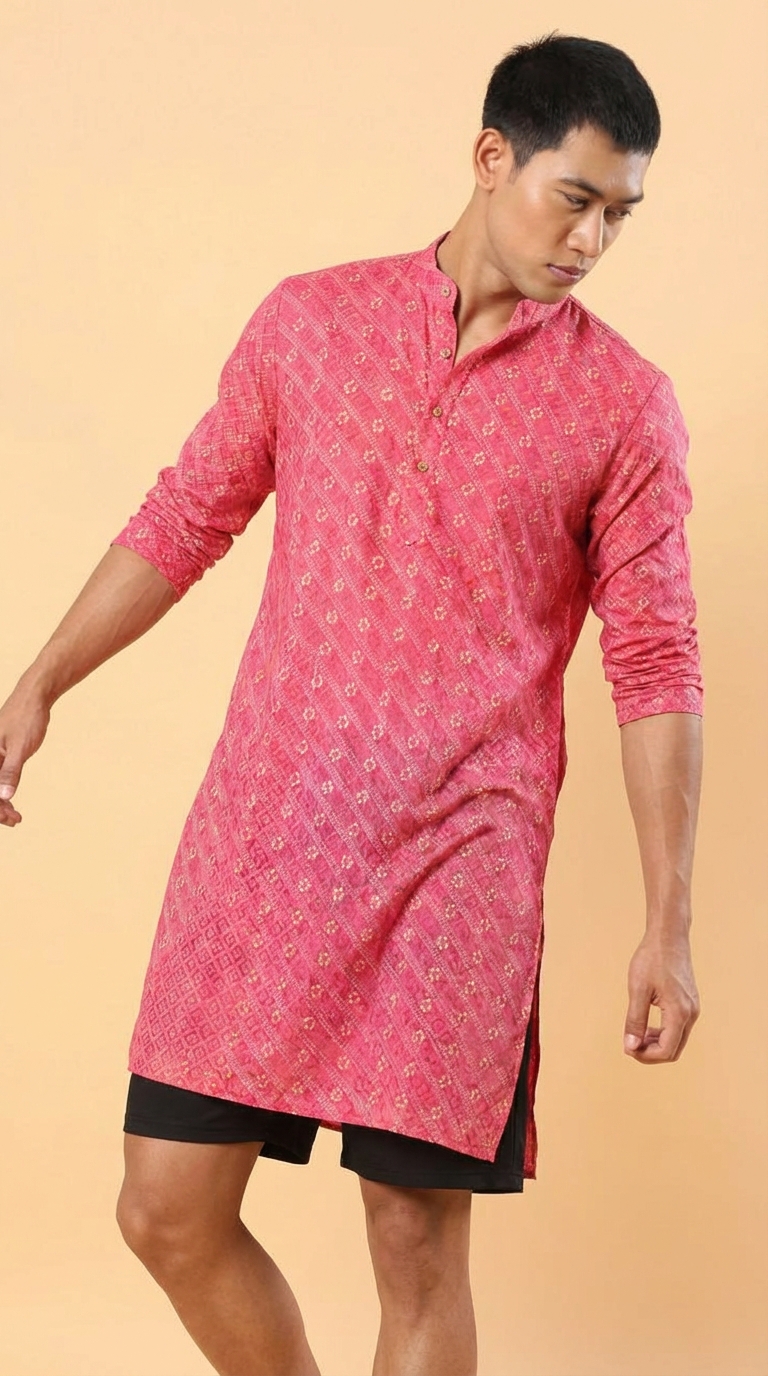
Thinking Process
PHASE 1: VISUAL DECONSTRUCTION
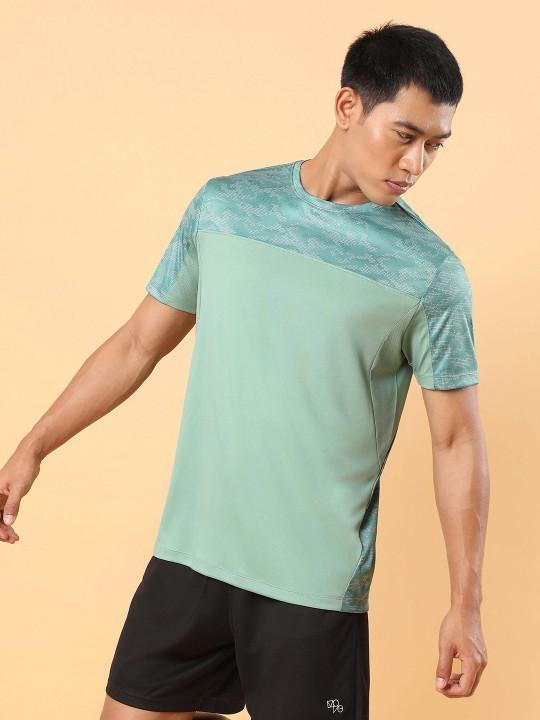
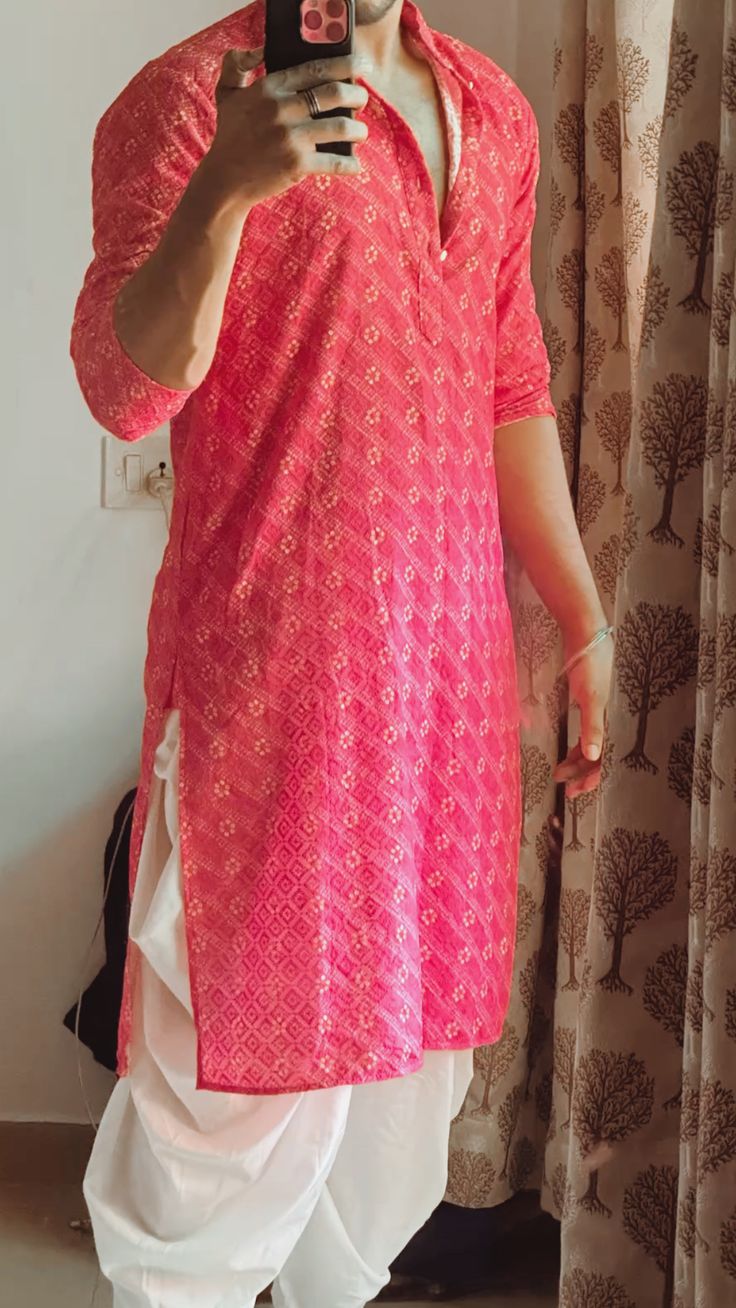
- **Fabric Physics:** The source garment appears to be a lightweight woven cotton or cotton-silk blend with a printed geometric pattern. Unlike the target's current knit athletic wear, this fabric has low elasticity (stretch). It possesses a subtle sheen/specularity indicating a smoother surface texture than matte cotton. The physics simulation must treat this as a semi-structured drape that resists clinging to muscle definition.
- **Key Features:**
- **Pattern Continuity:** The diamond/geometric pattern must remain consistent across seams and cannot be distorted by the warp.
- **Placket & Collar:** The stand collar and button placket (currently partially obscured by the source's phone) must be reconstructed and centered on the target.
- **Side Vents:** The characteristic side slits (chaak) at the hemline must be preserved to allow for the spread of the fabric over the hips.
- **Length:** This is a Kurta, not a shirt; the hemline must extend significantly lower than the current t-shirt, reaching mid-thigh level.
PHASE 2: FIT & DRAPE SIMULATION
- **Body Mapping:**
- **Shoulder Anchor:** The garment hangs from the trapezius/shoulder line. Due to the target's athletic build, the fabric should drape vertically from the chest peak, creating a gap between the fabric and the abdomen (no vacuum-sealing to abs).
- **Sleeve Interaction:** The target's arms are extended/abducted. The Kurta sleeves (likely 3/4 or full length) must form tension wrinkles at the armpit and hang loosely around the bicep/elbow, distinct from the current tight t-shirt sleeves.
- **Lower Body Interaction:** The long hem of the Kurta will overlay the black shorts. The simulation must account for the fabric falling past the waist, potentially obscuring the top half of the shorts.
- **Occlusion Handling:**
- **Source Inpainting:** The source image contains a hand and phone blocking the chest. This area requires generative inpainting to reconstruct the missing pattern and placket before transfer.
- **Target Occlusions:** The target pose is low-occlusion. Arms are clear of the torso. No hair or jewelry overlaps the chest area. This allows for a clean overlay.
PHASE 3: ENVIRONMENT & LIGHTING
- **Light Match:** The target environment uses soft, diffuse, warm studio lighting (likely a large softbox from the front-left). The high-contrast, directional indoor shadows from the source image (mirror selfie) must be neutralized. The new garment must cast soft ambient occlusion shadows onto the target's neck and arms.
- **Color Calibration:** The target background is a warm beige. The source garment is a vibrant pink/red. The white balance of the garment must be adjusted to match the warm color temperature of the target scene to prevent the fabric from looking "cool" or detached from the environment.
PHASE 4: IDENTITY PROTECTION
- **Facial Lock:** Absolute pixel preservation of the target's head, face, neck, and haircut. The neckline of the Kurta must sit naturally at the base of the neck without cropping the target's chin or jawline.
- **Body Integrity:** The target's muscular arm definition and leg shape must be preserved where exposed. Do not slim the torso; however, the volume of the Kurta will naturally obscure the waist taper. The skin tone of the arms and legs must remain untouched.