Thinking Process
PHASE 1: VISUAL DECONSTRUCTION
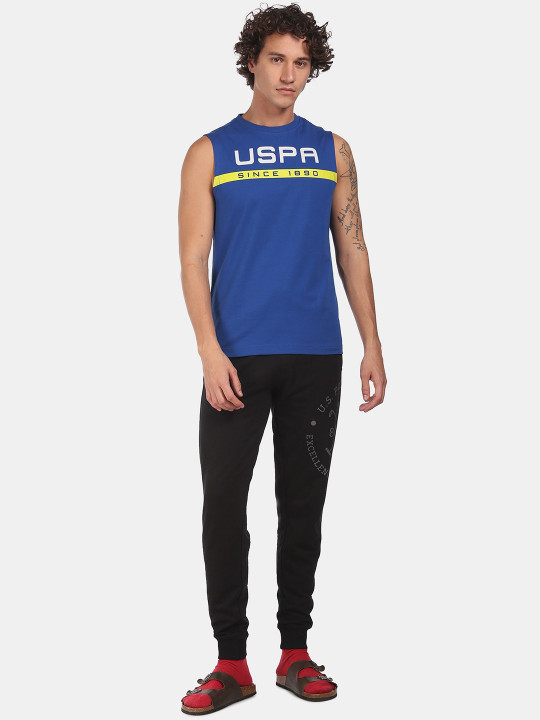
- **Fabric Physics:** The source garment is a cotton jersey knit. It is a matte textile with high pliability and moderate weight. It absorbs light rather than reflecting it (low specularity). The simulation must avoid the stiffness of the current dress shirt; it should exhibit soft micro-folds typical of knitwear rather than sharp creases.
- **Key Features:** The large "USPA" text logo and the yellow "SINCE 1890" horizontal stripe across the chest are vector-critical elements that must not be warped illegibly. The crew neckline and the deep-cut armholes (sleeveless structure) are defining geometric boundaries.
PHASE 2: FIT & DRAPE SIMULATION
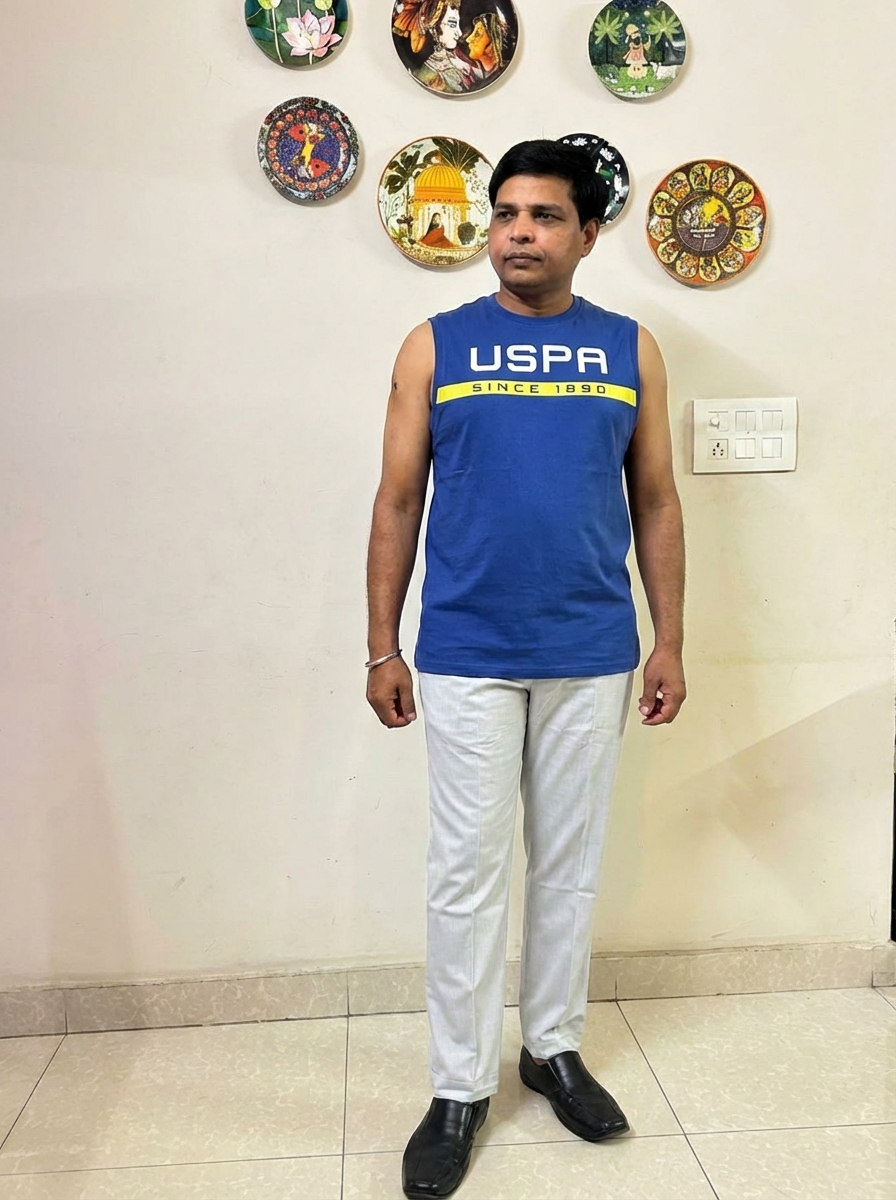
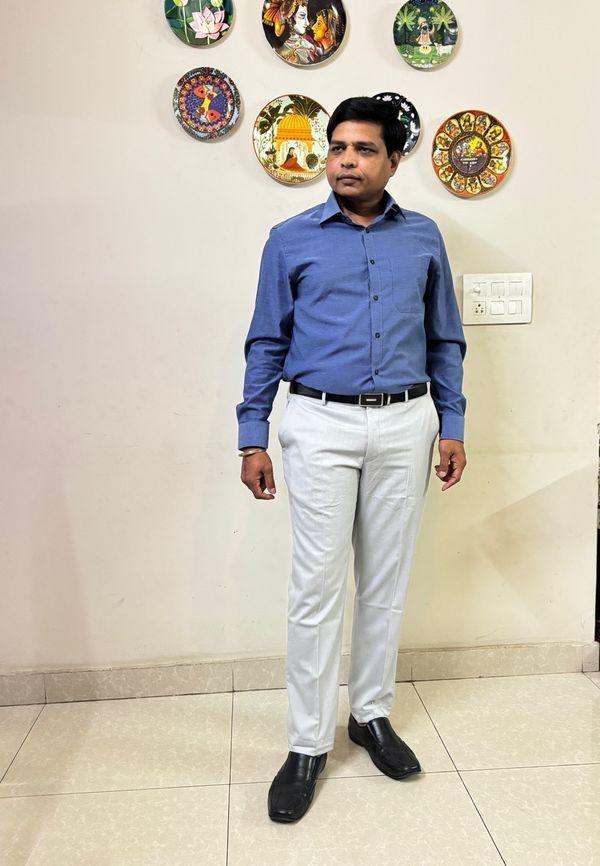
- **Body Mapping:** The target user is currently wearing a tucked-in button-down. The new garment (tank top) implies a relaxed, untucked fit. The simulation must generate a draping effect where the hemline falls loosely over the trouser waistband, obscuring the belt. **Crucial Generation:** Since the target is wearing long sleeves and the source is sleeveless, the system must generatively inpaint the user's upper arms and shoulders, matching the skin tone from the face and hands.
- **Occlusion Handling:** The user's pose is open with arms at the sides. There are no hair or jewelry occlusions to manage. However, the simulation must accurately mask the existing collar of the blue dress shirt to ensure the new crew neck sits directly on the skin without "ghosting" the old collar.
PHASE 3: ENVIRONMENT & LIGHTING
- **Light Match:** The user environment features soft, diffuse top-down indoor lighting (likely a ceiling fixture) casting soft shadows downward and slightly to the user's right. The bright, high-contrast studio lighting of the source garment must be neutralized. The blue tank top must accept a slightly warmer, yellow-tinted cast to match the ambient room temperature reflected off the cream walls.
- **Color Calibration:** The "Royal Blue" of the source garment must be desaturated slightly to match the dynamic range of the user photo (which is shot on a phone camera in lower light). The white logo must not be pure #FFFFFF but rather a light grey-white to match the lighting context.
PHASE 4: IDENTITY PROTECTION
- **Facial Lock:** The user's entire head, including the specific hairstyle and facial expression, is a hard freeze zone. The neck region above the suprasternal notch must be preserved.
- **Body Integrity:** The user's shoulder width and torso volume must be maintained. Do not slim the waist or broaden the shoulders to match the athletic build of the model in the source image. The generated arms must be proportional to the user's existing forearm and wrist thickness.