Thinking Process
PHASE 1: VISUAL DECONSTRUCTION
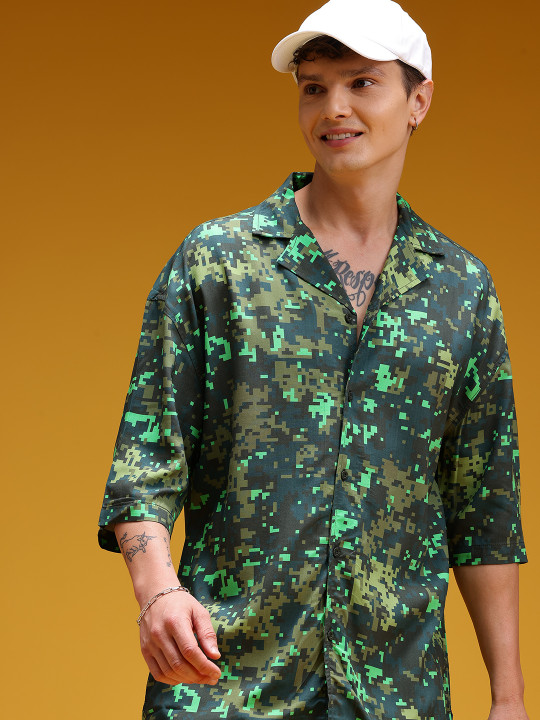
- **Fabric Physics:** The source garment appears to be a lightweight woven fabric, likely viscose, rayon, or a soft cotton blend. It has a high drape coefficient, meaning it hangs loosely and flows rather than holding a rigid shape. It has a matte finish with very low specularity; it should not shine like the user's current leather jacket, but rather absorb the flash lighting softly.
- **Key Features:** The specific "digital pixel camouflage" pattern (black, forest green, and neon lime) is the primary visual anchor and must not be distorted. The open "camp collar" (notched lapel) structure, the elbow-length sleeves (oversized fit), and the black button closure sequence down the center front must be preserved.
PHASE 2: FIT & DRAPE SIMULATION
- **Body Mapping:**
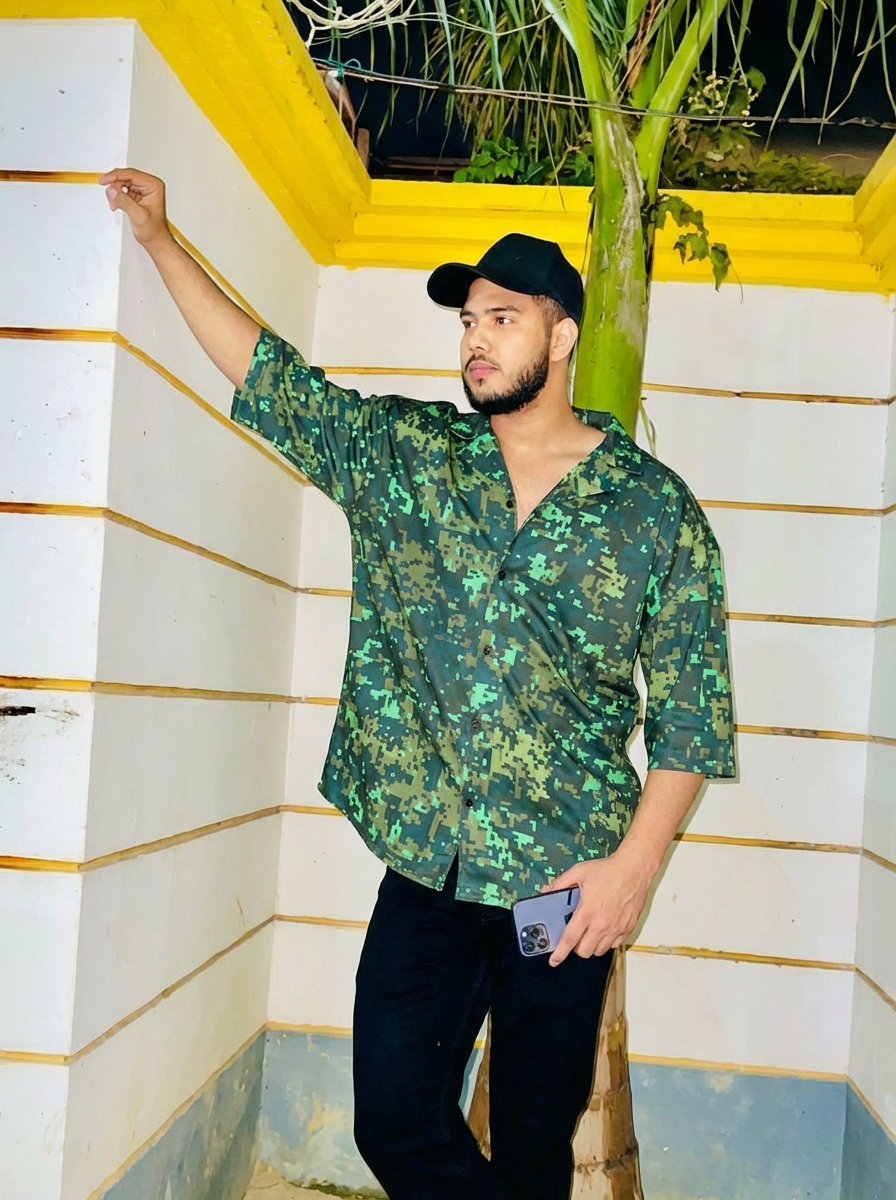
- **Right Arm (Raised):** Due to the user's raised right arm, the oversized sleeve must slide down towards the shoulder/axilla due to gravity, exposing the underside of the arm. The fabric on the right side of the torso will be pulled taut upward.
- **Left Arm (Down):** The sleeve will hang loosely to the elbow.
- **Torso:** The shirt is a relaxed fit; it should not hug the user's waist but hang straight down, following the lean of the body against the wall.
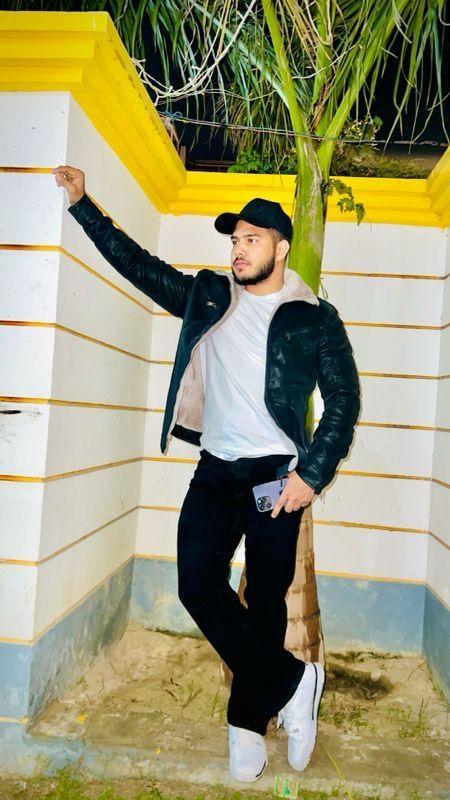
- **Skin Generation:** Since the user is wearing a long-sleeved jacket and the target shirt has elbow-length sleeves, the system must generate realistic skin texture for the user's forearms where the jacket currently covers them.
- **Occlusion Handling:** The user's left hand (holding the phone) and the phone itself are critical occlusion layers. The bottom hem of the new shirt must pass *behind* this hand/phone assembly. The user's beard interacts with the collar area and must be layered *over* the new garment's neckline.
PHASE 3: ENVIRONMENT & LIGHTING
- **Light Match:** The target environment utilizes a direct, hard flash from the camera (front-on lighting). This creates harsh shadows directly behind the subject on the white wall. The new garment must exhibit this same "flash photography" look: bright illumination on the chest/stomach area with rapid light fall-off towards the sides. Cast shadows from the collar and buttons must be sharp and distinct, consistent with a point-light source.
- **Color Calibration:** The source image is warm studio lighting. The target image is cool/neutral flash lighting. The green tones in the camouflage must be color-graded to appear slightly cooler to match the flash temperature, ensuring the neon green pixels react realistically to the high-intensity light.
PHASE 4: IDENTITY PROTECTION
- **Facial Lock:** The user's entire head region, including the black cap, facial hair, ear, and neck structure, must be frozen. The jawline definition must remain untouched when replacing the high crew-neck t-shirt with the open V-neck collar of the source shirt.
- **Body Integrity:** The user has a standard, athletic build. Do not warp the torso to match the slimmer physique of the source model. The simulation must fill the volume of the user's current jacket without retaining the jacket's bulky shoulder pads.