Thinking Process
PHASE 1: VISUAL DECONSTRUCTION
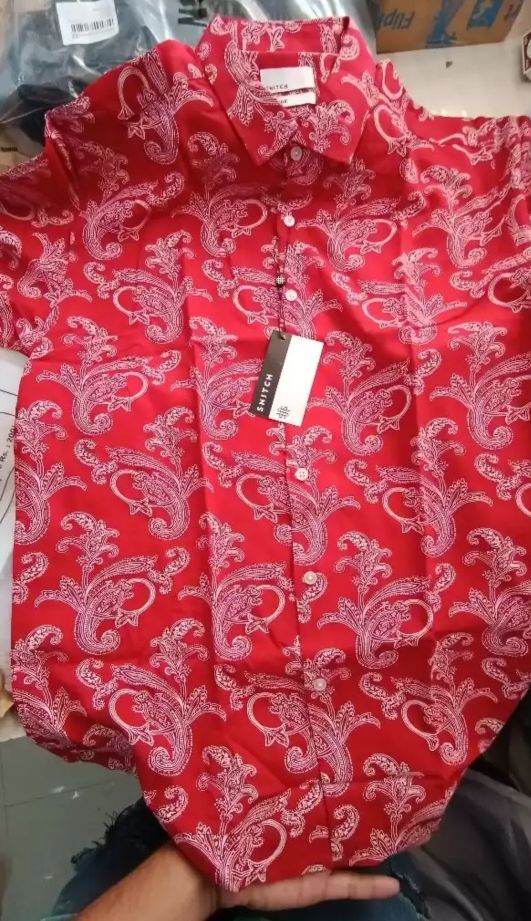
- **Fabric Physics:** The source garment appears to be a printed cotton or cotton-poplin blend. It possesses medium stiffness with low elasticity. Unlike the current knit t-shirt, the target shirt has structural rigidity, particularly at the collar and placket. Light reflection should be diffuse (matte) with slight specular highlights only on the button curvature; the fabric itself should not appear satin or glossy.
- **Key Features:** The intricate white paisley/ornamental pattern is high-frequency and must be preserved without pixelated blurring. The shirt structure includes a spread collar, a visible button placket (white buttons), and short sleeves. The hanging retail tag must be digitally removed during transfer, but the "SNITCH" brand label inside the collar area should be implied if the collar opens slightly, or occluded by the neck.
PHASE 2: FIT & DRAPE SIMULATION
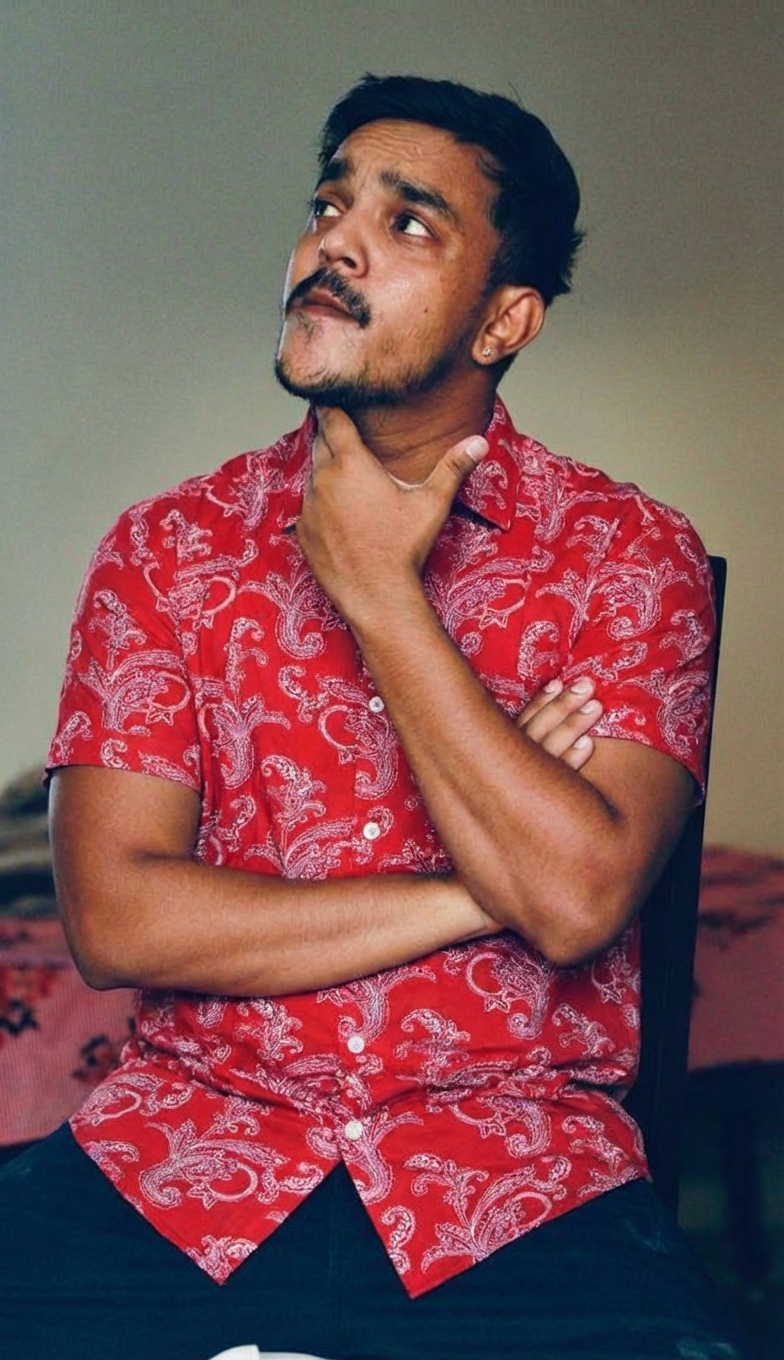
- **Body Mapping:** Due to the "arms crossed" pose, the fabric simulation requires high tension mapping across the scapula (back) and shoulders. The shirt must not hang loosely; it must exhibit compression folds and bunching at the inner elbows where the arms fold. The collar must rise higher on the neck than the current crew-neck t-shirt, interacting with the trap muscles. The bottom hem will be largely obscured or bunched due to the seated position.
- **Occlusion Handling:** This is a high-complexity occlusion scenario. The User's right forearm, right hand (touching the chin/neck), and left fingers (tucked under the bicep) must be segmented as foreground layers. The red shirt must be rendered *behind* these limb elements. Specifically, the collar area must be masked accurately around the fingers touching the throat.
PHASE 3: ENVIRONMENT & LIGHTING
- **Light Match:** The User image features soft, warm, directional lighting coming from the upper-left (user's right), casting shadows to the right. The flat-lay shirt image has harsh, cool, overhead warehouse lighting. The shirt's albedo map must be warmed to match the room's ambient temperature. Deep ambient occlusion shadows must be generated under the crossed arms and inside the collar folds to ground the garment in 3D space.
- **Color Calibration:** The source red is vibrant/saturated. To look natural in the user's lower-light environment, the red luminance must be slightly reduced, and a subtle red color-bleed (global illumination) should be projected onto the user's inner forearms and neck where the fabric reflects light onto the skin.
PHASE 4: IDENTITY PROTECTION
- **Facial Lock:** The user's facial structure, upward gaze, mustache/beard, and hair are strictly frozen. The boundary where the jawline meets the hand must remain pixel-perfect.
- **Body Integrity:** No warping or slimming of the user's biceps, forearms, or shoulder width is permitted. The virtual garment must adapt to the user's existing volume, not reshape the user to fit the shirt. The skin tone of the arms and neck must remain unaltered.