Thinking Process
PHASE 1: VISUAL DECONSTRUCTION
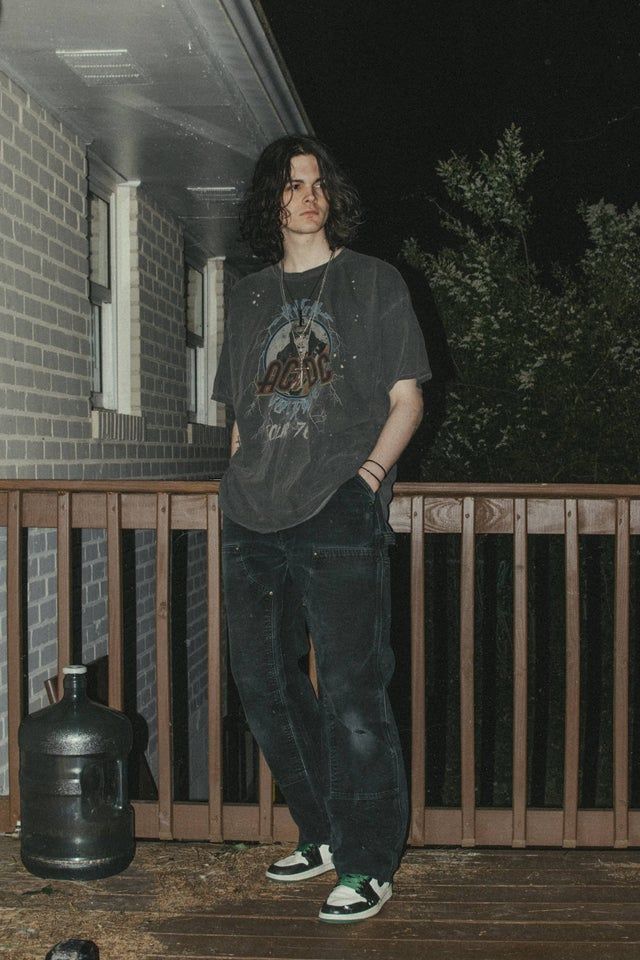
- **Fabric Physics:** The source garment is a vintage-wash, heavyweight cotton jersey. It has a matte finish with high light absorption and low specularity. The texture is soft but structural, meaning it will create softer, wider folds rather than sharp, crisp creases.
- **Key Features:** The central graphic ("AC/DC" text with lightning bolt and figure) is the focal point and must remain centered relative to the sternum, undergoing perspective warping rather than texture stretching. The distressed "vintage" fading pattern and the specific crew-neck ribbing width must be preserved. Note the small distress holes/pilling on the upper chest; these texture details must transfer.
PHASE 2: FIT & DRAPE SIMULATION
- **Body Mapping:**
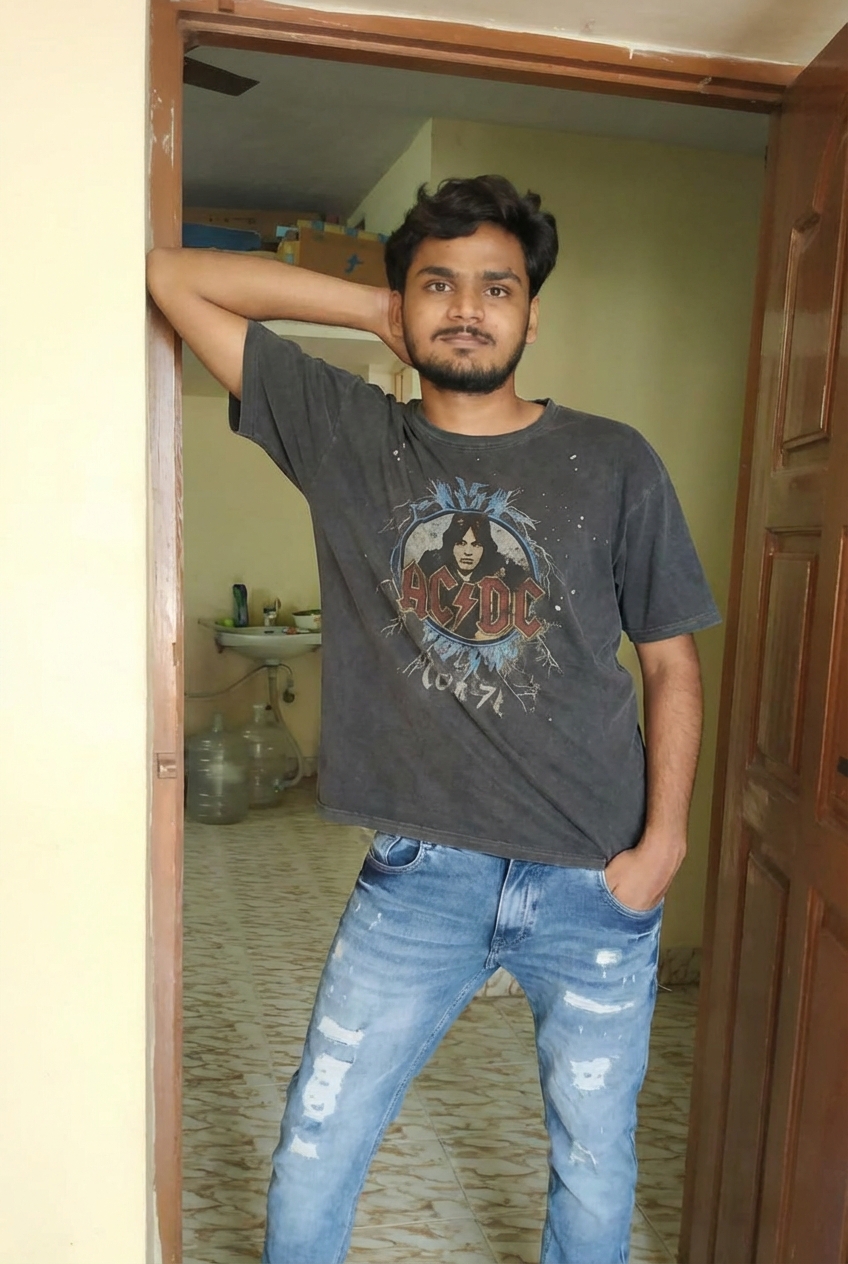
- **Right Arm (Raised):** Due to the arm being raised behind the head, the right sleeve of the T-shirt must slide down towards the shoulder (gravity bias), exposing the underarm area. The fabric on the right lateral torso must pull taut upwards from the waist to the armpit.
- **Left Arm (Down/Pocket):** The user's hand is inside the jeans pocket. The hem of the T-shirt must interact with the wrist/forearm here, likely bunching slightly above the pocket entry or draping over the wrist if the shirt is long enough.
- **Torso Lean:** The user is leaning against a doorframe. Gravity dictates the fabric should hang vertically, meaning it will cling to the user's left hip (viewer's right) and hang slightly loose/away from the right side of the ribcage.
- **Occlusion Handling:**
- **Doorframe:** The right arm/shoulder is pressed against the doorframe. The rendered T-shirt sleeve must appear compressed against this hard surface, not clipping through it.
- **Waistline:** The current hoodie is tucked/bunched at the jeans. The new T-shirt should drape *over* the waistline of the jeans naturally, un-tucked, unless the fit implies a crop (which this source does not).
PHASE 3: ENVIRONMENT & LIGHTING
- **Light Match:** The user image utilizes indoor, diffused ambient lighting (likely overhead CFL or LED), casting soft shadows downward and slightly to the viewer's right. The source image uses harsh, direct flash photography. The flash reflection on the source graphic must be neutralized and replaced with a soft, diffuse fall-off consistent with the room's ambient light.
- **Color Calibration:** The source image has a warm/greenish tint typical of outdoor night photography. The target room has cool/neutral tones (white walls, blue jeans). The dark grey of the T-shirt must be color-corrected to remove the green cast, shifting towards a neutral charcoal to match the indoor white balance.
PHASE 4: IDENTITY PROTECTION
- **Facial Lock:** Absolute freeze required on the user's facial geometry, skin tone, facial hair (beard/mustache), and the hairstyle. The boundary between the neck and the new T-shirt collar must be seamlessly blended without altering the user's neck width.
- **Body Integrity:** Do not slim or alter the user's skeletal structure. However, because the user is currently wearing a thick hoodie and the target garment is a thinner T-shirt, the simulation must accurately reveal the slimmer biological silhouette that exists *under* the bulky hoodie, specifically in the arm and shoulder definition, without artificially reducing the user's actual body mass.