
Thinking Process
PHASE 1: VISUAL DECONSTRUCTION
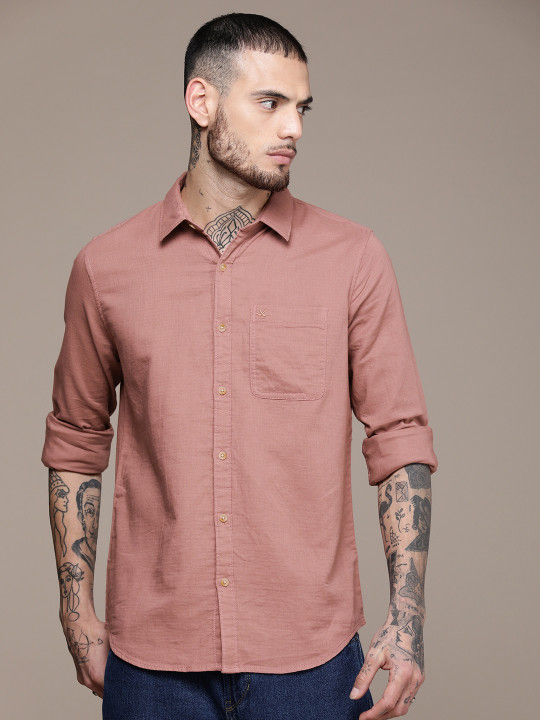
- **Fabric Physics:** The source garment is a woven cotton or linen blend with a matte finish. It possesses medium structural rigidity—pliable but prone to sharp creasing rather than fluid draping. Light reflection should be diffuse with low specularity (no shine), absorbing the ambient light rather than reflecting it.
- **Key Features:** The rolled-up sleeves (cuffed below the elbow) are a defining geometric trait. The single chest pocket with the small embroidered logo, the visible placket stitching, and the specific "dusty pink/salmon" hue must be preserved. The collar structure is stiff and must stand up around the neck, distinct from the current soft t-shirt neckline.
PHASE 2: FIT & DRAPE SIMULATION
- **Body Mapping:** **Critical Volume Reduction:** The user is currently wearing a high-volume puffer jacket. The simulation must estimate the user's true biological torso size beneath the puffer and "shrink" the silhouette significantly to drape the thin shirt against the skin. The shirt should drape vertically from the shoulders with minimal bunching, following the user's slight rotation to his left.
- **Occlusion Handling:** The user's beard overlaps the neck area and must layer *over* the new shirt collar. The user's hands appear to be in pockets or low; since the source shirt has rolled sleeves and the current jacket has long sleeves, the lower forearms (currently covered by black nylon) will require generative skin texture matching the user's face to fill the gap between the rolled sleeve hem and the wrist.
PHASE 3: ENVIRONMENT & LIGHTING
- **Light Match:** The user's environment consists of cool, diffuse outdoor lighting (overcast sky) with a blue/grey cast. The source image has warm, directional studio lighting. The shirt's lighting must be neutralized and relit with a soft, top-down ambient cool light to integrate with the background bokeh. Shadows should be extremely soft and minimal.
- **Color Calibration:** The "dusty pink" of the shirt must be color-graded to account for the blue environmental tint. This involves slightly desaturating the warm tones and shifting the white balance toward cyan/cool to prevent the shirt from looking like a pasted sticker.
PHASE 4: IDENTITY PROTECTION
- **Facial Lock:** The user's entire face, beard, ears, and the blue beanie/hat must be frozen and masked precisely. The beanie's edge must remain the boundary for the top of the head.
- **Body Integrity:** While the artificial bulk of the puffer jacket must be removed, the user's estimated shoulder width and chest breadth must remain true to his anatomy. Do not artificially narrow the shoulders or lengthen the neck beyond natural proportions.