
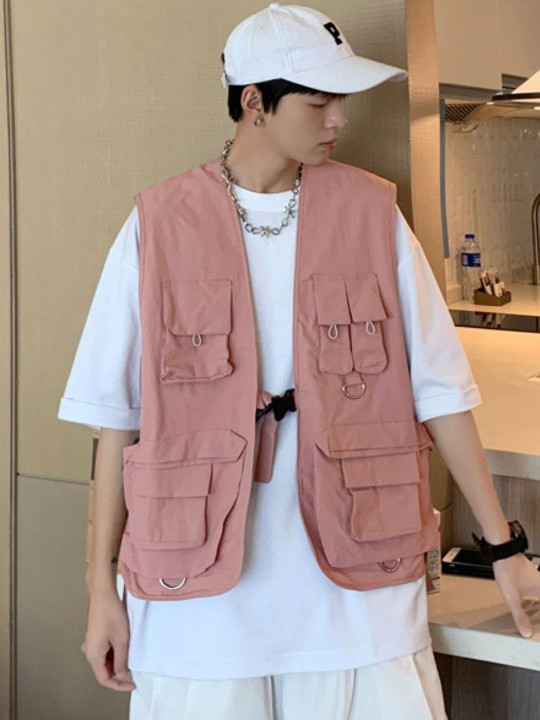
Thinking Process
PHASE 1: VISUAL DECONSTRUCTION
- **Fabric Physics:** The source garment is a composite: a heavy-weight canvas or cotton twill utility vest layered over a generic cotton jersey t-shirt. The vest is structural and stiff, maintaining its boxy shape and pocket volume rather than clinging to the body. It has a matte finish with low light reflectivity. The underlying white t-shirt has a softer drape and higher pliability.
- **Key Features:**
- **Utility Elements:** Four prominent gusseted cargo pockets with flap closures on the vest front.
- **Hardware:** Metal D-rings attached to the bottom of the lower pockets and pocket flaps.
- **Closure:** The black webbing strap/buckle connecting the vest across the mid-torso.
- **Layering:** The visual distinction between the pink vest and the white t-shirt sleeves/hem protruding underneath.
PHASE 2: FIT & DRAPE SIMULATION
- **Body Mapping:**
- **Pose Interaction:** The user's arms are crossed. This requires a high-complexity simulation. The stiff canvas vest must *not* collapse entirely under the arms; it should maintain some rigidity near the armpits.
- **Compression points:** The underlying white t-shirt sleeves must bunch and wrinkle significantly at the inner elbows due to the folded arm position. The vest panels will be pushed slightly outward and compressed against the chest by the forearms.
- **Occlusion Handling:**
- **Primary Occlusion:** The user's crossed forearms and hands are the dominant occluding layer. The new garment (vest and t-shirt) must be rendered *behind* the arms.
- **Accessories:** The wristwatch on the user's left wrist must be preserved and layered on top of the new garment's fabric.
- **Waistline:** The user's belt and trouser waistline act as the bottom boundary; the t-shirt hem should naturally fall over the belt, potentially obscuring it, unlike the tucked-in source shirt.
PHASE 3: ENVIRONMENT & LIGHTING
- **Light Match:** The target image is a low-light, nighttime outdoor scene with artificial, likely cool-toned street lighting coming from the front-left. The source garment is currently lit by flat, bright studio light. The new garment must be significantly darkened. Shadows must be generated *under* the user's crossed arms onto the vest, and the vest's pockets must cast self-shadows to prove depth in the low light.
- **Color Calibration:** The bright salmon/pink of the vest needs to be desaturated and cooled (shifted slightly blue/cyan) to match the ambient night aesthetics. The white t-shirt must not be pure white; it should be grey-scaled to match the exposure of the user's face.
PHASE 4: IDENTITY PROTECTION
- **Facial Lock:** Absolute preservation of the user's face, hairstyle, beard, and neck structure. The transition from the user's neck to the new t-shirt collar must be seamless.
- **Body Integrity:** The user's shoulder width and arm volume must not be altered to fit the boxy vest. The simulation must conform the garment to the user, not slim the user to the garment. The crossed-arm pose is a hard constraint and must not be warped.