Thinking Process
PHASE 1: VISUAL DECONSTRUCTION
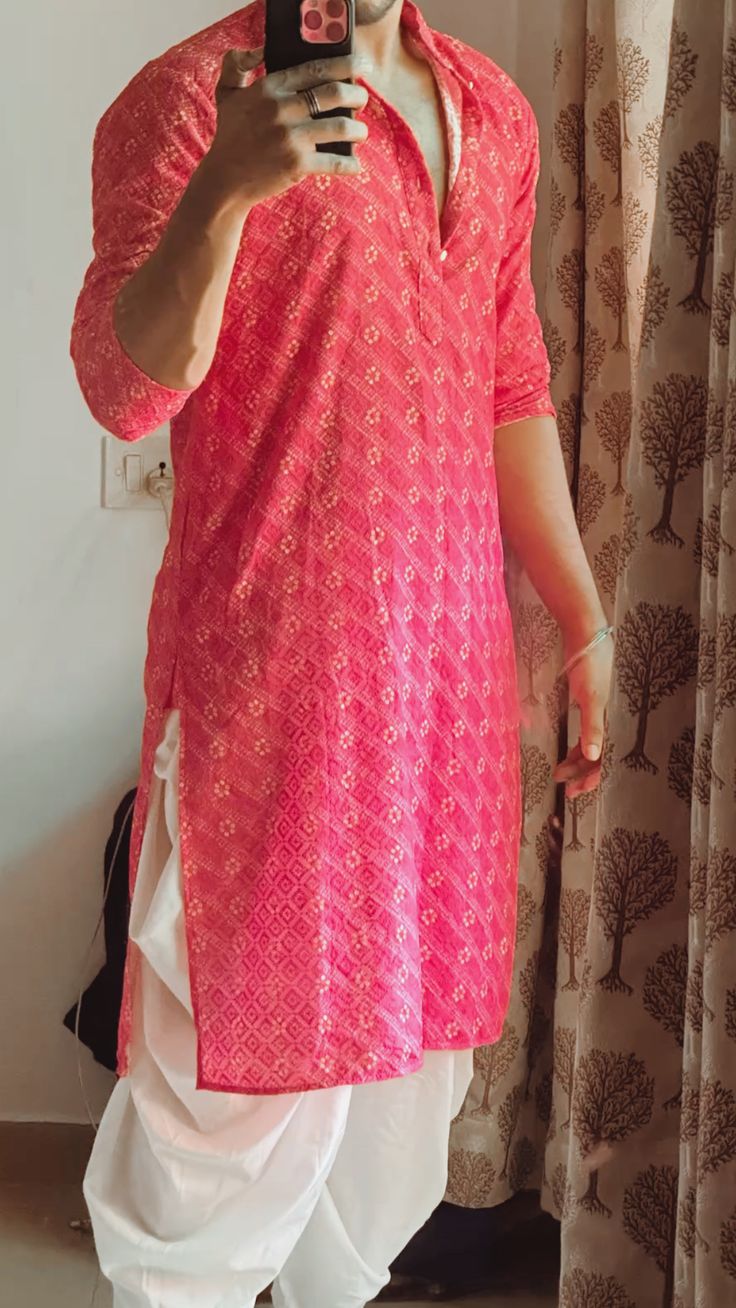
- **Fabric Physics:** The source garment is a patterned Kurta, likely a cotton-silk blend or glazed cotton. Unlike the stiff denim currently worn by the user, this fabric has a moderate drape with a soft, semi-matte sheen. It is lighter weight than denim but holds structural integrity at the collar and placket. The gold/yellow geometric patterns are woven or printed and should exhibit specular highlights different from the base pink fabric.
- **Key Features:**
- **Pattern:** The diagonal diamond/line geometric motif must be preserved without distortion.
- **Structure:** The mandarin collar/placket region, currently unbuttoned at the top.
- **Hemline:** Side slits (vents) typical of a Kurta, which are essential for the silhouette.
- **Sleeves:** The source sleeves are rolled to the elbow; this styling should be maintained or intelligently extended depending on the target arm length mapping.
PHASE 2: FIT & DRAPE SIMULATION
- **Body Mapping:**
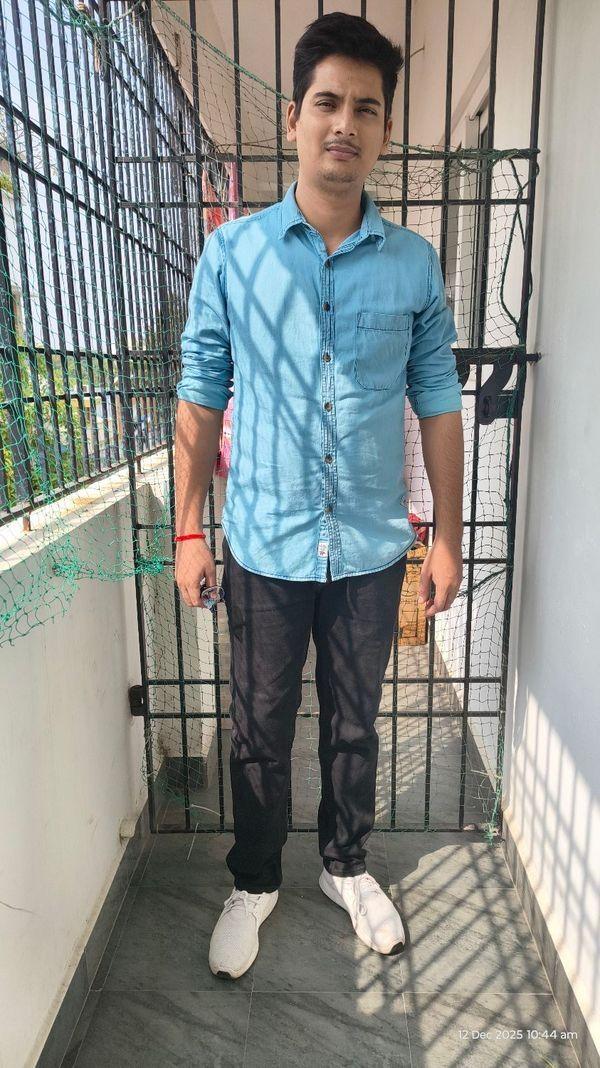
- **Length Transformation:** The Kurta is significantly longer than the user's current denim shirt. The simulation must extend the hemline past the waist, draping down to the mid-thigh area, covering the upper portion of the black pants.
- **Shoulder & Chest:** The fabric should hang loosely from the user's shoulders (trapezius) rather than contouring tightly to the pectorals, reflecting the "comfort fit" of a Kurta.
- **Gravity:** Given the user's straight standing pose, the fabric must hang vertically. The bunching seen in the source image (due to the bent arm selfie pose) must be relaxed into straight, vertical folds along the user's arms.
- **Occlusion Handling:**
- **Hands:** The user's right hand (holding sunglasses) and left hand must remain visible. The sleeves must end before the wrist or appear naturally rolled at the forearm, ensuring the hands are layered *over* the garment.
- **Waist/Hips:** Since the Kurta goes over the pants, the belt line and pockets of the current jeans will be occluded. However, the black pants must be visible through the side slits of the Kurta as the user walks or stands.
PHASE 3: ENVIRONMENT & LIGHTING
- **Light Match:**
- **Direction:** The user is standing in strong, hard daylight coming from the top-left, casting sharp shadows. The source garment is in soft, diffused indoor light.
- **Shadow Projection (CRITICAL):** The complex "grid" shadows cast by the safety grille (visible on the current blue shirt) MUST be procedurally generated and projected onto the pink Kurta. Without these hard, cage-like shadows, the composite will fail.
- **Color Calibration:** The source image has warm, indoor tungsten tones. The target environment is cool/neutral daylight (approx 5500K). The magenta/pink of the Kurta must be color-corrected to appear naturally lit by the sun, likely increasing brightness while desaturating slightly to match the outdoor exposure.
PHASE 4: IDENTITY PROTECTION
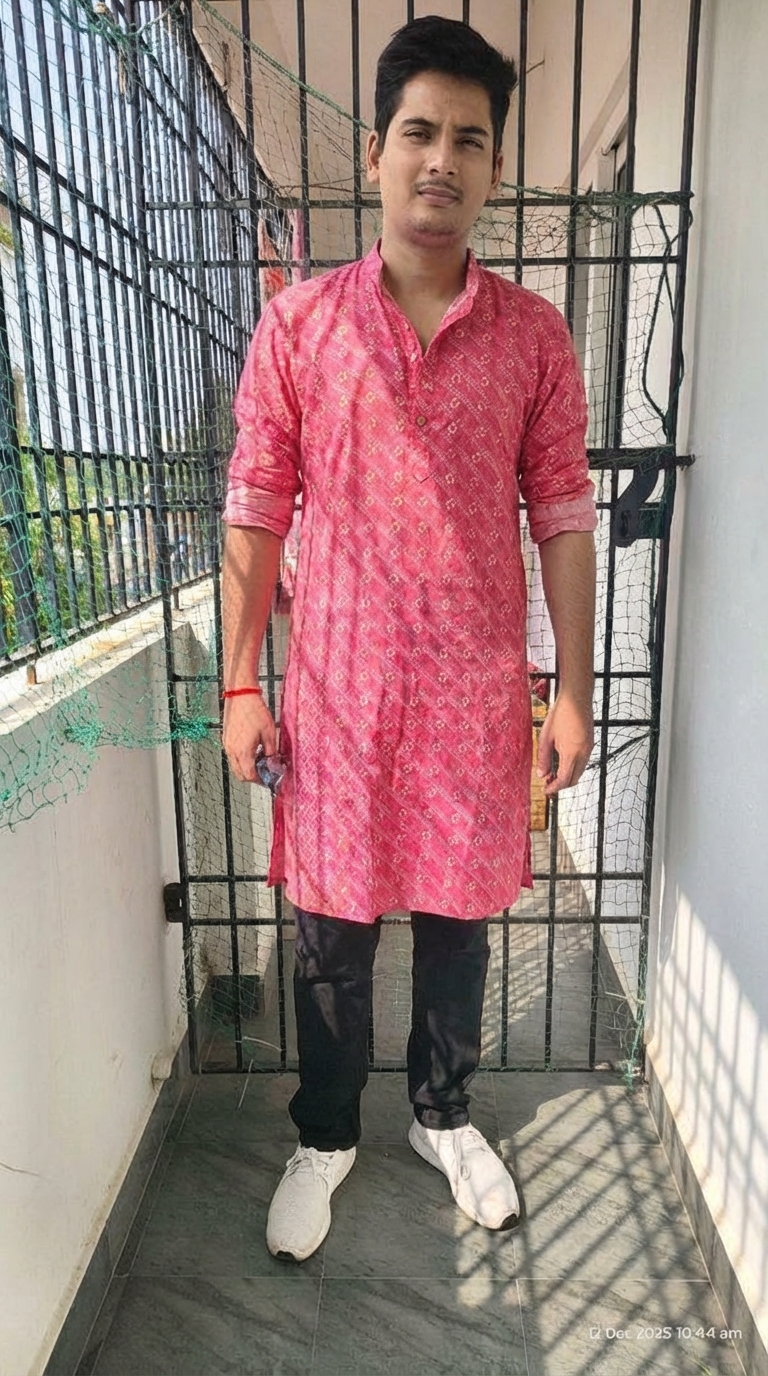
- **Facial Lock:** The user's face, including the hairline, ears, jawline, and neck structure, must be frozen. The skin tone of the neck must seamlessly transition into the open collar of the Kurta.
- **Body Integrity:** The user's body type is leaner than the source model. Do not bulk up the user's shoulders or arms to match the source. The Kurta should drape loosely on the user's actual frame, not stretch to fill a larger bounding box. Do not alter the width of the user's legs or the stance of the feet.