Thinking Process
PHASE 1: VISUAL DECONSTRUCTION
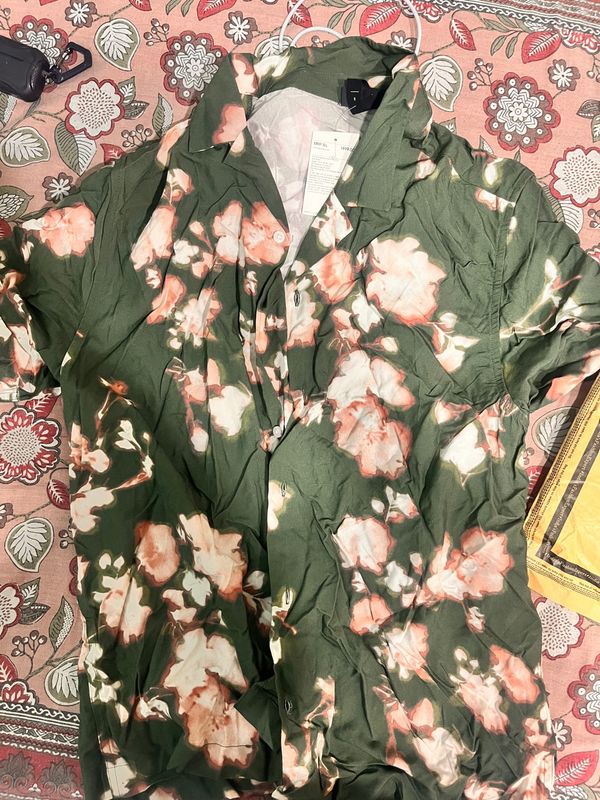
- **Fabric Physics:** The source garment appears to be a lightweight Viscose or Rayon blend. This is evidenced by the deep, irregular wrinkles and lack of structural rigidity in the source photo. The simulation must treat this as a high-drape, low-stiffness material that succumbs easily to gravity. It has a matte finish with very low specularity; it should not shine like silk or polyester.
- **Key Features:** The olive green base with large, distinct peach/pink floral patterns must be preserved without distortion. The "camp collar" style (relaxed, open neck) is distinct from the current crew neck t-shirt. The white buttons down the center placket must be rendered. Note: The price tag/label visible in the neck area of the source image must be virtually removed.
PHASE 2: FIT & DRAPE SIMULATION
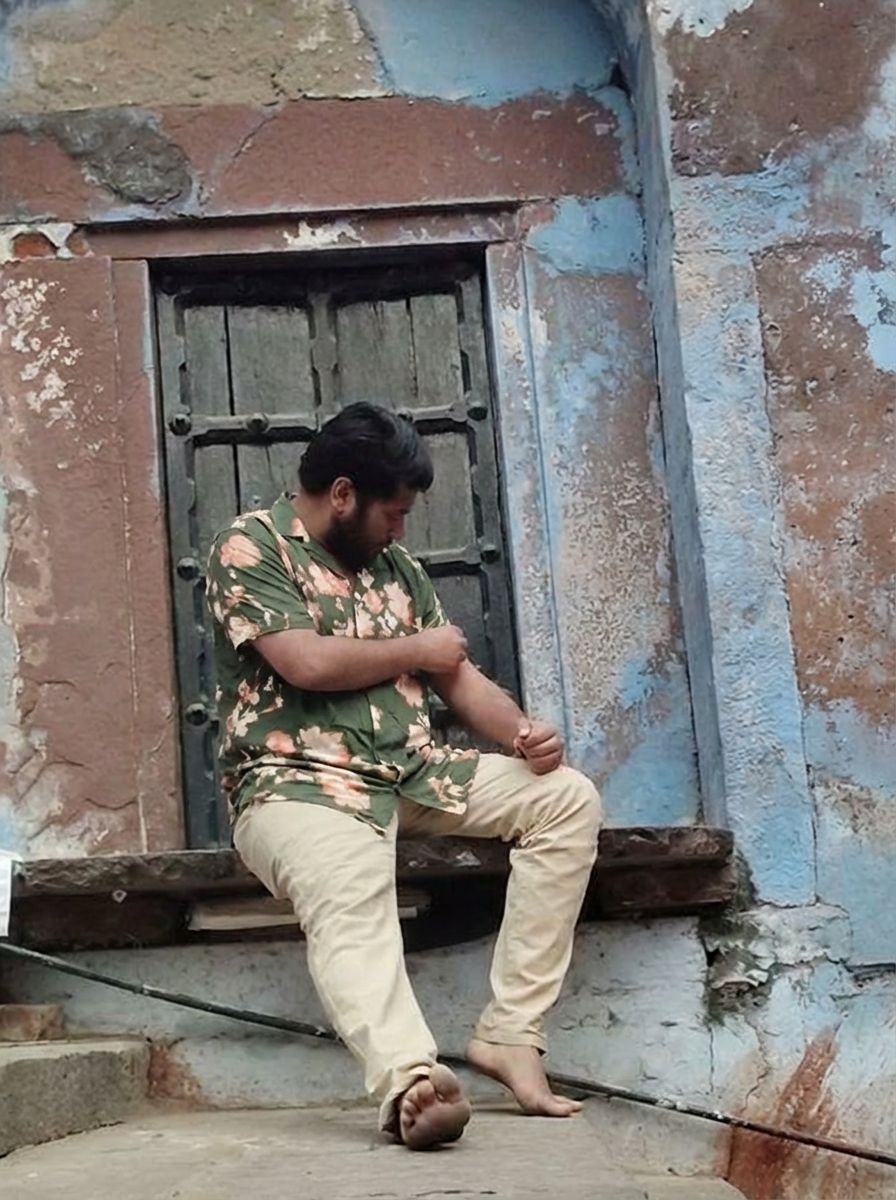
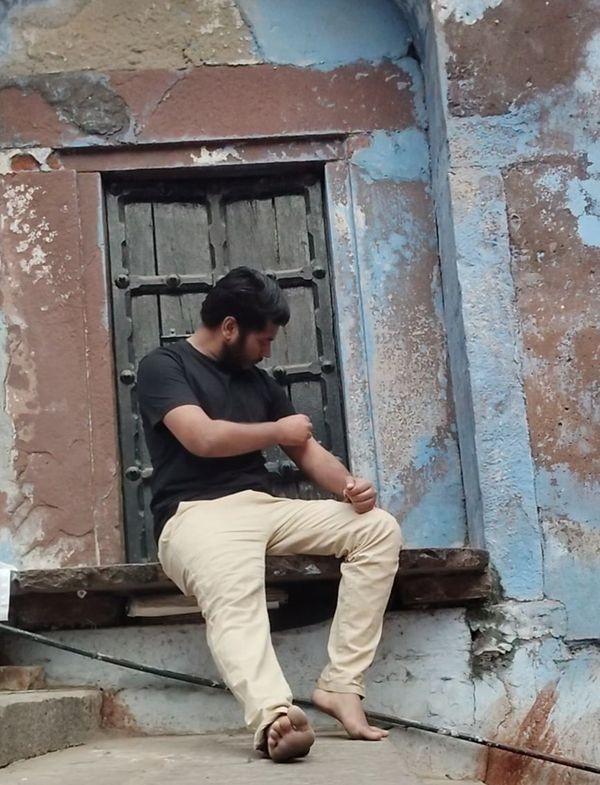
- **Body Mapping:** Unlike the current tight black t-shirt, the target shirt is a button-down which requires a looser fit (air gap between skin and cloth). Due to the user's seated, hunched-forward posture, the fabric must pool and fold significantly at the abdomen/lap area. The shoulders should drop slightly to reflect a relaxed fit. The fabric tension across the upper back must reflect the forward hunch.
- **Occlusion Handling:** The user's right hand/arm is crossing the torso to touch the left arm. This is a critical occlusion zone; the new shirt texture must pass *behind* the right forearm and hand. The hem of the shirt will interact with the beige trousers and the stone ledge he is sitting on; the shirt tails should drape naturally over the hips/thighs, potentially flaring out slightly due to the seated compression.
PHASE 3: ENVIRONMENT & LIGHTING
- **Light Match:** The user image features diffuse, soft, natural outdoor daylight (likely overcast or shaded) with a cool temperature, contrasting with the warmer, artificial indoor lighting of the cloth image. The shirt's lighting must be neutralized and relit with a soft ambient fill. Shadows should be subtle and cast downward and slightly to the right, matching the shadowing under the user's chin and legs.
- **Color Calibration:** The olive green of the shirt needs to be slightly desaturated and shifted cooler to harmonize with the dominant blue and grey tones of the background wall. The contrast of the floral print must be reduced slightly to match the lower-contrast "faded" aesthetic of the user photo.
PHASE 4: IDENTITY PROTECTION
- **Facial Lock:** The user's entire head, including the beard, hair, and specific profile angle, must be masked and frozen. The neck area where the beard meets the skin must be carefully segmented to allow the new open collar to sit naturally without clipping into the jawline.
- **Body Integrity:** The user's physique (arm thickness, torso width, and seated posture) must not be altered. The simulation must add volume *on top* of the body (due to the looser fit of the shirt) rather than slimming the user to fit the garment. The feet and legs must remain pixel-perfectly identical to the original image.