Thinking Process
PHASE 1: VISUAL DECONSTRUCTION
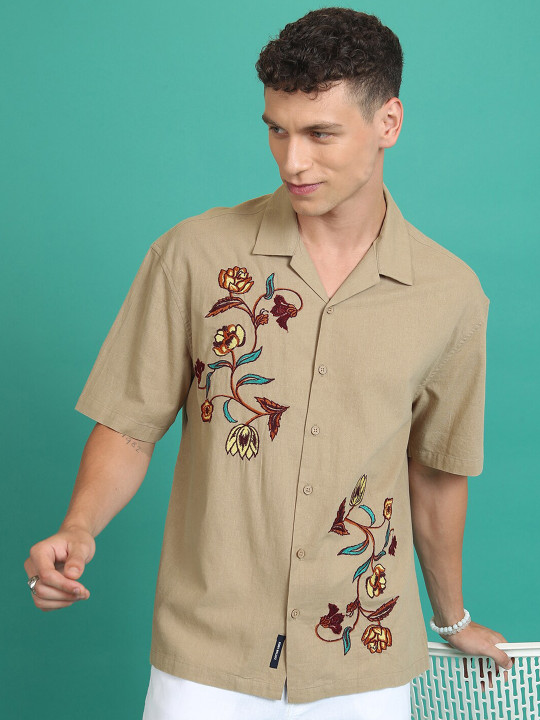
- **Fabric Physics:** The source garment is a linen or linen-blend fabric with a matte finish. It possesses medium stiffness but high breathability, meaning it does not cling like lycra nor hold rigid shapes like heavy denim. Light reflection must be diffuse (low specularity) to capture the natural, fibrous texture. The fabric should exhibit soft, organic micro-wrinkles rather than sharp, geometric creases.
- **Key Features:**
1. **Cuban Collar:** The open, notched lapel structure must be preserved and seated correctly around the user's neck.
2. **Floral Embroidery:** The large floral motifs (brown/yellow/teal) on the chest and abdomen must be retained. Crucially, the embroidery thread has a slight sheen/relief texture different from the base fabric.
3. **Button Placket:** Brown buttons and the specific button spacing.
4. **Hemline Tag:** The small black rectangular brand tag near the bottom hem.
PHASE 2: FIT & DRAPE SIMULATION
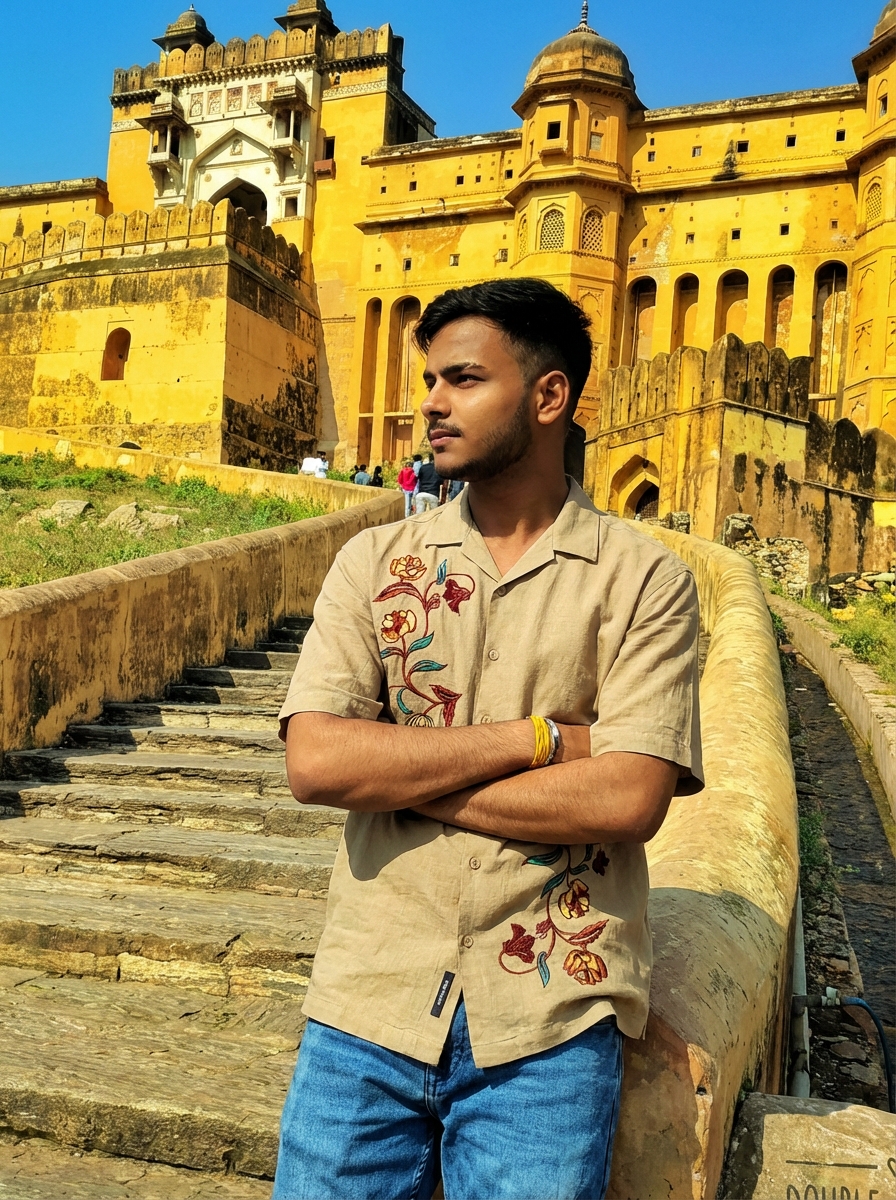
- **Body Mapping:** The user is in a "Crossed Arms" pose with a slight lean.
- **Torso Compression:** The fabric must appear compressed and bunched between the user's biceps and pectorals due to the crossed arms. It cannot sit flat; it must warp inward at the fold points.
- **Sleeve Physics:** The source is short-sleeved (mid-bicep), while the target currently wears long sleeves. The simulation must terminate the new garment at the mid-bicep. The fabric at the shoulder/armpit must stretch across the back deltoids due to the forward arm position.
- **Embroidery Distortion:** The floral patterns will be partially obscured or folded by the arm position; the pattern mapping must distort physically, not just visually crop.
- **Occlusion Handling:**
- **Primary Occlusion:** The user's left forearm and hand (wearing the yellow wristband) are the dominant foreground layer. The new shirt's fabric must pass *behind* this arm.
- **Secondary Occlusion:** The right hand is tucked under the left bicep; the garment needs to drape around this tucked volume without intersecting the geometry.
PHASE 3: ENVIRONMENT & LIGHTING
- **Light Match:** The target environment features harsh, high-contrast natural sunlight (hard lighting) coming from the upper left.
- **Shadow Casting:** The new garment must cast a hard shadow onto the user's jeans. Furthermore, the user's crossed arms must cast deep, sharp shadows onto the chest and stomach area of the new beige shirt.
- **Texture Depth:** The linen texture needs high-contrast normal mapping to show depth in this harsh sunlight.
- **Color Calibration:** The target scene is dominated by warm yellow sandstone (Amber Fort) and blue sky.
- **Global Illumination:** The beige/tan color of the source shirt must be warmed significantly. It requires a "golden hour" or warm daylight tint to match the ambient bounce light from the yellow walls. It should not retain the cool/neutral tone of the green-screen studio shot.
PHASE 4: IDENTITY PROTECTION
- **Facial Lock:** Absolute freeze on the user's face, jawline, hair, and ear structure. The neck area above the collar bone must remain untouched.
- **Body Integrity:** The volumetric shape of the user must be preserved. Do not slim the torso or alter the width of the shoulders. The volume of the arms, specifically the biceps flattened against the chest, must dictate the garment shape, not the other way around. The user's skin tone on the visible hands/neck must not change.