
Thinking Process
PHASE 1: VISUAL DECONSTRUCTION
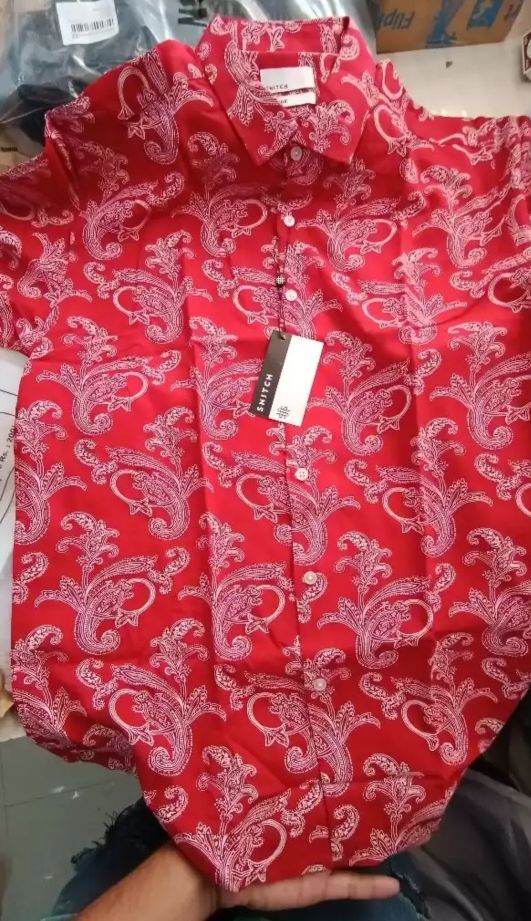
- **Fabric Physics:** The source garment appears to be a lightweight woven cotton or cotton-poplin blend. Unlike the user's current knit polo, this fabric has higher structural rigidity and lower elasticity. It should simulate a matte finish with diffuse reflection. The drape must exhibit crisp folding rather than clinging, maintaining a structured collar stand and sharper creases at stress points (shoulders/axilla) compared to the soft folds of the current jersey fabric.
- **Key Features:** The complex white paisley pattern on the red base must maintain vector consistency and not distort unnaturally across body curvature. Critical details to preserve include the white 4-hole buttons, the structured collar shape, the visible stitching on the placket, and the distinct sleeve hem. The retail hangtag (black tag labeled "SNITCH") should typically be removed for a realistic "worn" simulation, but the button placement it is attached to must remain intact.
PHASE 2: FIT & DRAPE SIMULATION
- **Body Mapping:** Due to the user's robust build and seated/standing posture, the woven fabric must drape significantly differently than the current polo. It should hang somewhat vertically from the chest peak, creating a "tented" gap above the stomach rather than hugging the abdomen. The fabric must deform realistically around the shoulders and tension lines should radiate from the buttons across the chest, indicating the fit on a broader torso without looking like spandex. The sleeves should flare slightly away from the bicep, not grip it.
- **Occlusion Handling:** This is a high-complexity occlusion scenario. The bouquet of roses and its pink wrapping paper cover the central torso (stomach/solar plexus region). The user's hands and the red/yellow religious thread bracelet on the right wrist are foreground objects. These elements must be segmented out and layered *strictly over* the generated paisley shirt. The gold chain necklace must also be re-composited over the new collar area or masked to appear tucked in, depending on the new collar's height.
PHASE 3: ENVIRONMENT & LIGHTING
- **Light Match:** The user is in a soft-light environment (likely a greenhouse or porch) with diffused natural daylight coming primarily from the front-left. The new garment requires ambient occlusion generation where the bouquet casts shadows onto the shirt chest. Shadows on the shirt itself must fall towards the user's right side (viewer's right). The lighting is soft; avoid harsh specular highlights on the cotton fabric.
- **Color Calibration:** The source cloth image has cool, artificial warehouse lighting. The red base of the paisley shirt must be color-graded to match the warmer, natural tones of the user's environment. The white paisley print must reflect the ambient environmental color (slight warm/green tint from surroundings) rather than remaining stark, artificially white.
PHASE 4: IDENTITY PROTECTION
- **Facial Lock:** Absolute pixel-lock required on the user's face, including the jawline, glasses (frames and lens reflections), hair, and neck texture up to the collar line.
- **Body Integrity:** Strictly forbidden to slim, contour, or alter the user's torso volume or arm circumference. The simulation must fit the garment to the user's existing biometric mesh, preserving the natural silhouette of the shoulders and midsection.