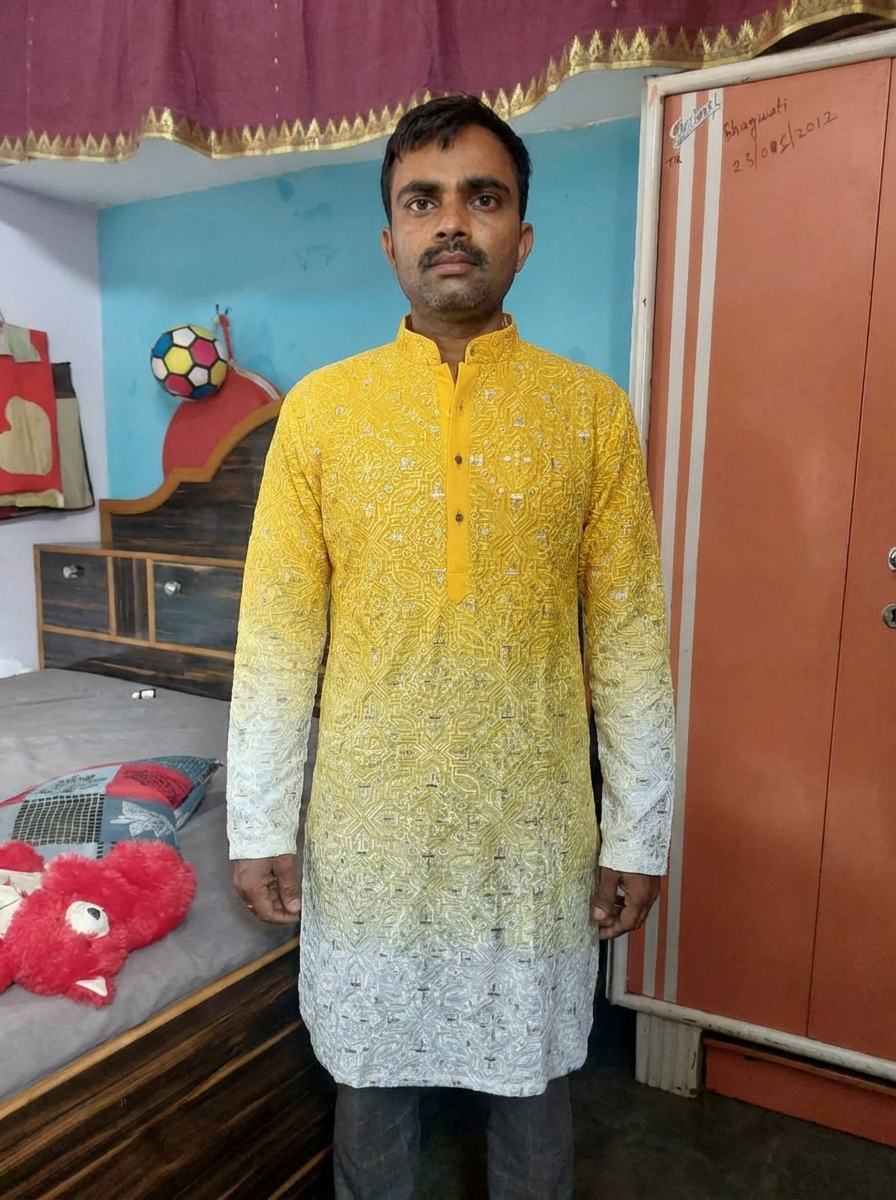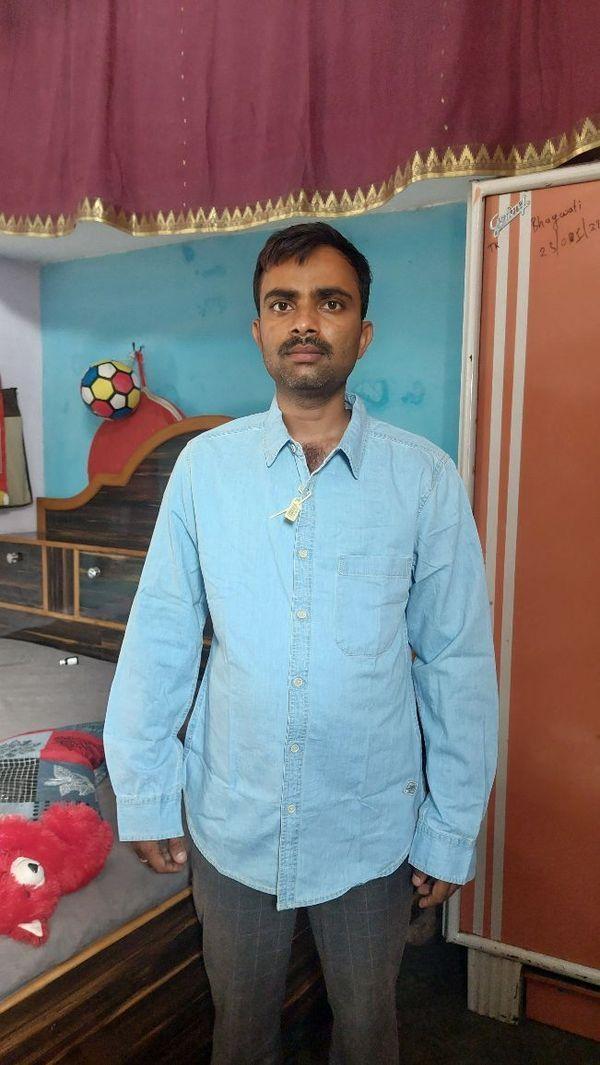
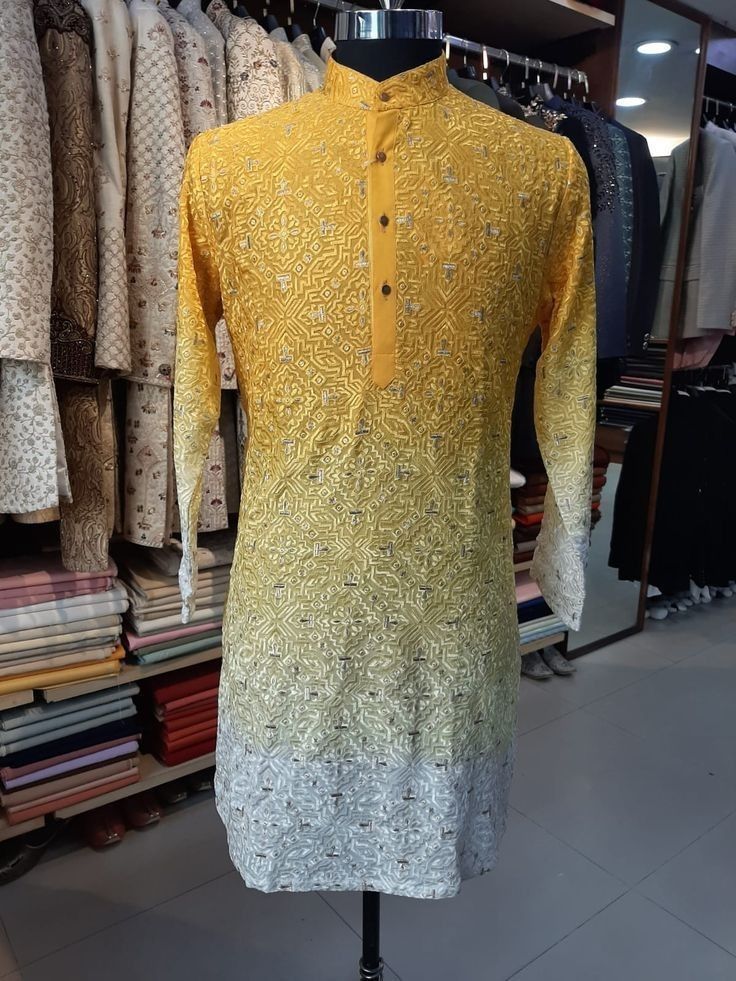
Thinking Process
PHASE 1: VISUAL DECONSTRUCTION
- **Fabric Physics:** The source garment is a structured, embroidered Kurta (likely silk-blend or starched cotton). It possesses a medium-heavy weight due to the dense thread work and embellishments. It should display anisotropic reflection—meaning the embroidery threads and sequins catch light differently than the base fabric, creating a localized shimmer rather than a uniform gloss. The drape should be somewhat rigid, maintaining a columnar shape rather than clinging tightly to the skin.
- **Key Features:**
1. **Ombre Gradient:** The transition from golden yellow at the shoulders to silver/white at the hem must be smooth.
2. **Mandarin Collar:** The stiff, upright collar structure must replace the user's current fold-down collar.
3. **Embroidery Texture:** The raised geometric/floral relief pattern must retain its depth map and not appear as a flat JPEG texture.
4. **Placket & Buttons:** The central vertical button line must remain centered on the user's sternum.
5. **Length:** This is a long garment; the hemline must extend significantly lower than the user's current shirt, reaching mid-thigh or knee-level.
PHASE 2: FIT & DRAPE SIMULATION
- **Body Mapping:**
1. **Shoulder Alignment:** The stiff shoulders of the Kurta must align with the user’s natural shoulder slope, replacing the dropped shoulder seam of the denim shirt.
2. **Vertical Hang:** Due to the garment's weight and length, gravity will pull the fabric straight down from the chest/shoulder line. It should bridge over the waist area rather than tucking in or conforming to the hips.
3. **Sleeve Interaction:** The sleeves should be less bunched than the current denim shirt. While the user's arms are slightly bent, the Kurta fabric is stiffer and should show fewer, sharper folds at the elbow crease compared to the soft denim.
- **Occlusion Handling:**
1. **Hands/Wrists:** The user's hands are visible; the new sleeves must terminate at the wrist bone, ensuring the hands layer *over* the cuffs.
2. **Lower Body Interaction:** Since the Kurta is longer than the current shirt, the simulation must generate the lower portion of the Kurta *over* the user's grey trousers. The trousers should only be visible starting from the mid-thigh/knee down.
PHASE 3: ENVIRONMENT & LIGHTING
- **Light Match:** The user's environment has a fairly harsh, direct frontal artificial light source (likely a camera flash or bright bulb), casting a defined shadow behind the subject on the bed frame. The high-contrast studio lighting of the mannequin must be flattened. The new garment requires a frontal fill light with a slight specularity for the embroidery, but avoiding deep, dramatic folds.
- **Color Calibration:** The user's room has blue walls, which creates a cool ambient fill. The yellow of the Kurta needs to be slightly desaturated and cooled to avoid looking "pasted on." The white bottom section of the Kurta should reflect a subtle blue tint from the surrounding walls rather than remaining pure studio white.
PHASE 4: IDENTITY PROTECTION
- **Facial Lock:** The user's entire head region, specifically from the neck up (including the jawline, facial hair, ears, and hair), must remain completely frozen. The new Mandarin collar must wrap around the existing neck geometry without cutting into the chin.
- **Body Integrity:** The user's shoulder width and arm volume must remain constant. The simulation must not slim the waist or broaden the chest to match the mannequin's proportions; the cloth must conform to the user, not the reverse.