
Thinking Process
PHASE 1: VISUAL DECONSTRUCTION
- **Fabric Physics:** The source garment consists of a heavy-gauge crochet or macramé knit, likely mercerized cotton. Unlike the smooth jersey knit the user is currently wearing, this material has significant structural rigidity and depth. It does not flow like liquid; it holds its shape with a boxy drape. Light interaction must account for "subsurface scattering" through the yarn and specular highlights on the 3D floral appliqués. The material is porous/open-work, meaning skin or a neutral under-layer must be visible through the intricate web pattern.
- **Key Features:** The 3D floral rosettes (raised texture) are the primary visual anchor and must retain their volumetric depth, not appearing as flat prints. The scalloped/crochet edge hemline and sleeves must be preserved, avoiding a straight "cut" line. The intricate radial web patterns connecting the flowers must remain distinct.
PHASE 2: FIT & DRAPE SIMULATION
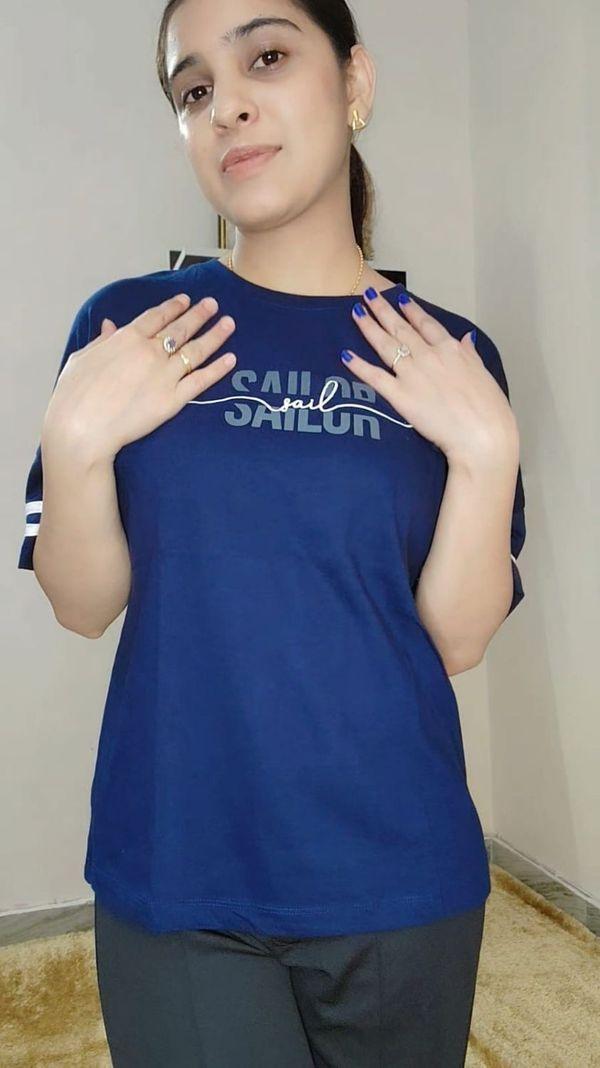
- **Body Mapping:** Due to the user's pose (hands pressed against upper chest), the rigid crochet fabric will experience compression at the contact points of the fingers. The garment has a boxy, semi-cropped cut; it should hang straighter from the shoulders than the current fitted blue t-shirt, creating a slight "tenting" effect below the bust line. The wide boat-neckline of the source garment will likely sit wider on the clavicles than the current crew neck.
- **Occlusion Handling:** **CRITICAL:** Both hands (specifically fingers and rings) obscure the upper torso. A strict alpha mask must be applied to the hands to layer them *over* the new crochet texture. The gold necklace currently worn falls near the new neckline; it must either be layered on top or realistically tucked inside depending on the exact drop of the new neckline. The hair strands on the neck must be segmented and placed in the foreground.
PHASE 3: ENVIRONMENT & LIGHTING
- **Light Match:** The user's environment utilizes soft, diffuse indoor lighting (likely a ring light or window) coming from the front-left, creating soft shadows on the wall. The source garment is currently lit by harsh, high-contrast sunlight. The VTO process must neutralize the high-contrast sun shadows on the crochet and re-render the texture with softer ambient occlusion to match the indoor scene. Shadows generated by the 3D flowers must fall to the right and slightly back, matching the shadow cast by the user's head.
- **Color Calibration:** The source garment is warm/golden due to sunlight. It requires color temperature cooling to match the neutral/cool white balance of the user's room. The "cream" color must react to the indoor light without appearing washed out or artificially bright white.
PHASE 4: IDENTITY PROTECTION
- **Facial Lock:** The entire head region, from the hairline to the chin, including ears and earrings, is a strict "frozen zone." No pixel alteration is permitted here.
- **Body Integrity:** The user's shoulder width and waist circumference must be respected. Do not slim the user to match the model in the source image. The precise geometry of the user's fingers and hand size must remain exactly as is—no generative warping of the digits is allowed.
