Thinking Process
PHASE 1: VISUAL DECONSTRUCTION
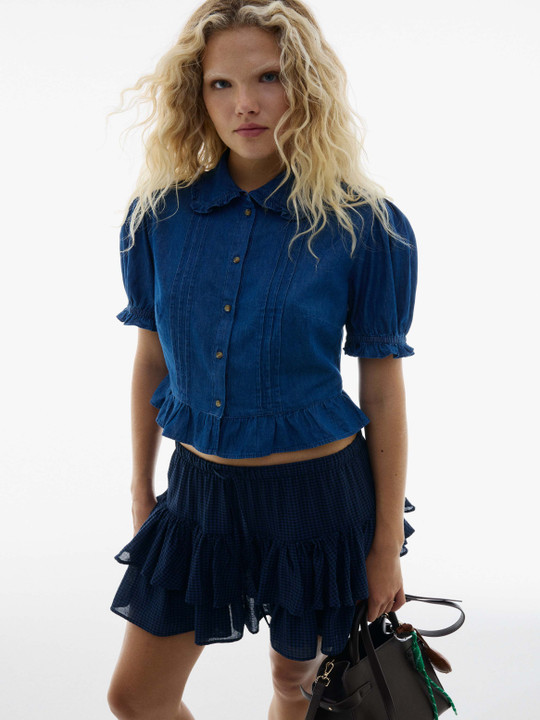
- **Fabric Physics:** The source garment is a lightweight denim or chambray material. It possesses moderate structural stiffness, evident in how the puff sleeves hold their volume and the collar stands. Unlike the user's current flowy top, this fabric should not drape like liquid; it must exhibit rigid folding patterns, particularly at the button placket and the ruffled peplum hem. Light reflection should be matte with low specular highlights, characteristic of cotton twill weave.
- **Key Features:** The transfer must preserve the vertical pin-tuck pleating on the bodice, the central vertical button line (brown/brass buttons), the "Peter Pan" style collar, the elasticated puff sleeves, and the specific ruffled peplum hemline. The cropped nature of the top (ending near the waistline) is a critical geometry detail.
PHASE 2: FIT & DRAPE SIMULATION
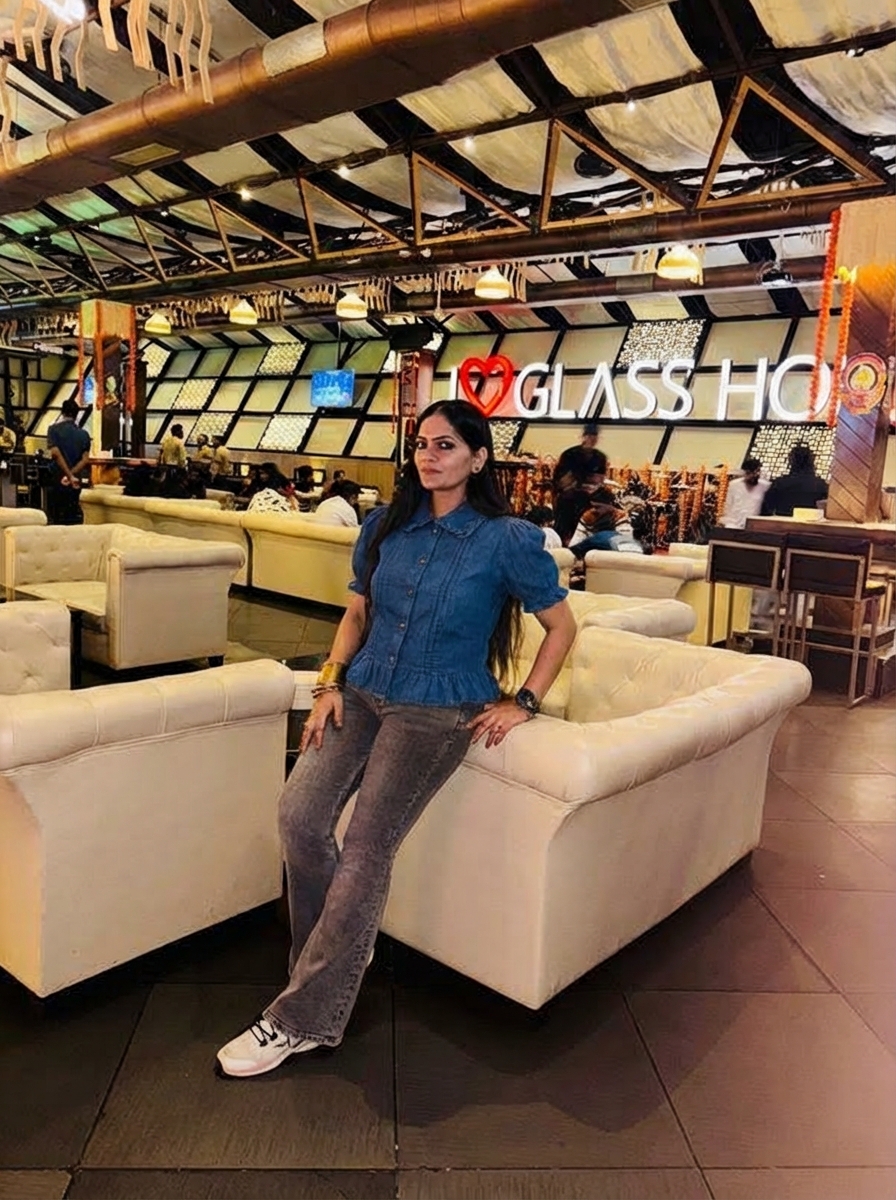
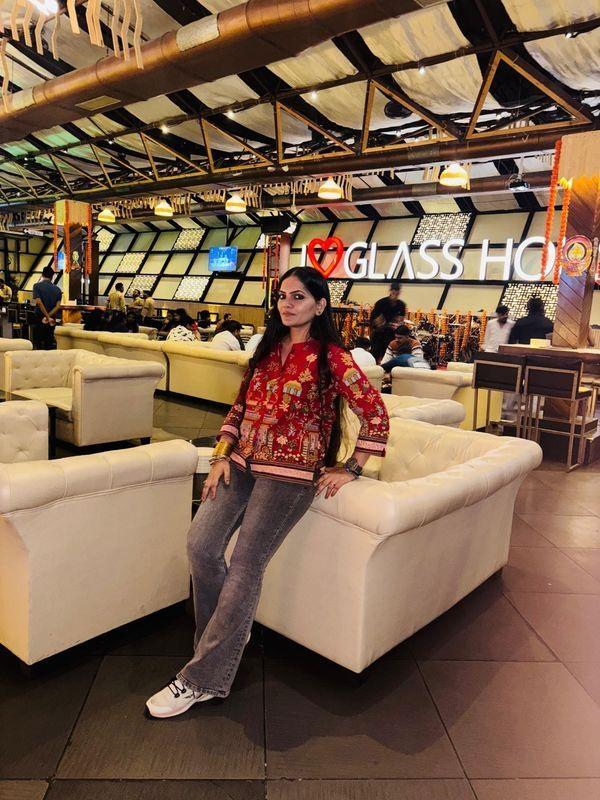
- **Body Mapping:** Due to the user's reclined/leaning back pose on the sofa, the denim shirt must conform to a compressed torso. The front of the shirt should show horizontal compression wrinkles across the stomach area. The ruffled hem must sit naturally just above or touching the waistband of the jeans, potentially lifting slightly away from the body due to the leaning angle. Crucially, since the source is short-sleeved and the target is long-sleeved, the simulation must generate accurate skin texture and lighting for the user's forearms, which are currently covered.
- **Occlusion Handling:** The user has long, dark hair cascading over both shoulders and down the chest. This is a high-priority occlusion layer; the hair must be segmented and composited *over* the new denim fabric. The user's right hand (resting on the leg) and left hand (on the sofa) must remain the top-most layer, ensuring the new shirt hem does not obscure the wrist or hand placement.
PHASE 3: ENVIRONMENT & LIGHTING
- **Light Match:** The target environment is a warm, dimly lit interior (restaurant/lounge) with overhead artificial fixtures. The source garment (currently in studio high-key lighting) must be significantly darkened. Shadows must be cast downwards from the ceiling lights, creating deeper shading under the collar, beneath the bust, and inside the fabric folds caused by the sitting posture.
- **Color Calibration:** The bright blue of the source denim must be color-graded to absorb the warm yellow/orange ambient tint of the room. The contrast should be softened to match the slightly grainy, low-light quality of the user image, removing the "studio crispness" of the source cloth.
PHASE 4: IDENTITY PROTECTION
- **Facial Lock:** The user's face, jawline, neck, and the specific volume and texture of her long hair must be frozen and completely preserved.
- **Body Integrity:** Strict prohibition on slimming or altering the user's waist width or arm thickness. The generated forearms (for the short sleeves) must anatomically match the scale and skin tone of the user's visible hands and face. The natural slouch/lean of the torso against the sofa must be maintained—do not artificially straighten the spine.