Thinking Process
PHASE 1: VISUAL DECONSTRUCTION
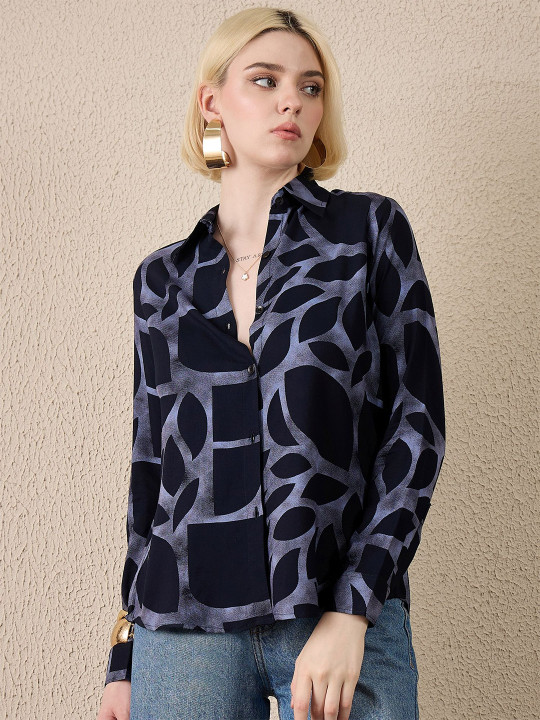
- **Fabric Physics:** The source garment appears to be a lightweight woven fabric, likely Rayon or Viscose. It possesses a soft drape with a matte finish (low specularity/shine). It is not stiff; therefore, the simulation must allow for fluid deformation rather than rigid geometric holds. It should drape heavily under gravity rather than standing away from the body.
- **Key Features:** The abstract blue/grey "leaf" geometric print on the dark navy background must remain crisp. The sharp shirt collar structure, the central button placket, and the specific cuff detailing on the long sleeves are critical anchor points that must be generated.
PHASE 2: FIT & DRAPE SIMULATION
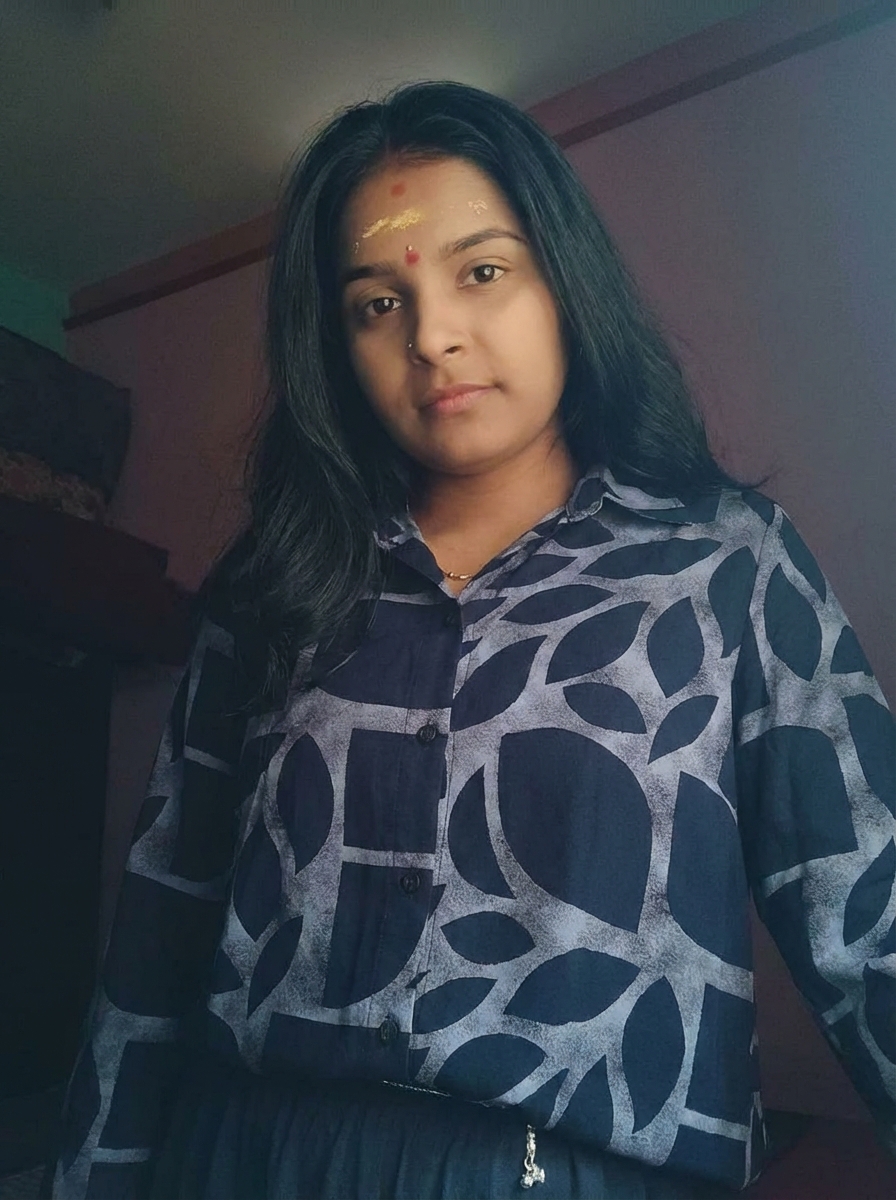
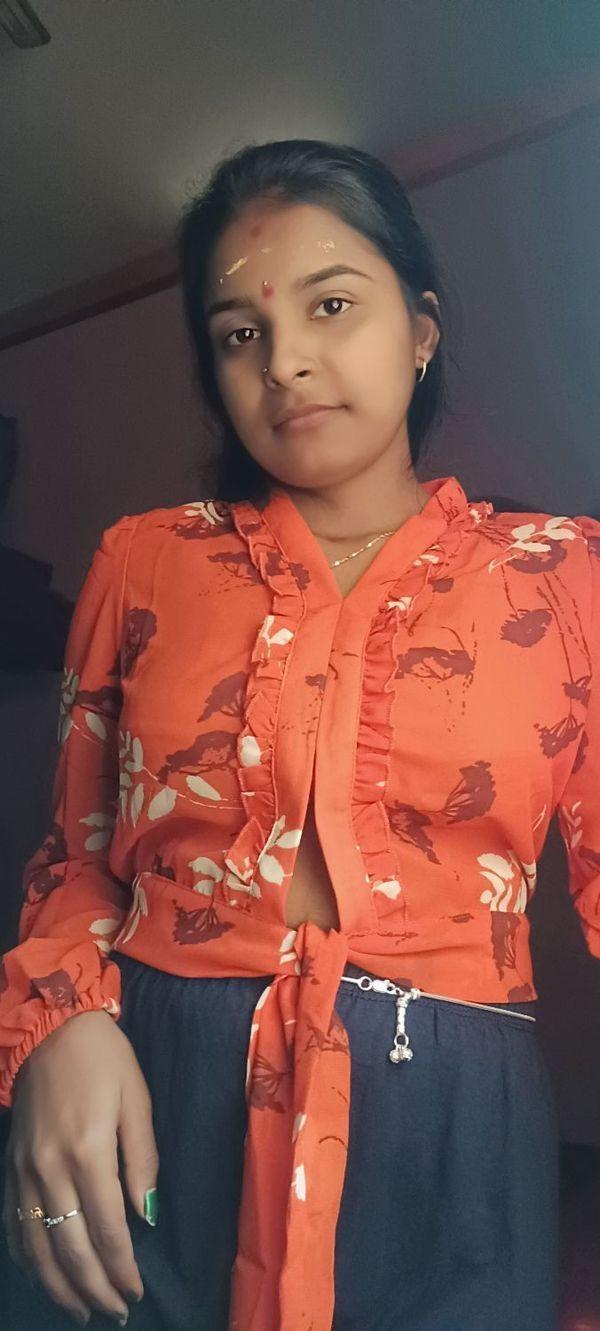
- **Body Mapping:** The source shirt is a full-length tunic style, whereas the user is currently wearing a cropped tie-front top. The simulation must extend the fabric geometry downwards to cover the user's currently exposed midriff and navel area. On the user's right arm (viewer's left), which is straight, the sleeve should hang smoothly with slight bunching at the wrist. On the left side, the fabric must conform to the body's slight rotation without warping the pattern.
- **Occlusion Handling:**
1. **Hair:** The user's dark hair cascades over her right shoulder (viewer's left). The new shirt collar and shoulder panel must receive a hard mask to sit *behind* this hair volume.
2. **Waist Chain:** The silver waist chain currently sits on the hips. Since the new garment is longer, it will naturally drape *over* and obscure this chain unless a tuck-in is simulated. Default physics should obscure the chain to avoid unnatural clipping.
3. **Hands:** The user's right hand (resting on the thigh) must be segmented out; the sleeve cuff must terminate before the hand or layer behind it.
PHASE 3: ENVIRONMENT & LIGHTING
- **Light Match:** The user's environment has soft, diffuse indoor lighting, likely from a window on the viewer's left (judging by the forehead highlight). The source image is high-contrast studio lighting. The target render must lower the contrast of the shirt, reducing the harsh studio highlights and introducing soft, diffuse shadowing on the right side of the torso (viewer's right) to match the room's ambient occlusion.
- **Color Calibration:** The source shirt is cool-toned (navy/grey). The user's image has a warmer, yellowish indoor cast. A slight warm filter (temperature adjustment +5-10%) must be applied to the shirt texture to integrate it into the room's atmosphere, preventing it from looking like a superimposed "sticker."
PHASE 4: IDENTITY PROTECTION
- **Facial Lock:** Absolute freeze on the user's facial features, specifically the eyes, nose, lips, jawline, and the forehead markings (bindi/vibhuti). The neck transition point must be blended seamlessly.
- **Body Integrity:** Strictly forbidden to slim the user's torso or arms. The simulation must respect the user's natural width. Since the new shirt is a "relaxed fit," it should add slight volume/silhouette width compared to the current tight crop top, accurately representing the change in style.