Thinking Process
PHASE 1: VISUAL DECONSTRUCTION
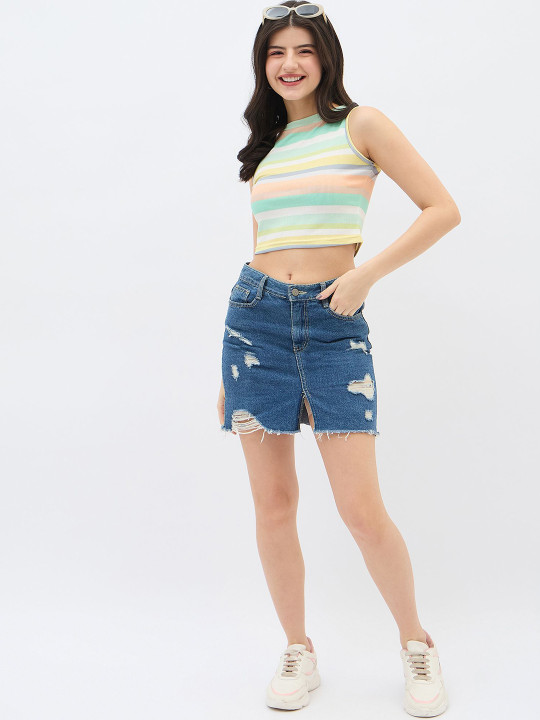
- **Fabric Physics:** The source garment is a rib-knit jersey cotton blend. It possesses high elasticity and a matte finish with very low specular reflection. It behaves as a "second skin," stretching tightly across curvatures rather than draping loosely. The simulation must treat the horizontal pastel stripes as texture on a deformable mesh to account for stretch without pixelation.
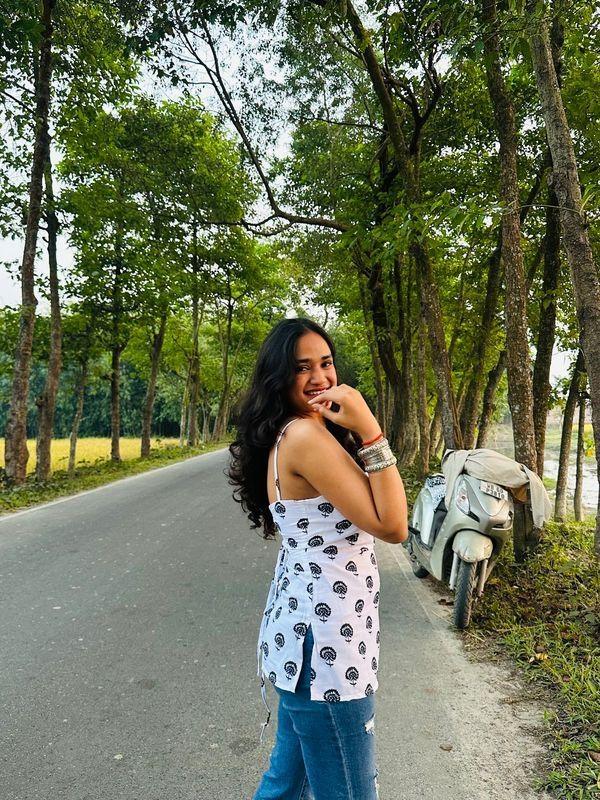
- **Key Features:** The high crew neckline is distinct and differs significantly from the user's current spaghetti straps. The pastel horizontal striping pattern (mint, yellow, peach, white) must be preserved. The hemline is cropped (sitting above the navel), which is shorter than the user's current tunic; the simulation must account for this cut change.
PHASE 2: FIT & DRAPE SIMULATION
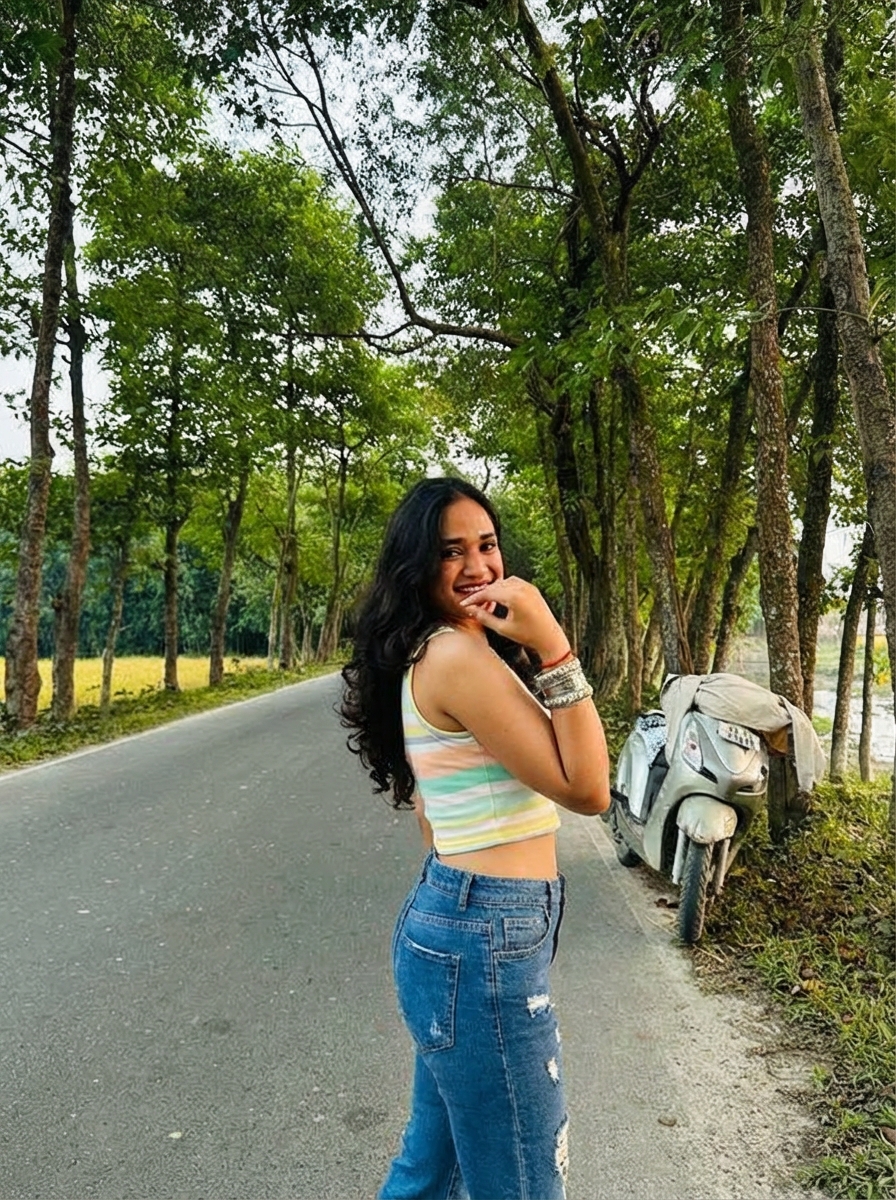
- **Body Mapping:** Due to the user's twisted torso pose (approx. 135-degree turn away from the camera), the horizontal stripes of the garment must warp sigmoidally to follow the spinal rotation and the projection of the right shoulder blade. The fabric must appear taut across the upper back and shoulder blade, with potential micro-folds appearing near the right armpit due to the raised arm position.
- **Occlusion Handling:**
- **Hair:** The user's voluminous dark, wavy hair falling over the right shoulder and down the back is the primary occlusion layer. The new garment must pass *under* these hair locks.
- **Accessories:** The silver cuff and red thread on the right wrist must remain the top layer, though they likely won't intersect the torso fabric directly.
- **Current Straps:** The user's current thin straps must be completely inpainted out, replaced by the wider shoulder coverage of the source tank top.
PHASE 3: ENVIRONMENT & LIGHTING
- **Light Match:** The target environment is diffuse outdoor daylight with soft, scattering shadows (likely overcast or shaded by trees). The source garment's flat studio lighting must be adjusted to accept ambient occlusion from the user's hair and soft directional shadowing from the upper left.
- **Color Calibration:** The source garment's studio-white balance is too sterile. It requires a subtle color grade shift toward the cooler, slightly green-tinted ambient light of the tree-lined road to match the target's white balance. Saturation should be slightly desaturated to match the natural outdoor aesthetic.
PHASE 4: IDENTITY PROTECTION
- **Facial Lock:** Absolute freeze on the facial region (eyes, nose, smiling mouth), the chin, and the right hand interacting with the face. The jawline definition must remain sharp.
- **Body Integrity:** The user's arm thickness and torso curvature must remain unaltered. No slimming filters. The skin tone of the shoulders and midriff (exposed by the new crop cut) must match the user's existing complexion perfectly.