Thinking Process
PHASE 1: VISUAL DECONSTRUCTION
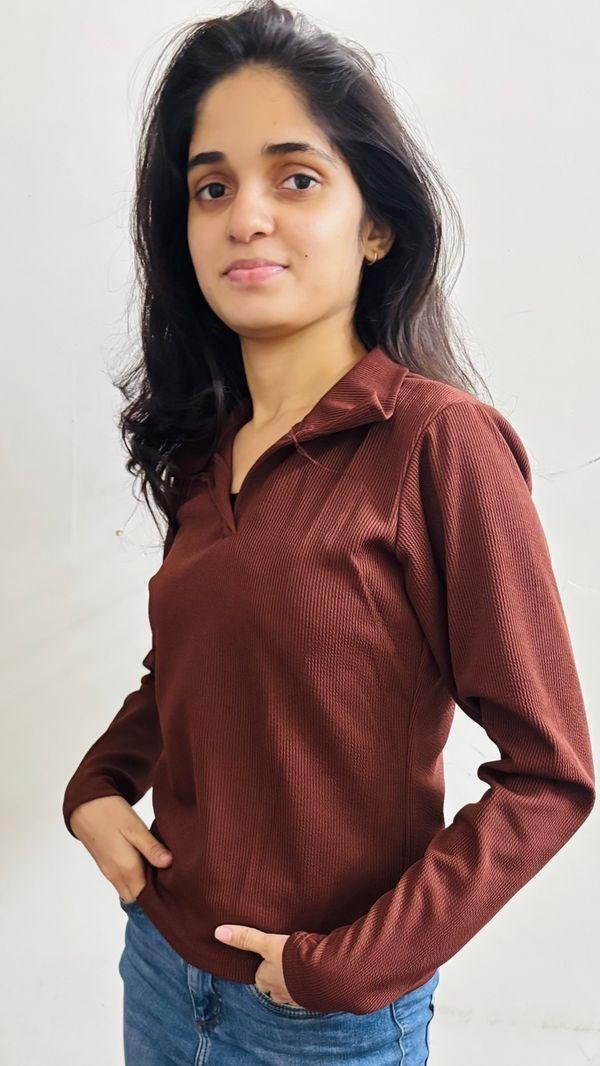
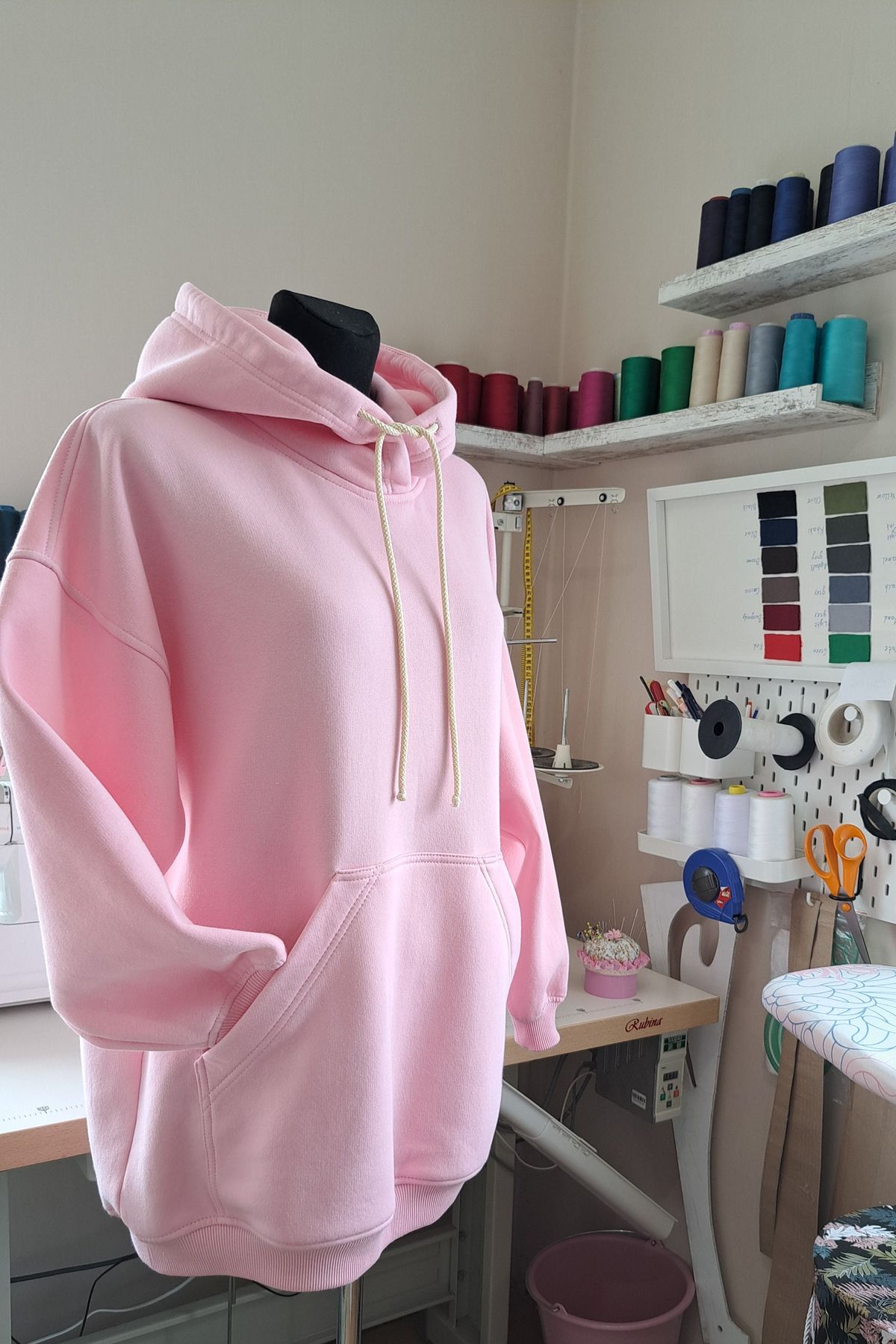
- **Fabric Physics:** The source garment is a heavy-weight cotton fleece blend (sweatshirt material). It has high bending resistance and structural rigidity compared to the user's current thin ribbed top. The surface is matte, diffusing light rather than reflecting it. The simulation must account for the fabric's thickness, preventing it from clinging tightly to the skin; it must maintain its own volume.
- **Key Features:**
- **The Hood:** Must be rendered as a voluminous addition around the neck, not flat.
- **Drawstrings:** The thick, twisted rope drawstrings are white and must hang subject to gravity, reacting to the slight tilt of the user's torso.
- **Kangaroo Pocket:** The stitching and dimensional pouch on the front must be preserved.
- **Ribbed Trims:** The elastic structure of the cuffs and bottom hem needs to be distinct from the main body fabric.
- **Drop Shoulders:** The seam placement must fall well below the user's natural shoulder line to maintain the "oversized" aesthetic.
PHASE 2: FIT & DRAPE SIMULATION
- **Body Mapping:**
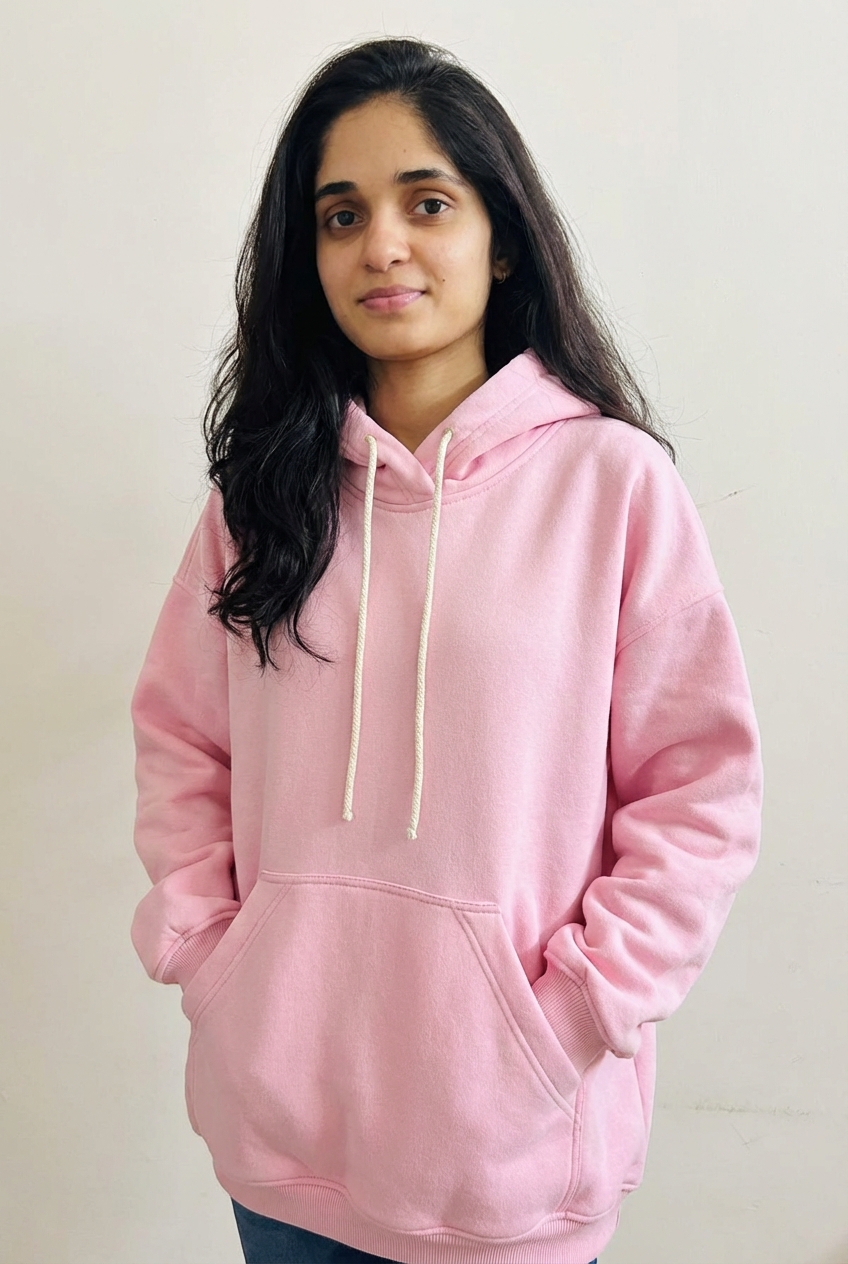
- **Silhouette Change:** The target garment is an "oversized fit." The simulation must expand the user's silhouette significantly at the torso and arms. The garment should not taper at the waist.
- **Sleeve Interaction:** The user's elbows are bent. The thick fleece fabric must create heavy, transverse folds at the inner elbow (cubital fossa) rather than small micro-wrinkles.
- **Hemline Interaction:** The user's hands are tucked into her jeans pockets/waistband. Since the hoodie is long, the bottom hem and lower pouch area will drape *over* the wrists and bunch up slightly where the hands enter the jeans, creating tension wrinkles radiating from the wrist/pocket area.
- **Occlusion Handling:**
- **Hair:** The user has voluminous dark hair draping over her left shoulder (viewer's right) and back. This hair must be segmented and layered *on top* of the pink hoodie. The hood geometry must be flattened or displaced slightly to accommodate the hair volume behind the neck.
- **Hands/Wrists:** The user's hands serve as an occlusion boundary. The garment sleeves must terminate at the wrists, and the bottom hem must interact physically with the forearms, not clip through them.
PHASE 3: ENVIRONMENT & LIGHTING
- **Light Match:** The user image features soft, diffuse daylight coming from the left (viewer's left), casting subtle shadows to the right. The hoodie must generate self-shadowing (ambient occlusion) particularly under the hood, inside the kangaroo pocket lip, and along the right side of the torso.
- **Color Calibration:** The source image (sewing room) has a warmer, yellowish indoor tungsten cast. The user image is cooler/neutral (daylight). The pink hue of the hoodie must be color-corrected (cooled down) to match the white balance of the user's environment, ensuring the whites of the drawstrings match the white of the background wall.
PHASE 4: IDENTITY PROTECTION
- **Facial Lock:** Absolute freeze on the facial region (eyes, nose, lips, eyebrows) and the skin tone of the face and neck. The jawline definition must remain sharp where it meets the hood/collar area.
- **Body Integrity:** Strictly forbidden to alter the user's underlying skeletal structure. Do not artificially slim the user to make the oversized hoodie look fitted. The result must show the user's petite frame wearing a large garment, preserving the realistic scale difference between body and cloth.