Thinking Process
PHASE 1: VISUAL DECONSTRUCTION
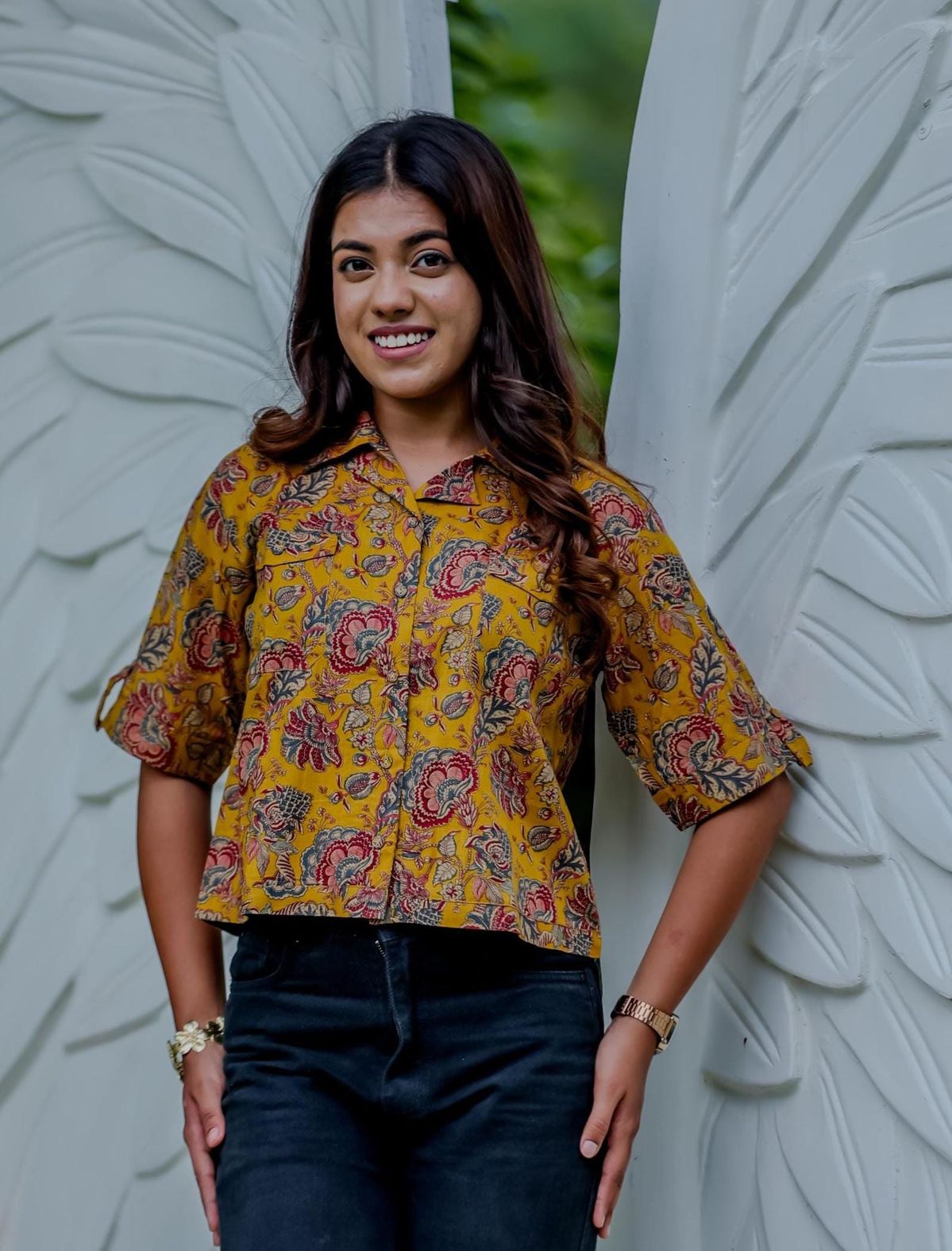
- **Fabric Physics:** The source garment is a woven cotton or cotton-blend poplin with a block-print pattern. Unlike the User’s current knit top, this material has low elasticity and medium structural rigidity. It should exhibit a matte finish with very low specular highlights. The drape must be semi-structured, holding its shape at the collar and sleeve cuffs rather than clinging to skin contours.
- **Key Features:** The floral block-print pattern (yellow base with red/green motifs), the structured collar, the front button placket, the chest pockets, and the folded/buttoned sleeve cuffs must be preserved. The slightly cropped, boxy silhouette is essential to the style and must replace the current tight-fitting silhouette.
PHASE 2: FIT & DRAPE SIMULATION
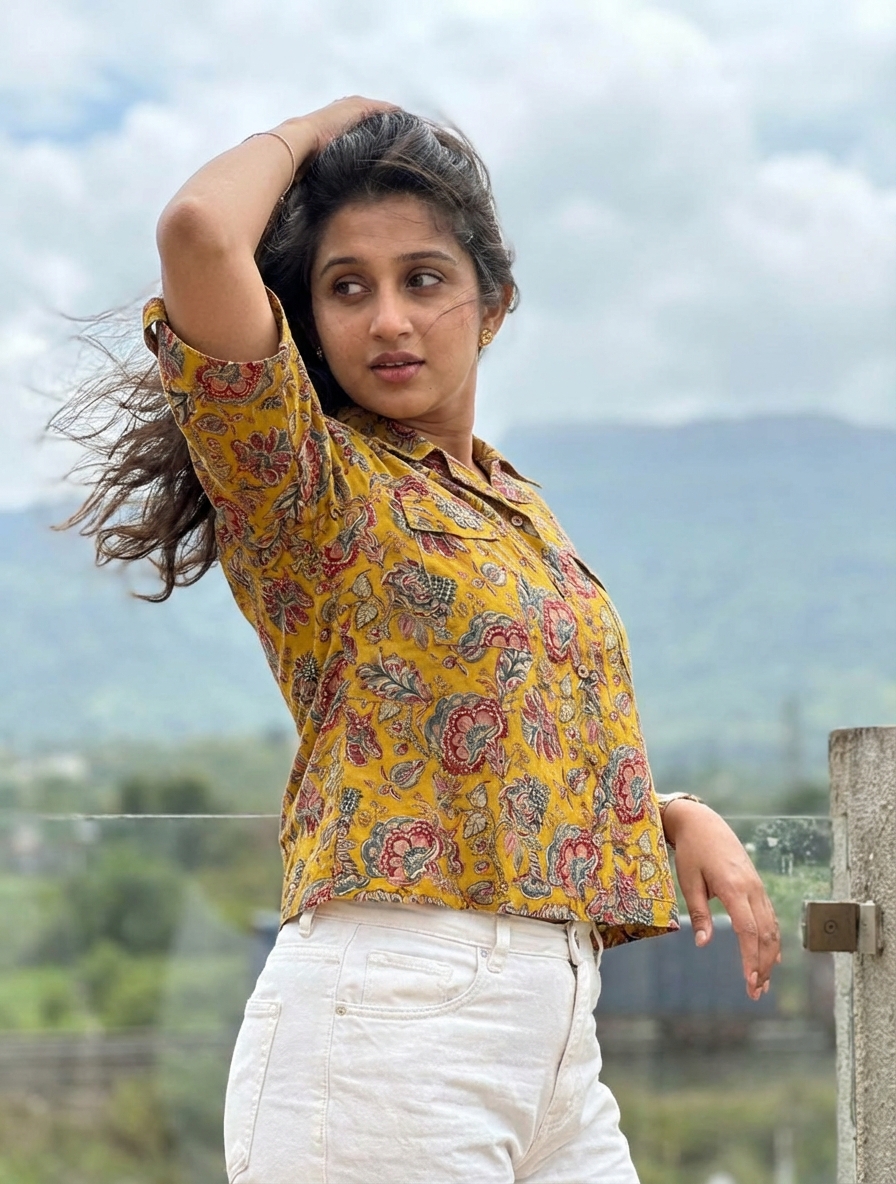
- **Body Mapping:** Due to the User's twisted torso pose (looking back over left shoulder) and the raised left arm, the non-stretch fabric must behave dynamically.
- *Left Shoulder (Raised):* The sleeve must slide down towards the shoulder joint due to gravity, causing fabric bunching at the deltoid/armpit area.
- *Right Shoulder (Leaning):* Since the right arm is resting on the railing, the right shoulder is elevated. The shirt fabric should bunch slightly at the clavicle and hang vertically, not curving inward at the waist.
- *Waist:* The garment should hang loosely over the waistband of the white jeans, creating a distinct separation gap rather than being tucked in or skin-tight.
- **Occlusion Handling:**
- **Hair:** The User's voluminous, wind-blown hair falling over the right shoulder and back is a critical occlusion layer. It must be masked and composited *over* the new shirt collar and shoulder panel.
- **Left Hand/Wrist:** The watch on the left wrist is high enough to be clear, but the arm position dictates the sleeve opening angle.
- **Railing:** The bottom hem of the shirt on the right side may interact with the glass railing; the fabric must appear to rest against or hang just above the railing, not clip through it.
PHASE 3: ENVIRONMENT & LIGHTING
- **Light Match:** The User environment is an overcast outdoor setting with soft, diffuse, top-down daylight (cool temperature). Shadows are soft and minimal. The source garment's lighting is fairly flat/studio-lit. We must introduce subtle ambient occlusion shadows where the collar meets the neck and inside the sleeve openings to ground the garment.
- **Color Calibration:** The source garment's yellow is warm and saturated. It must be slightly desaturated and color-graded with a cool/blue tint to match the atmospheric perspective of the cloudy outdoor background, ensuring it doesn't look like a high-contrast overlay.
PHASE 4: IDENTITY PROTECTION
- **Facial Lock:** The entire head, facial expression (smile), and neck structure above the clavicle must remain strictly frozen. The specific hairline and the wind-blown hair silhouette are immutable.
- **Body Integrity:** Strict prohibition on warping the user's arm thickness or waist width. The white jeans must remain untouched. The simulation must fit the *cloth to the body*, not warp the body to fit the cloth. The skin tone on the exposed arms and midriff (if visible) must match the original image exactly.