Thinking Process
PHASE 1: VISUAL DECONSTRUCTION
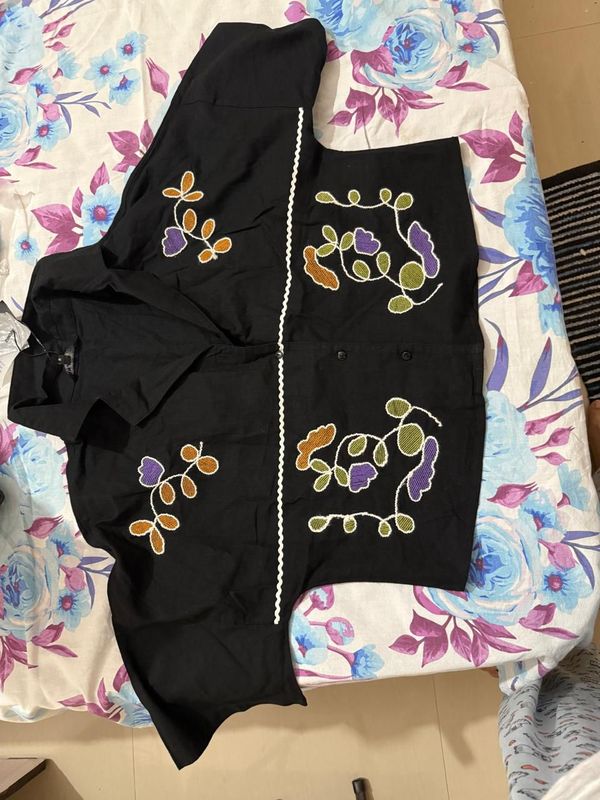
- **Fabric Physics:** The source garment appears to be a medium-weight woven cotton or cotton-rayon blend with a matte finish. It possesses low specular reflection (it will not shine under the outdoor sun) but absorbs light heavily due to the black pigment. The fabric has moderate structural integrity to support the embroidery but will drape softly rather than stand stiffly.
- **Key Features:**
- The white "rickrack" (wavy) piping running vertically down the placket is a critical high-contrast anchor point.
- The floral embroidery (purple, green, orange thread) on the chest and lower abdomen must maintain thread texture and not appear as a flat print.
- The camp-collar style neckline.
- The button placements along the center axis.
PHASE 2: FIT & DRAPE SIMULATION
- **Body Mapping:**
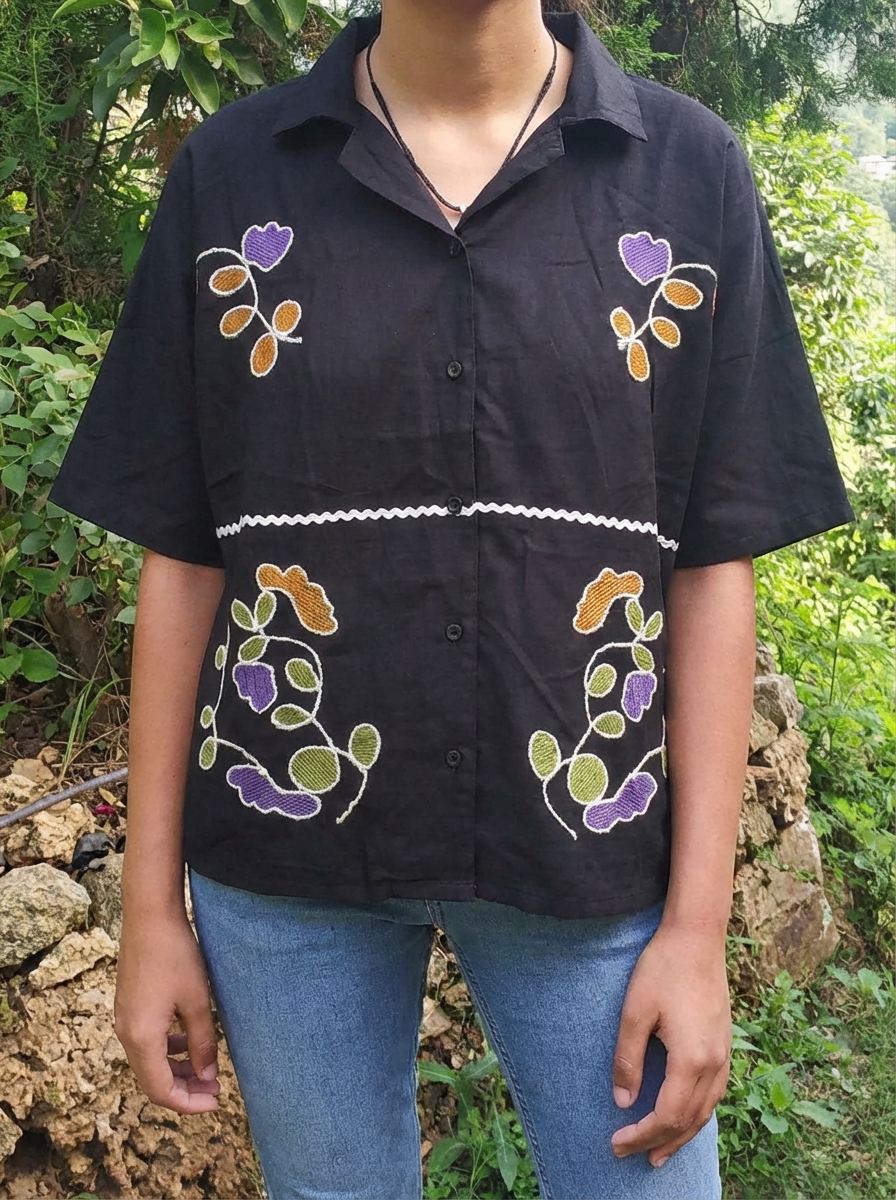
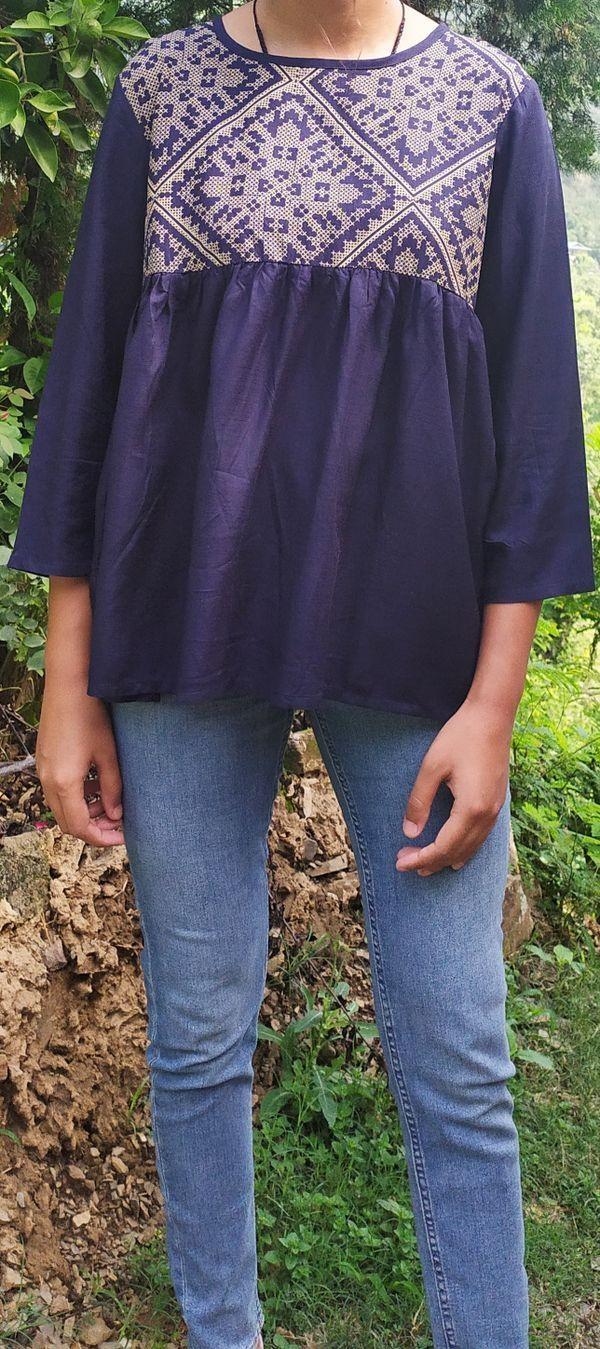
- **Torso Reconstruction:** The user is currently wearing a high-volume, gathered "peplum" style top. The simulation must ignore the volumetric flare of the current blue top and map the black shirt to the estimated narrower torso underneath. The new shirt is a straight-cut button-down; it should hang vertically from the shoulders and bust, settling near the hips without the gathered fullness of the original garment.
- **Sleeve Transition:** The source garment has short sleeves, while the user is wearing long sleeves. The physics engine must terminate the black sleeves at the mid-bicep. *Critical:* The user's forearms (currently covered in blue fabric) require generative skin reconstruction to match the visible neck/chest skin tone.
- **Occlusion Handling:**
- **Necklace:** The black cord necklace worn by the user must be segmented and layered *over* the new collar to maintain realism.
- **Waist/Hips:** The hem of the black shirt should fall naturally over the waistband of the jeans, interacting with the hips but not clipping into the denim.
- **Hands:** The hands are positioned low; the new shirt's hemline needs to clear the wrists/fingers properly without unnatural collision.
PHASE 3: ENVIRONMENT & LIGHTING
- **Light Match:** The target environment is outdoor daylight with diffuse, soft lighting (no harsh directional shadows). The source image has indoor, likely warm artificial lighting. The black shirt must be color-graded to remove yellow casts and adopt a cooler, natural daylight tone.
- **Color Calibration:**
- The "black" of the shirt must be lifted slightly to dark grey in the highlights to prevent "crushing" the texture against the outdoor background.
- The embroidery thread colors must be vibrance-adjusted to match the saturation levels of the surrounding green foliage in the user image.
PHASE 4: IDENTITY PROTECTION
- **Facial Lock:** The user's neck, chin line, and visible lower face must be masked and frozen completely.
- **Body Integrity:** Strict prohibition on warping the user's underlying skeletal structure. Although the current garment is loose, the VTO must not assume the user is that wide; it must estimate the true body width for the straight-cut shirt to ensure the user does not look artificially bulky.