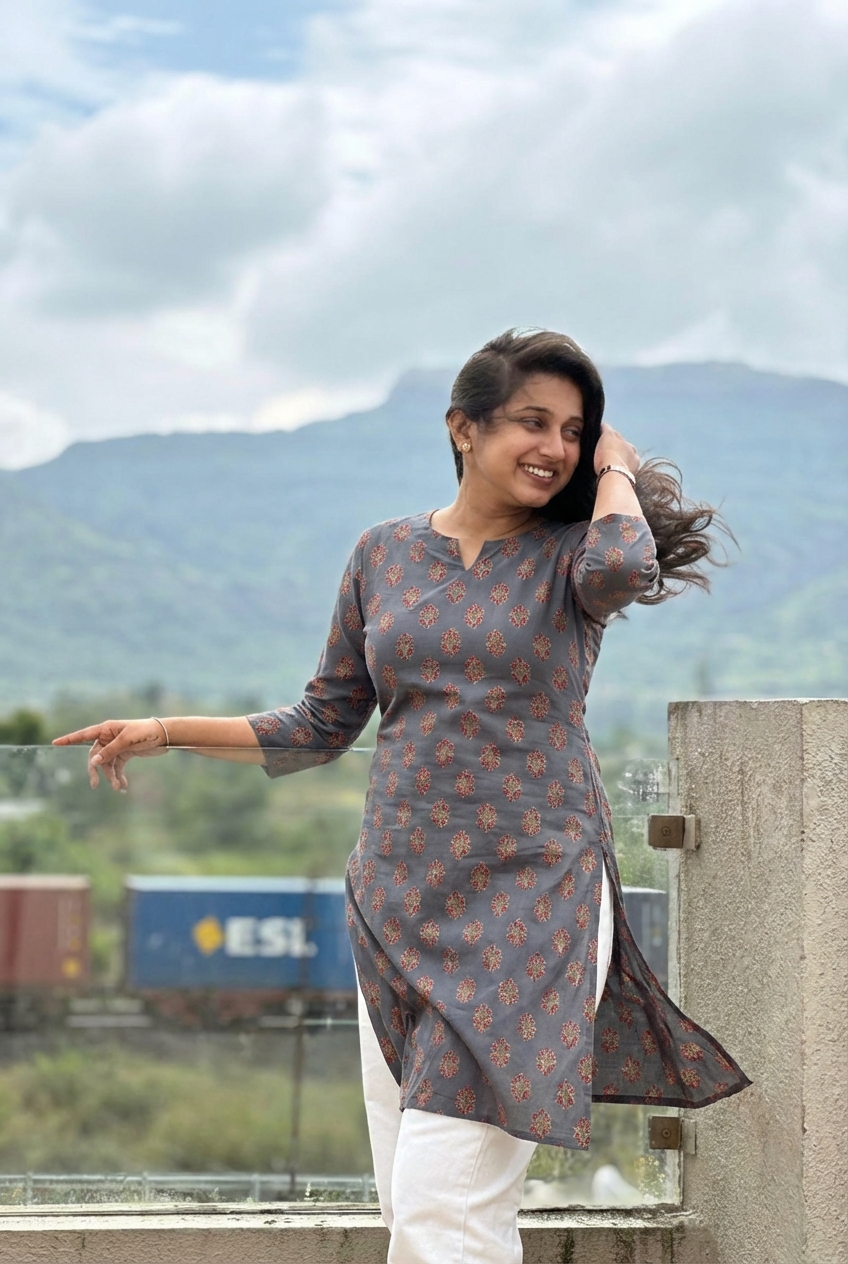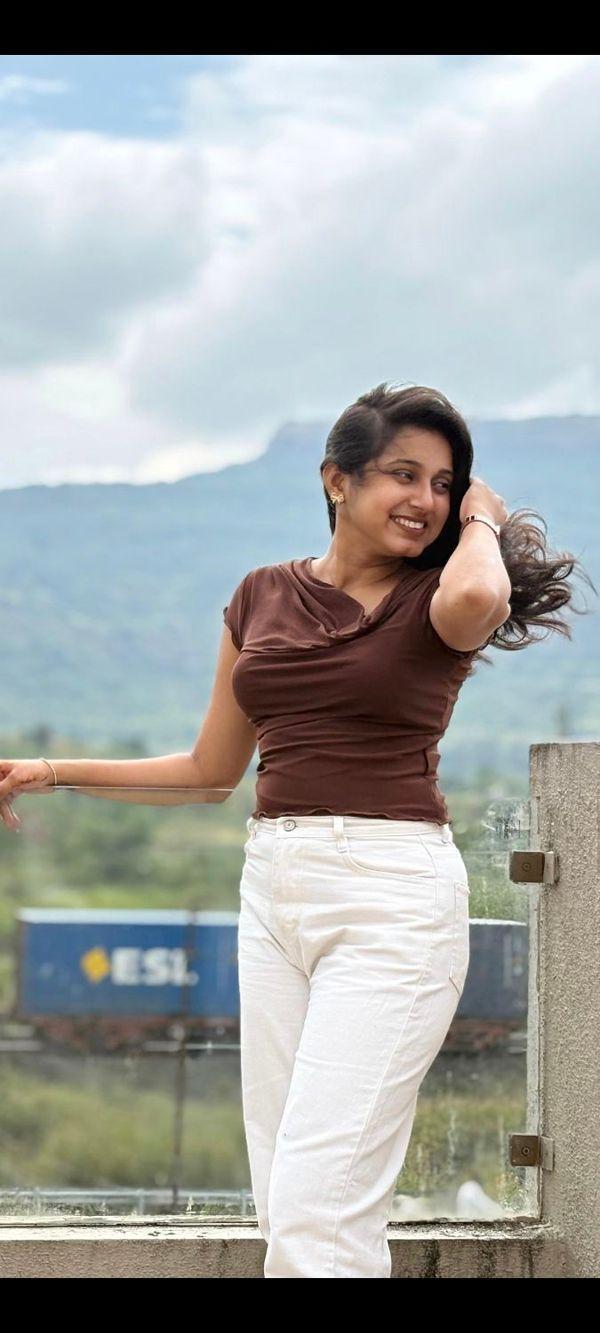
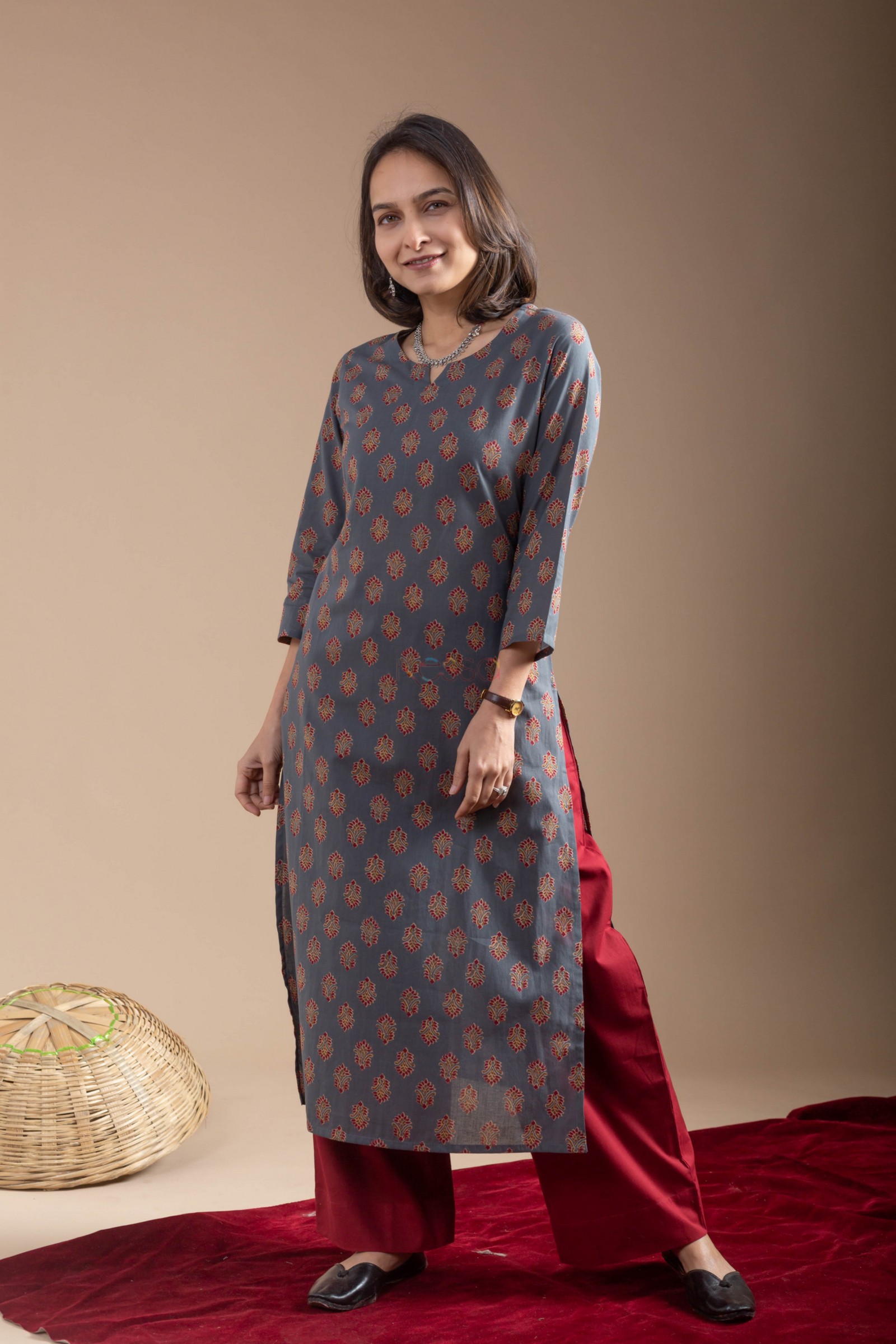
Thinking Process
PHASE 1: VISUAL DECONSTRUCTION
- **Fabric Physics:** The source garment is a printed cotton or cotton-blend Kurta. It possesses a matte finish with low specular reflection. Physically, it is semi-rigid yet breathable; it should not cling to the skin like spandex but rather hang vertically with structured folds. It has a static drape that resists high-frequency wrinkling but holds deep, soft creases at flex points.
- **Key Features:**
- The specific red and gold leaf block-print pattern must remain crisp and undistorted.
- The V-neckline with the subtle collar stand.
- The 3/4 length sleeves (ending midway down the forearm).
- The straight-cut silhouette (not hour-glass).
- The side slits (vents) which characterize a Kurta; these must be visible where the garment falls over the hips/thighs.
PHASE 2: FIT & DRAPE SIMULATION
- **Body Mapping:**
- **Torso:** Unlike the user's current tight top, the Kurta must float away from the waist. It should skim the bust and fall straight down, covering the waistline of the white jeans and extending to the mid-thigh/knee area.
- **Right Arm (Raised):** Gravity dictates the sleeve will slide down slightly toward the shoulder. Significant distinct bunching/folding is required at the inner elbow and armpit due to the raised angle.
- **Left Arm (Resting):** The sleeve should hang relatively straight but compress slightly against the torso.
- **Wind Dynamics:** The user's hair indicates strong wind blowing left-to-right. The Kurta's hemline should show subtle lateral movement/fluttering to the right to match this environmental force.
- **Occlusion Handling:**
- **Hair:** The user has voluminous hair blowing in the wind over the right shoulder and back. This requires high-fidelity segmentation; the hair strands must layer *over* the new Kurta collar and shoulder area.
- **Left Wrist/Watch:** Depending on sleeve scaling, the watch on the left wrist may be partially occluded; if visible, the sleeve cuff must cast a shadow onto the wrist.
- **Glass Railing:** Since the Kurta is long, the lower hem may descend behind the glass railing. The transparency of the glass must be maintained over the fabric.
PHASE 3: ENVIRONMENT & LIGHTING
- **Light Match:**
- **Source Lighting:** Studio hard lighting (warm/neutral).
- **Target Lighting:** Outdoor, overcast/cloudy natural light (cool/blue-tinted, highly diffuse).
- **Simulation:** The garment's lighting must be softened significantly. Shadows should be soft and spread out, matching the ambient occlusion seen on the user's white jeans. The direction of light is soft frontal/overhead.
- **Color Calibration:** The source garment is too warm and high-contrast for the target scene. Apply a cool color grading filter to the fabric to match the atmospheric haze of the mountain background. Reduce saturation slightly to integrate with the muted outdoor palette.
PHASE 4: IDENTITY PROTECTION
- **Facial Lock:** The user's face (eyes, nose, mouth, smile lines), neck, and the specific wind-blown geometry of her hair must be frozen and pixel-perfectly preserved.
- **Body Integrity:** Strictly forbidden to slim the user's waist or hips to match the source model. The simulation must drape the cloth over the user's actual curvy physique. The white jeans must remain unchanged below the new Kurta hemline.