Thinking Process
PHASE 1: VISUAL DECONSTRUCTION
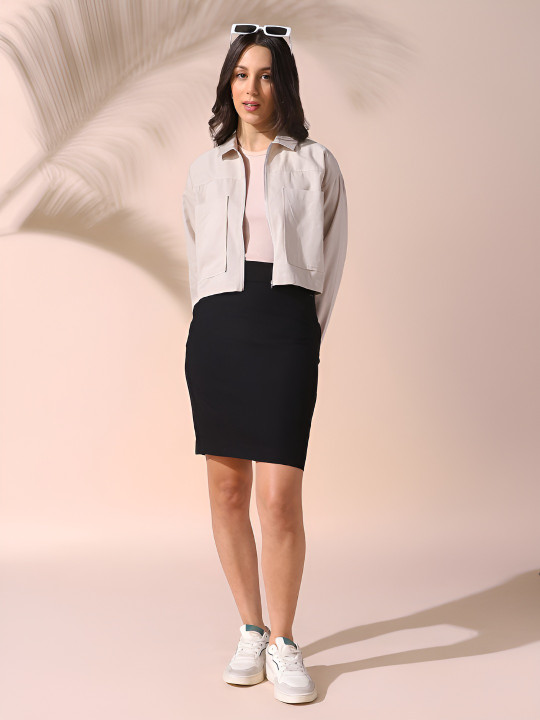
- **Fabric Physics:** The source garment is a lightweight structural fabric, likely cotton twill or a matte synthetic blend (windbreaker style). It possesses medium stiffness—it holds its boxy shape rather than draping like liquid, but will crease sharply at bend points. It has a matte finish with low reflectivity; lighting should diffuse across the surface rather than creating sharp specular highlights.
- **Key Features:** The specific beige/cream colorway must be maintained. Crucial details include the shirt-style collar, the dual large front patch pockets with flaps, the center zipper mechanism (worn open), and the cropped hemline which sits at the natural waist. The loose, slightly dropped shoulder seam construction must be preserved.
PHASE 2: FIT & DRAPE SIMULATION
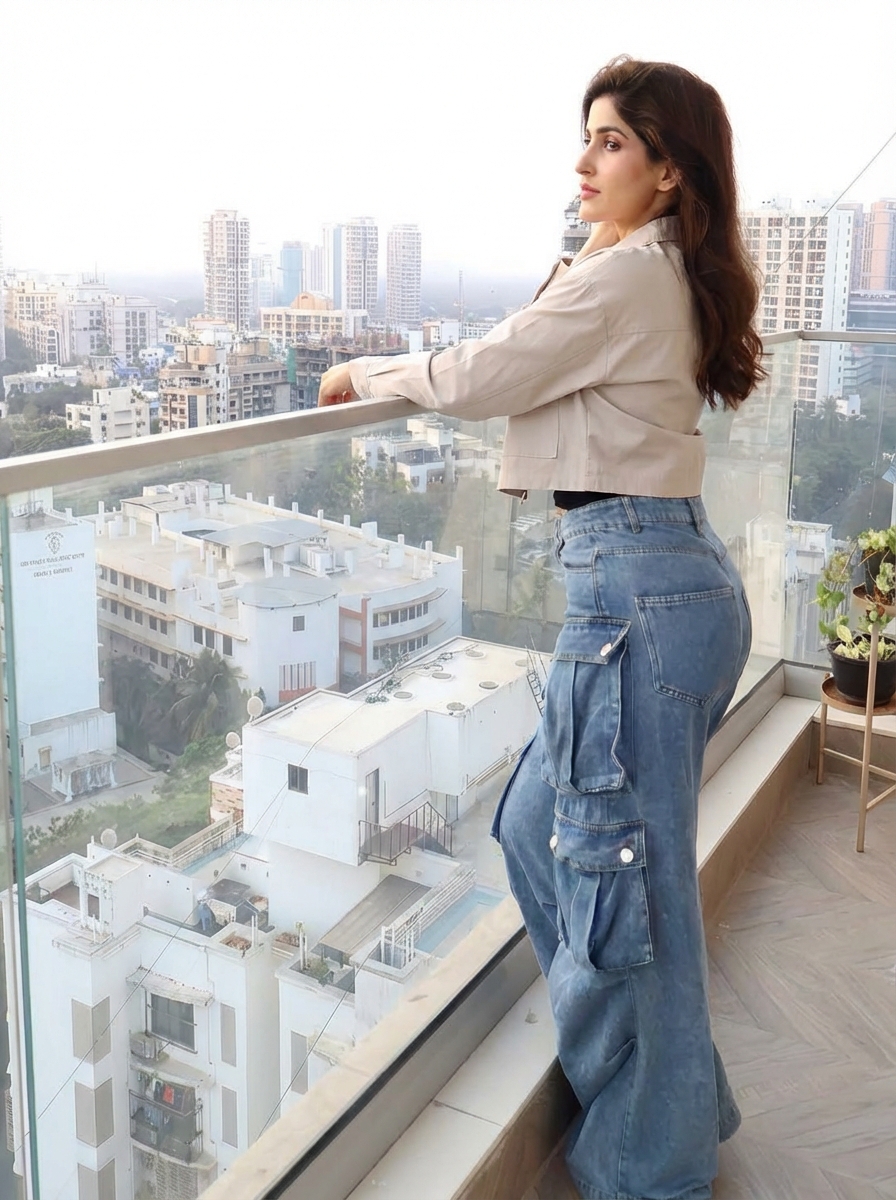
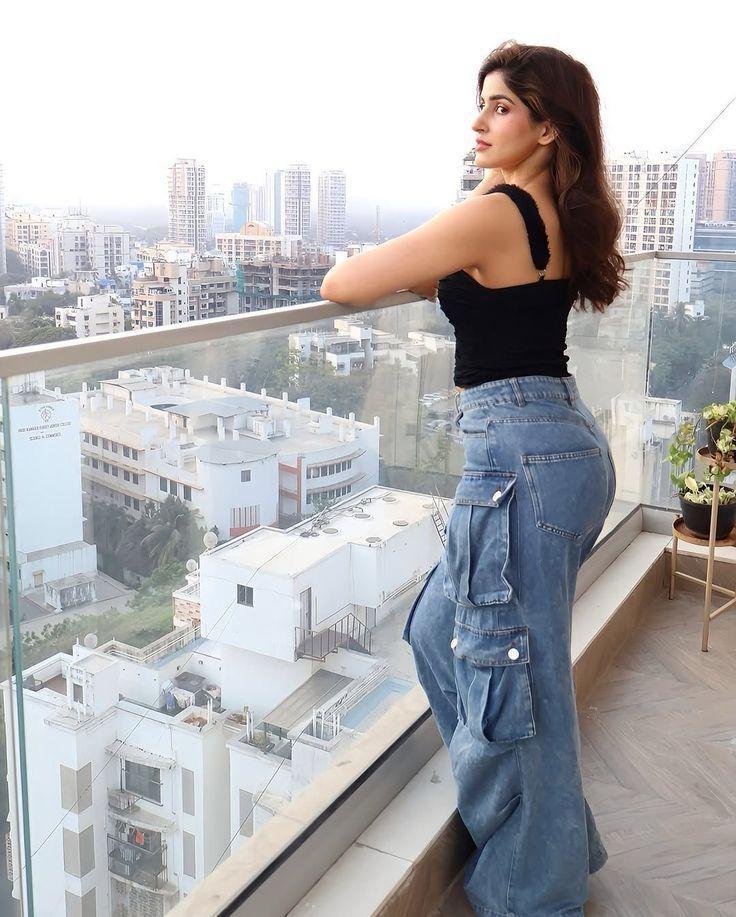
- **Body Mapping:** Due to the user's leaning forward pose (profile view), the jacket must hang vertically due to gravity, meaning the back hem will swing slightly away from the user's lower back, creating a gap rather than clinging to the lordotic curve. The right arm is bent at the elbow resting on the railing; the fabric must show compression bunching at the inner elbow and tension across the shoulder blade. The sleeves are long and loose, so they will obscure the user's currently bare arms entirely.
- **Occlusion Handling:** The user's long, wavy hair falls significantly over the upper back and right shoulder. A complex segmentation mask is required to layer this hair *over* the new jacket collar and upper back panel. The glass railing in the foreground must be accounted for; if the jacket hem drops below the rail line, it must appear behind the glass/reflections.
PHASE 3: ENVIRONMENT & LIGHTING
- **Light Match:** The target environment is high-exposure outdoor daylight, diffuse but coming predominantly from the front-left (city side). The jacket must be rendered with high brightness on the front lapels and sleeves, transitioning to self-shadowing on the back panel and under the armpit. The lighting is cool/neutral compared to the warm studio light of the source.
- **Color Calibration:** The source jacket has a warm tone. This must be color-graded to match the cooler, slightly bluish cast of the outdoor city atmosphere to prevent the jacket from looking pasted on. The black/contrast levels of the jacket's shadows must match the contrast seen in the user's jeans.
PHASE 4: IDENTITY PROTECTION
- **Facial Lock:** The user's side profile (nose, lips, jawline) and the specific volume and texture of her dark hair are strictly protected and must be frozen.
- **Body Integrity:** The user has a distinct curvy physique. Do not slim the waist or flatten the glutes to accommodate the jacket. The jacket adds volume *on top* of the existing silhouette; the underlying body mesh must remain unchanged, particularly the hip width and posture.