
Thinking Process
PHASE 1: VISUAL DECONSTRUCTION
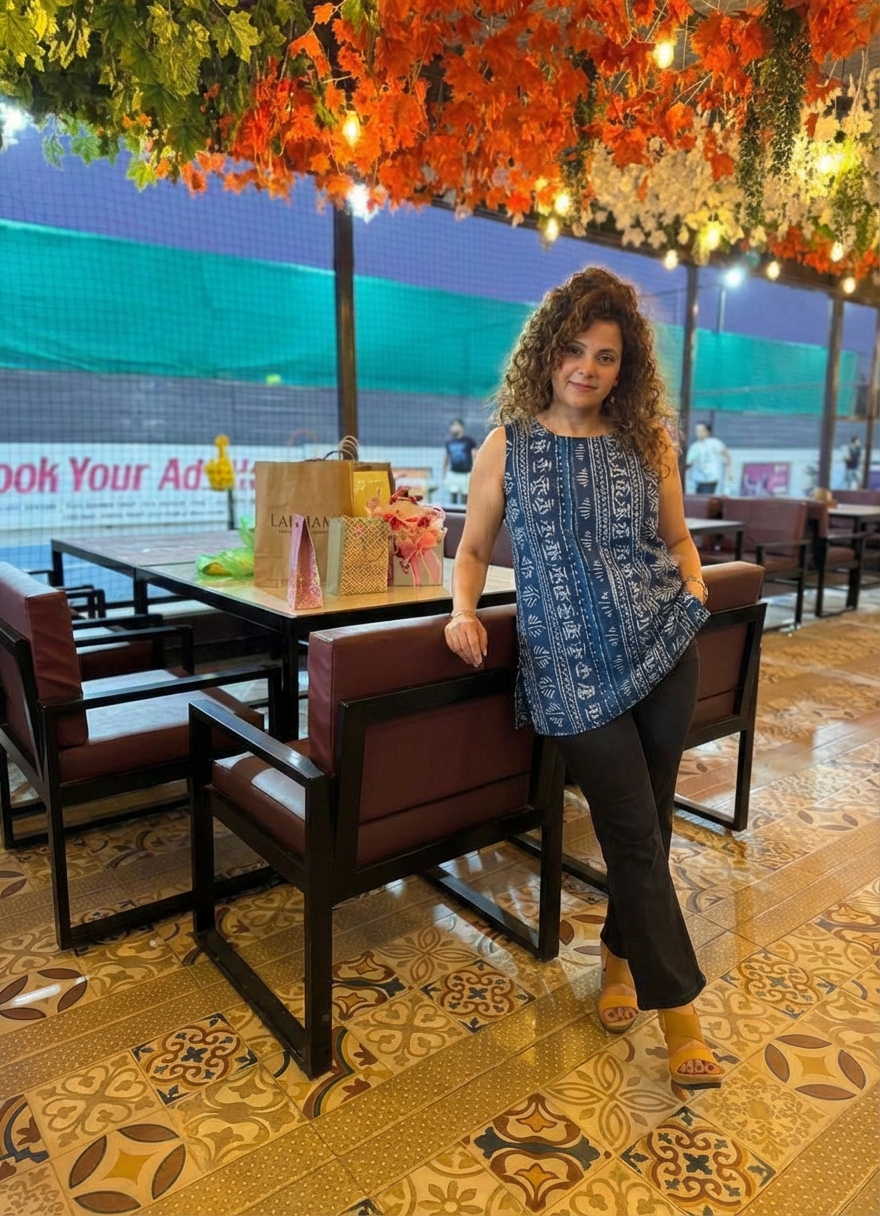
- **Fabric Physics:** The source garment appears to be a cotton or linen blend with a matte finish. It possesses a medium-weight structure, meaning it will hold a relatively straight shape rather than clinging tightly to curves (unlike spandex) or draping heavily (unlike velvet). It has low specular reflection; it should not shine but rather diffuse light softly.
- **Key Features:** The vertical white geometric/tribal block print pattern must remain aligned vertically. The indigo blue dye variation (slightly uneven texture typical of natural dyes) must be preserved. The round neckline and the specific sleeveless cut (armhole shape) are critical structural elements. The straight hemline which appears to fall to the mid-thigh/tunic length must be maintained.
PHASE 2: FIT & DRAPE SIMULATION
- **Body Mapping:** Due to the user's leaning pose (leaning onto her right arm), the garment must hang perpendicular to the ground due to gravity, not perpendicular to her spinal axis. This means the fabric will hang slightly away from her right side (the side she is leaning towards) and press closer against her left hip. Since the source is a long tunic and the target is wearing jeans, the garment should naturally drape *over* the waistband of the jeans, potentially covering the top of the pockets.
- **Occlusion Handling:** The user has voluminous curly hair cascading over both shoulders. This is a high-priority occlusion zone; the fabric straps must pass *under* the hair, not sit on top of it. The user's left hand (viewer's right) is tucked near the hip; the tunic length will likely interact here—the fabric must either drape behind the wrist or bunch slightly if it rests on the hand/wrist area.
PHASE 3: ENVIRONMENT & LIGHTING
- **Light Match:** The user environment features warm, overhead, diffuse lighting (cafe setting with artificial leaves and hanging bulbs). The lighting direction creates soft shadows casting downward. The neutral studio lighting of the source cloth must be replaced with this warm ambient occlusion.
- **Color Calibration:** The source garment is a cool, deep indigo. To integrate into the scene, the blue levels must be adjusted to accept a warm yellow/amber tint from the environment. Without this color temperature shift, the blue will look artificially superimposed and "sticker-like."
PHASE 4: IDENTITY PROTECTION
- **Facial Lock:** The user's facial features (eyes, nose, mouth), skin tone, and specifically the volume and texture of her curly hair must be frozen and masked out from any generation.
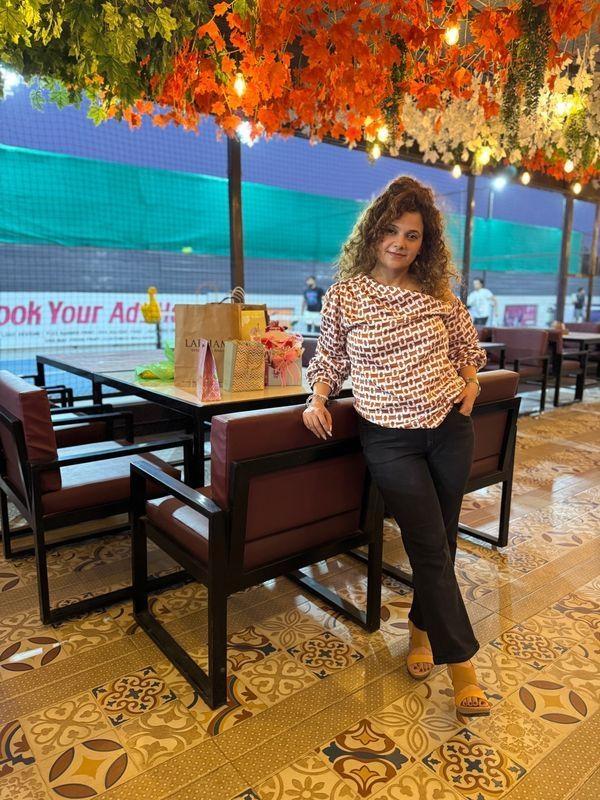
- **Body Integrity:** The simulation is strictly forbidden from altering the user's BMI or body proportions. The user's arms (which are currently partially covered by a one-shoulder top) will need skin-texture inpainting where the new sleeveless cut reveals them, but the underlying arm volume and shape must remain true to the user's physique.