Thinking Process
PHASE 1: VISUAL DECONSTRUCTION
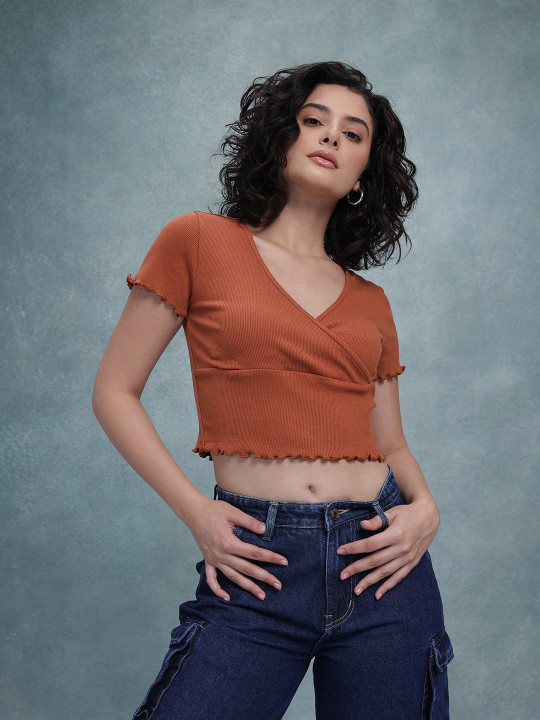
- **Fabric Physics:** The source garment is a ribbed knit fabric (likely cotton-spandex blend). It has high elasticity and a matte finish with low specular highlights. The physics engine must treat this as a "stretch" material that conforms tightly to the body rather than hanging loosely. The texture is defined by vertical ribbing which must deform/curve around volumetric shapes.
- **Key Features:**
- **Lettuce-Edge Hems:** The wavy, ruffled edges on the sleeves and bottom hem are distinct and must be rendered with high geometric detail, not just texture.
- **Cross-over V-Neck:** The overlapping fabric design on the chest needs to maintain depth separation (one layer clearly over the other).
- **Color:** Burnt orange/rust tone.
- **Texture:** Vertical rib lines that act as displacement maps, not just flat color.
PHASE 2: FIT & DRAPE SIMULATION
- **Body Mapping:**
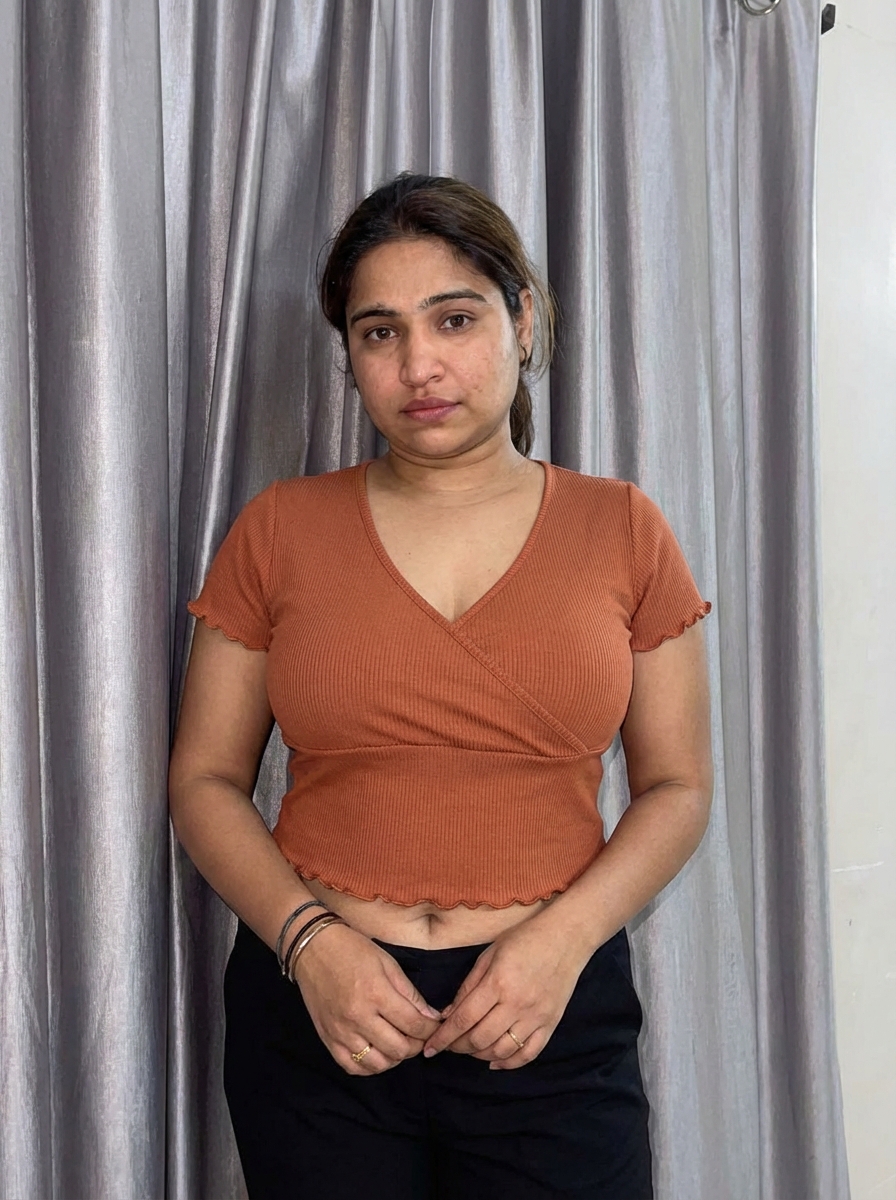
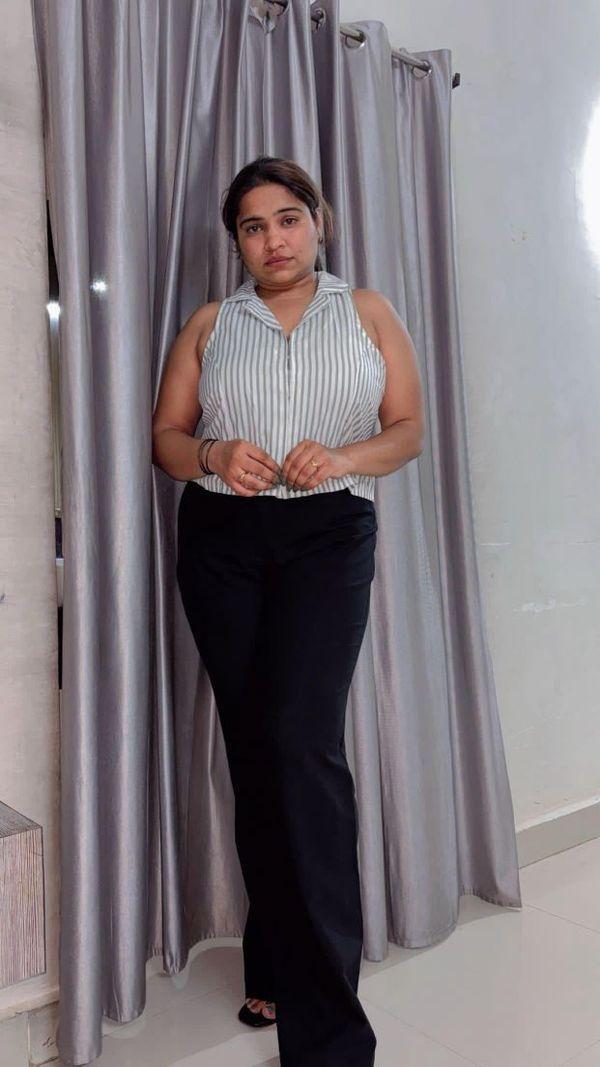
- **Torso Fit:** The source garment is a crop top. Unlike the user's current loose sleeveless shirt, the new garment fits tight. The simulation must show the fabric stretching horizontally across the bust and tapering at the waist.
- **Midriff Generation:** Since the user's current top is longer than the source crop top, the simulation must generate realistic skin texture for the exposed midriff area between the new hemline and the waistband of the trousers.
- **Sleeves:** The new garment has short sleeves, whereas the user is wearing sleeveless. The simulation must generate sleeves wrapping around the user's upper deltoids/biceps, adhering to the skin surface.
- **Occlusion Handling:**
- **Hands & Fingers:** The user's hands are clasped firmly in front of the lower torso/waist. This is a critical occlusion zone. The new garment (specifically the bottom hem) must pass *behind* the fingers and wrists.
- **Accessories:** The bangles/wristwear on the user's left arm must remain visible and layered *over* the garment if the sleeve or hem interacts with them.
PHASE 3: ENVIRONMENT & LIGHTING
- **Light Match:** The user's environment has soft, diffuse indoor lighting coming from the upper-front-right, casting soft shadows behind her onto the curtains. The new garment must cast self-shadows (ambient occlusion) in the V-neck folds and under the bust. The "lettuce edges" must catch the light to show their wavy 3D structure.
- **Color Calibration:** The source image has cool, studio-balanced lighting. The user image has warmer, likely tungsten or warm-white LED home lighting. The rust color of the top must be color-graded (slightly warmed and contrast-reduced) to match the tonal values of the user's room to prevent a "cut-and-paste" appearance.
PHASE 4: IDENTITY PROTECTION
- **Facial Lock:** The user's face, hair, and neck structure must remain pixel-perfectly frozen. No retouching of the jawline or skin texture on the face.
- **Body Integrity:** Strictly prohibited to slim the user's arms or waist to fit the model's dimensions. The garment must be digitally "tailored" up to fit the user's existing physique. The user's shoulder width and arm volume must remain constant.