Thinking Process
PHASE 1: VISUAL DECONSTRUCTION
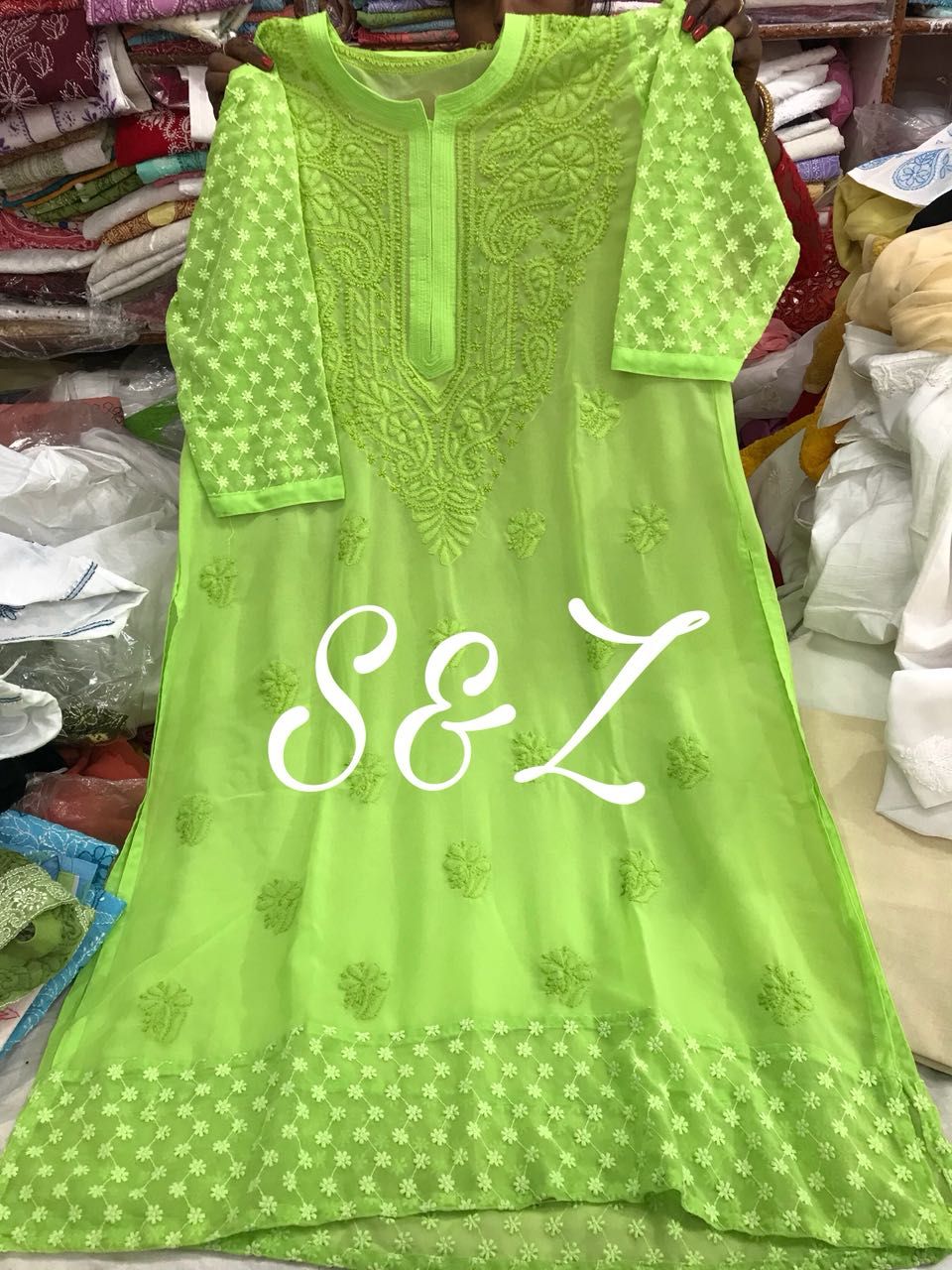
- **Fabric Physics:** The source garment appears to be a semi-sheer Georgette or Chiffon fabric with traditional Chikankari (white thread) embroidery. The simulation must treat the base green fabric as lightweight, flowy, and slightly translucent, while the embroidered sections must be rendered with higher opacity, matte texture, and slightly more weight/stiffness to prevent unrealistic crumpling.
- **Key Features:** The intricate floral embroidery pattern on the yoke (chest), the scattered motifs on the lower torso, and the dense border work at the hemline must be preserved with high fidelity. The 3/4 length sleeves with embroidered cuffs are critical. **Crucial:** The large white "S&Z" watermark and the hands holding the garment in the source image must be technically inpainted/removed during texture generation to prevent them from appearing as a print on the final virtual garment.
PHASE 2: FIT & DRAPE SIMULATION
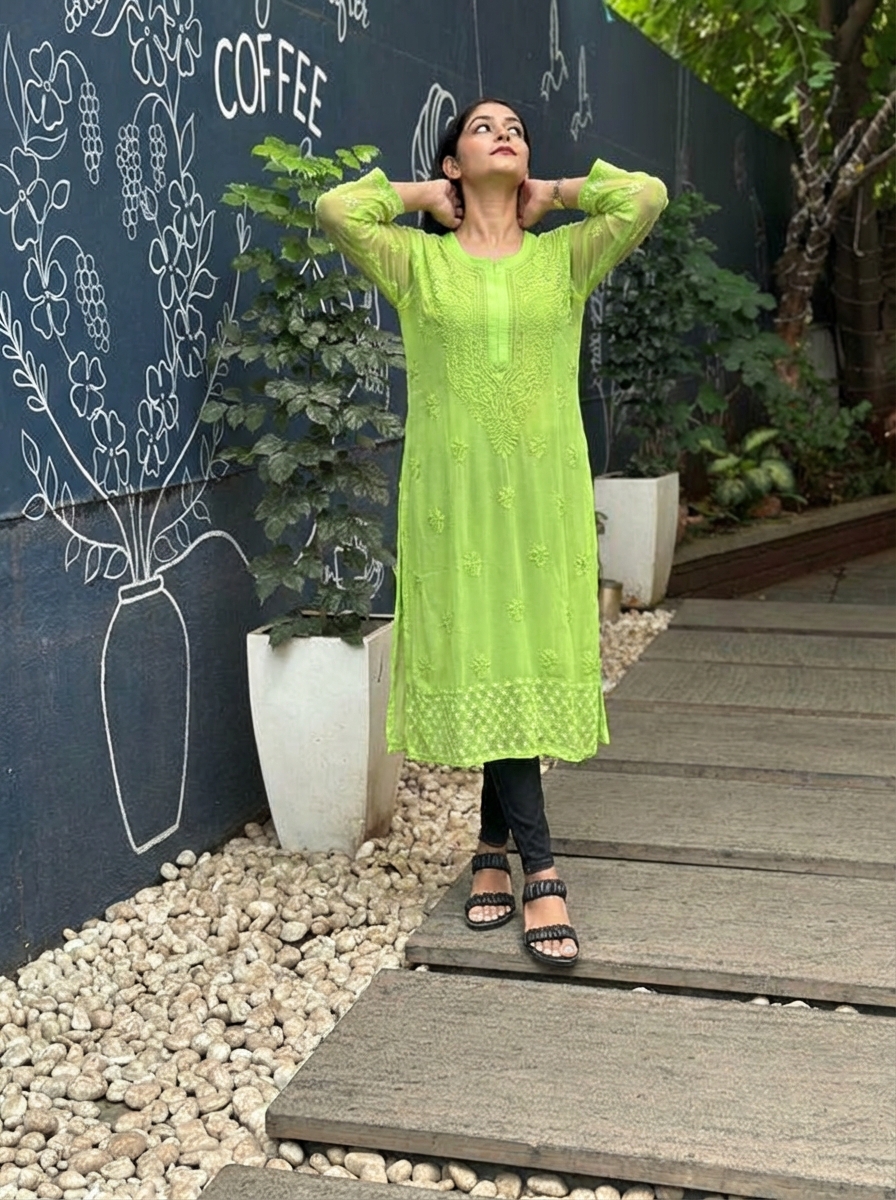
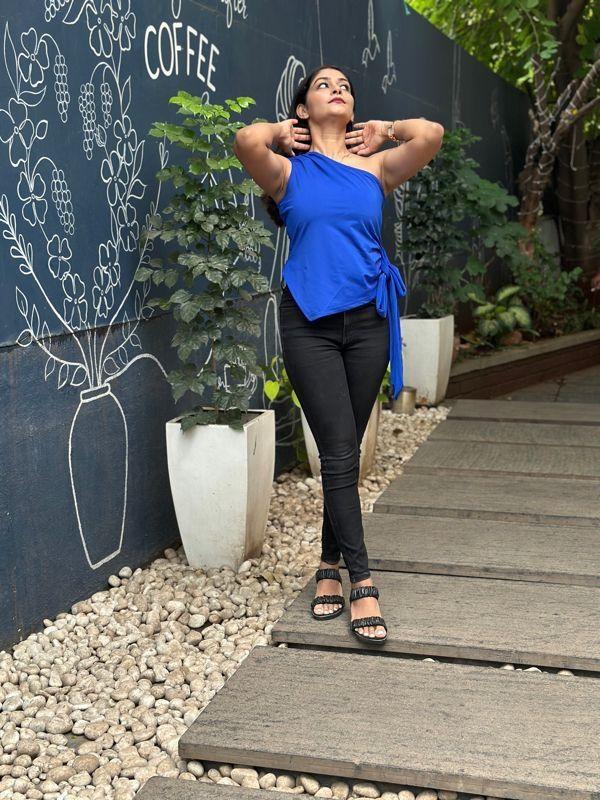
- **Body Mapping:** The user is in a "hands-behind-head" pose with raised elbows. This requires complex gravity calculation. Unlike the current form-fitting blue top, the Kurti is a loose-fitting garment. The fabric must drape vertically from the shoulders and chest, skimming over the waist rather than cinching it. The sleeves will not hang down to the wrists; due to the raised arms, gravity should cause the sleeves to slide down towards the shoulders/armpits, gathering slightly at the shoulder joint rather than the elbow. The long hemline of the Kurti will extend past the hips, covering the upper portion of the black jeans.
- **Occlusion Handling:** The user's hands are positioned behind the neck/head, so distinct occlusion masking is required around the wrists and forearms to ensure the sleeves pass *behind* the arms if the fit is loose, or stop *before* the elbows. The hair falls primarily behind the back, but any stray strands near the neck must remain layered *over* the collar of the Kurti. The existing blue tie/sash hanging from the user's waist must be completely erased and replaced by the Kurti's fabric.
PHASE 3: ENVIRONMENT & LIGHTING
- **Light Match:** The target environment features soft, diffused outdoor daylight (overcast or shaded) coming generally from above and slightly front-right. The rendered Kurti must avoid the harsh specular highlights seen in the source flash photography. It needs soft, ambient occlusion shadows in the folds, particularly under the bust and where the fabric gathers at the raised armpits.
- **Color Calibration:** The source image has a warm/indoor color cast. The lime green of the Kurti must be white-balanced to match the cooler, natural tones of the outdoor "coffee shop" background. The semi-transparent nature of the fabric means the green should subtly shift in darkness where it overlaps the black jeans versus where it covers skin.
PHASE 4: IDENTITY PROTECTION
- **Facial Lock:** The user's entire face, jawline, ears, and neck structure must be frozen and masked to prevent pixel alteration. The skin tone on the exposed arms and midriff (if visible through sheer fabric) must remain consistent with the original image.
- **Body Integrity:** Strict geometric constraints must be applied to the user's torso and hips. The simulation must fit the cloth to the body, not warp the body to fit the cloth. The user's slim silhouette must be maintained; the loose Kurti should add volume via fabric drape, not by expanding the underlying body mesh. The position of the crossed legs and the texture of the jeans below the Kurti's hemline must remain untouched.