Thinking Process
PHASE 1: VISUAL DECONSTRUCTION
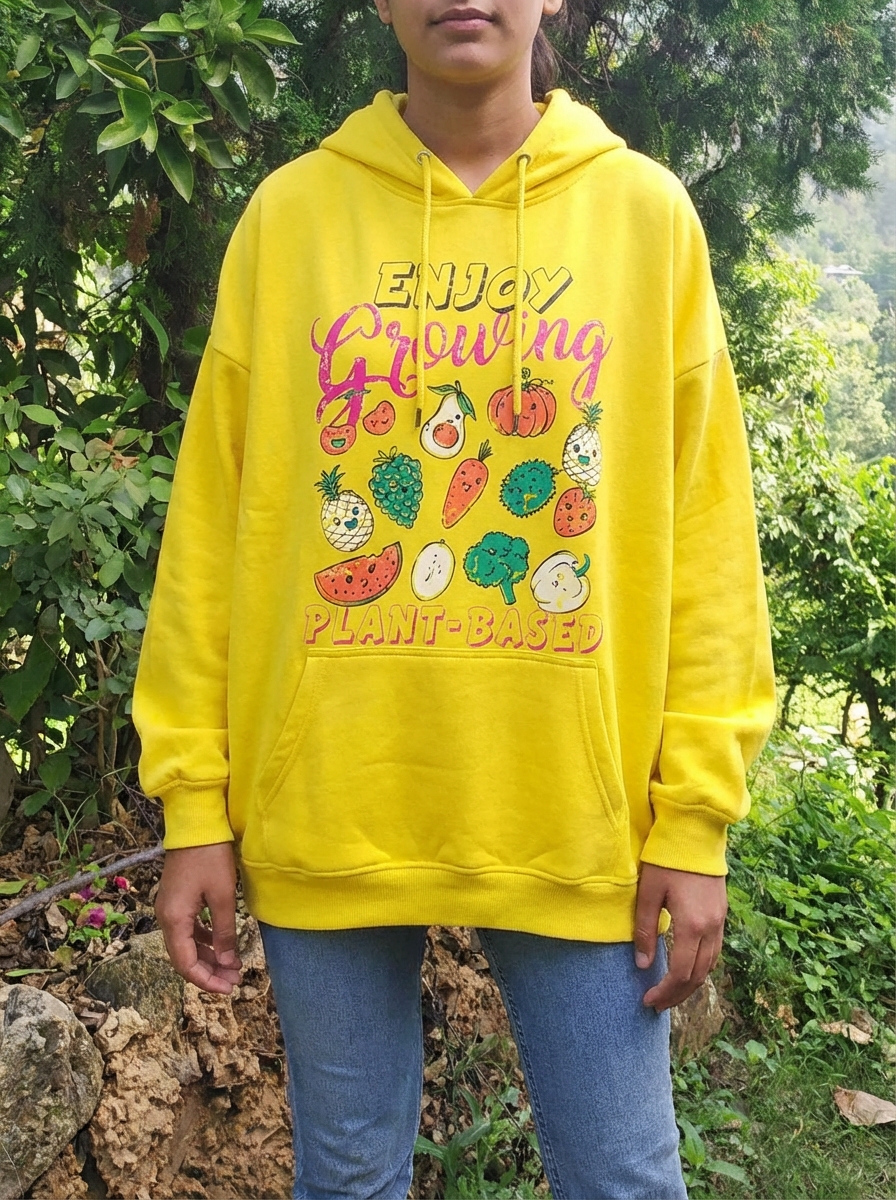
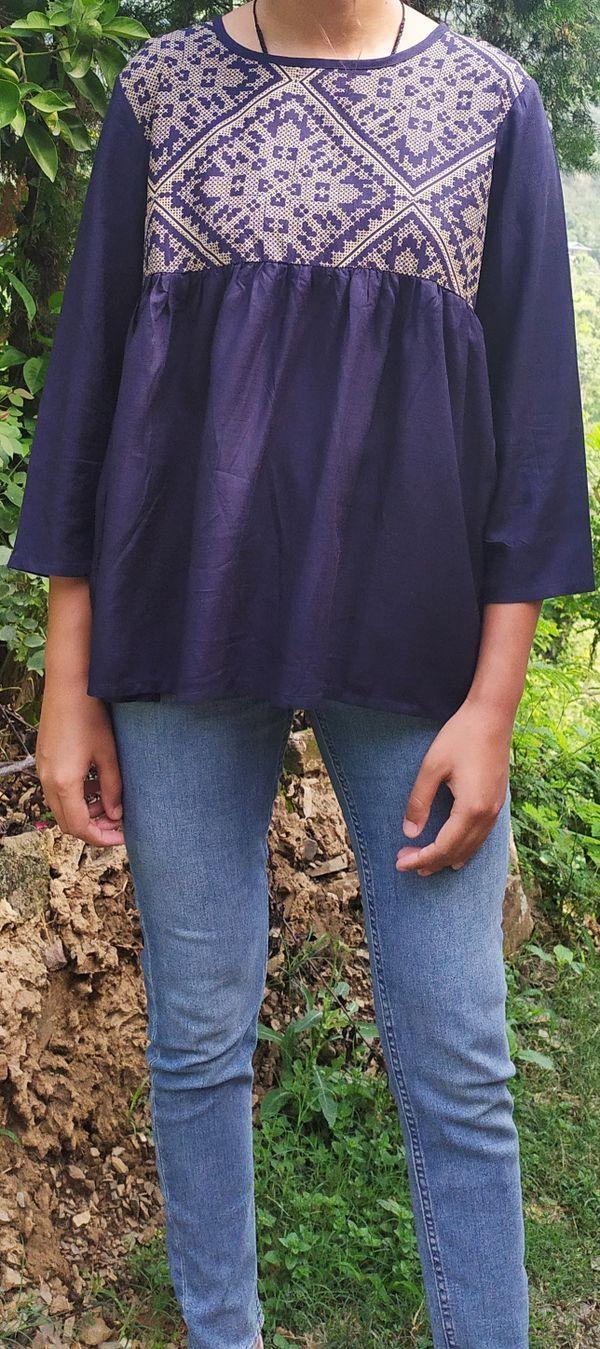
- **Fabric Physics:** The source garment is a heavyweight cotton-fleece blend hoodie. Unlike the user's current lightweight, woven tunic, the new garment has high bending resistance and substantial thickness. It features a matte finish with very low specular reflection. The fabric should exhibit soft, heavy folds rather than crisp creases, particularly where gravity pulls the weight of the hood and kangaroo pocket.
- **Key Features:**
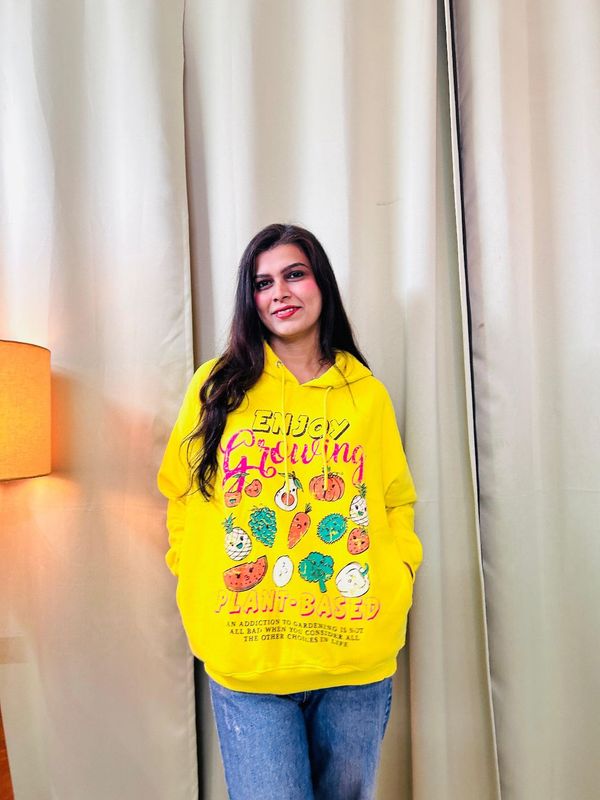
- The "Enjoy Growing / Plant-Based" central graphic and surrounding fruit illustrations must be preserved with high fidelity.
- **Crucial Reconstruction:** The source image has long hair covering the left shoulder and part of the "Enjoy" text; this obscured area must be inpainted/reconstructed to reveal the full graphic and shoulder seam for the target user.
- Ribbed cuffs and bottom hemline structure.
- Drawstrings hanging from the hood eyelets.
- The "kangaroo" pouch pocket structure.
PHASE 2: FIT & DRAPE SIMULATION
- **Body Mapping:** The hoodie has an oversized, relaxed fit compared to the user's current fitted-yoke top. The silhouette must change from an empire-waist flare to a boxy, straight drop from the shoulders. The ribbed hem should sit lower than the current tunic's hem, likely resting on the upper hips/jeans, creating a slight "stacking" or billowing effect just above the waistband. The sleeves are long and should bunch appropriately at the user's wrists, wider than the current 3/4 sleeves.
- **Occlusion Handling:**
- **Neck/Chin:** The user's chin and neck area are visible; the hoodie neckline must sit naturally around the base of the neck, potentially covering the lower curve of the black cord necklace currently worn by the user.
- **Hands:** The user's hands are hanging free, whereas the source hands are in pockets. The simulation must generate the empty kangaroo pocket area (currently hidden by the model's hands in the source) and ensure the target user's arms hang *outside* the garment without clipping through the thick fabric.
PHASE 3: ENVIRONMENT & LIGHTING
- **Light Match:** The target environment is outdoors with natural, diffuse daylight (likely overcast or shaded sun), casting soft shadows from the top-right. The source image has warm, indoor artificial lighting. The hoodie's lighting must be cooled significantly (shifting white balance towards blue/cyan) to match the outdoor ambiance. Shadows must be recalculated to fall downward and slightly to the left to match the user's environment.
- **Color Calibration:** The vibrant yellow of the hoodie must be slightly desaturated and tonally shifted to harmonize with the natural greens and earthy tones of the background. The black and red inks on the graphic print must interact with the ambient light so they look printed on fabric, not superimposed like a sticker.
PHASE 4: IDENTITY PROTECTION
- **Facial Lock:** The user's visible lower face (lips, chin, jawline) and neck skin texture must remain pixel-perfectly frozen.
- **Body Integrity:** Strictly forbidden to warp the user's skeletal frame to match the source model's pose. The user's legs (jeans) and stance width must remain untouched. The hoodie adds bulk; do not slim the garment to fit the user's current silhouette, but do not widen the user's actual body underneath the cloth simulation.